
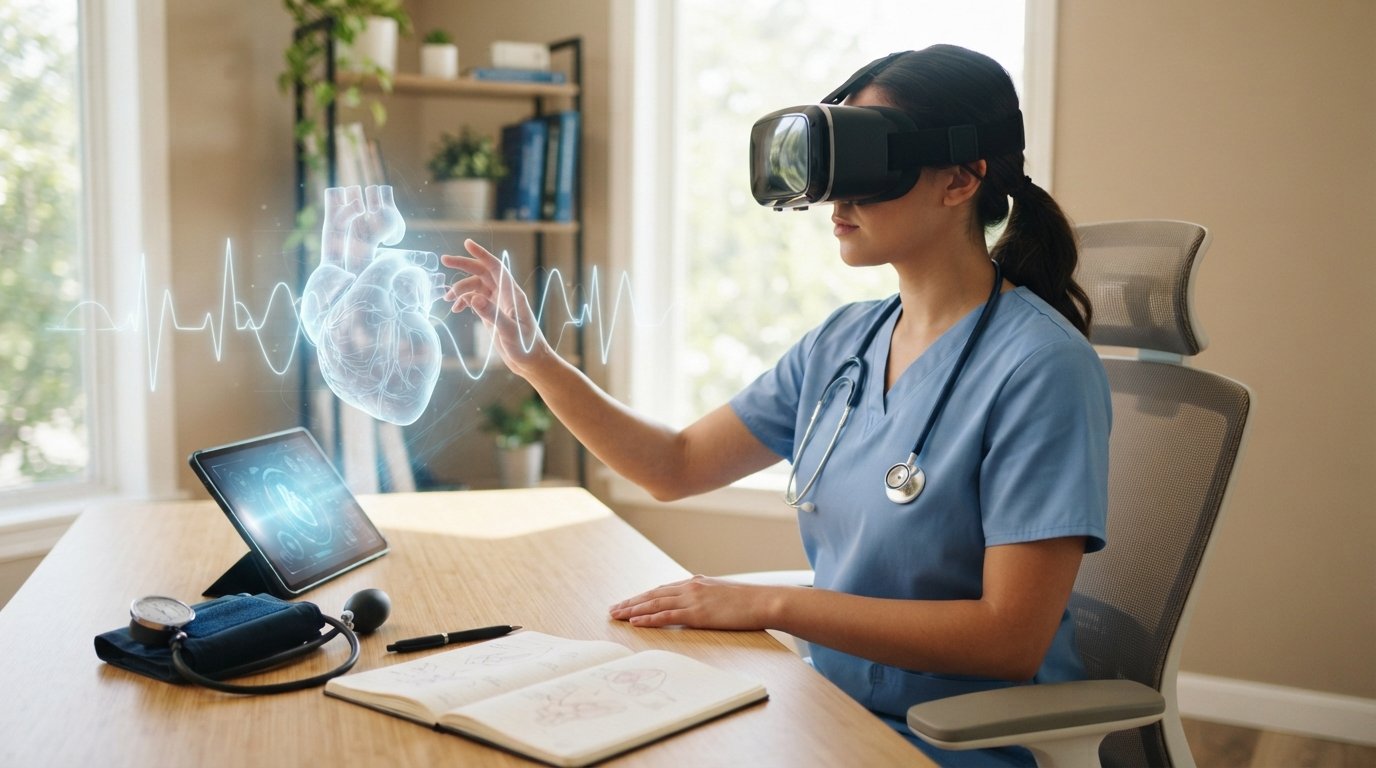
AR and VR Technology in Online Healthcare Courses
AR and VR technology in online healthcare courses reshapes clinical training. Call (877)-218-7081 to explore accredited programs and costs.

By David Reynolds
Online learning has transformed how students earn degrees in nursing, allied health, and medical support fields. Yet one question has always lingered: how can you master hands-on clinical skills through a screen? AR and VR technology in online healthcare courses is closing that gap, letting students practice assessments, procedures, and emergency decisions in realistic, risk-free environments before they ever step into a clinic. For anyone weighing an online healthcare degree path, understanding how immersive tools fit into the curriculum is now part of choosing the right program.
Why Immersive Tech Matters for Online Healthcare Training
Healthcare education has always relied on repetition and supervised practice. Students learn to take blood pressure, interpret heart rhythms, insert IV lines, and respond to deteriorating patients by doing these tasks under observation. When programs moved online, educators needed a way to preserve that experiential core. AR and VR technology in online healthcare courses provides it by recreating clinical scenarios inside a headset or on a tablet, then tracking every decision a student makes.
The result is more than a video game. Modern platforms log hand placement, timing, sequence of interventions, and communication choices. Instructors can review that data and give feedback the same way a clinical preceptor would after a shift. Because sessions are repeatable, students can practice a difficult scenario ten times without using up hospital resources or risking patient safety. That repeatability is especially valuable for adult learners balancing jobs and family obligations, who may not have daytime access to a simulation lab.
Accreditation bodies have taken notice. The Commission on Collegiate Nursing Education and the Accreditation Commission for Education in Nursing both allow a portion of clinical hours to be completed through simulation, provided the program documents equivalency and outcomes. That policy shift is a major reason immersive tools have moved from novelty to standard practice in many online healthcare courses.
How VR Simulations Supplement Hands-On Clinical Requirements
Most healthcare programs still require in-person clinical hours, but VR can cover a meaningful share of the preparatory work. A typical hybrid model looks like this: students complete foundational skills in VR, demonstrate competency through recorded assessments, then apply those skills in a supervised clinical placement. The virtual portion builds muscle memory and decision speed so that live patient interactions become more productive.
Consider a nursing student learning to manage a patient with sepsis. In VR, the student sees vital signs change in real time, hears the patient complain of chills, and must decide whether to start fluids, call the provider, or draw labs. The simulation responds to each choice. If the student delays, the patient deteriorates. If the student acts appropriately, the patient stabilizes. That cause-and-effect loop is difficult to replicate through readings or lecture videos.
Programs use VR in several distinct ways to satisfy clinical preparation requirements:
- Skills rehearsal for procedures such as catheter insertion, wound care, and medication administration
- Scenario-based decision training for emergency response, triage, and critical care
- Communication practice for patient interviews, family conversations, and interprofessional handoffs
- Anatomy and physiology exploration through interactive 3D models
- Competency checkpoints where students must pass a virtual assessment before advancing
Each of these uses addresses a different layer of clinical competence. Skills rehearsal builds psychomotor accuracy. Scenario training builds judgment. Communication practice builds empathy and clarity. When stacked together, they create a bridge between online coursework and the live clinical environment, reducing the shock of the first real patient encounter.
Which Healthcare Programs Currently Use Immersive Tech
Adoption is uneven across healthcare fields. Nursing programs lead the way, followed by medical schools, allied health, and emergency services training. The common thread is a need for high-stakes decision practice that cannot be safely replicated on live patients.
Online nursing degrees, including RN-to-BSN and master's entry programs, frequently integrate VR modules for assessment, pharmacology, and maternal-child care. Some family nurse practitioner programs use virtual standardized patients to practice diagnostic reasoning. Medical schools and physician assistant programs use AR overlays to teach anatomy and ultrasound guidance. Emergency medical technician and paramedic courses use VR to simulate mass casualty incidents and airway management. Pharmacy programs use virtual environments to practice sterile compounding and patient counseling.
Students considering a healthcare career should ask specific questions when comparing programs. Does the school provide headsets, or must students buy them? Are VR hours counted toward clinical requirements? What platform does the program use, and is technical support available? Answers to these questions reveal how seriously a program has invested in immersive learning and whether the technology will help or hinder progress.
Cost and Equipment Requirements for Students
Cost is the most practical barrier to immersive learning. Standalone VR headsets range from roughly two hundred to six hundred dollars, while AR-capable tablets and smartphones cost less but offer a narrower experience. Some programs include a headset in tuition or ship a loaner device. Others require students to purchase their own or use a campus lab during residencies.
Beyond hardware, students should consider internet bandwidth, physical space, and software licensing. VR sessions typically require a stable connection and a clear area of at least five feet by five feet. Some platforms charge a semester access fee, while others bundle the cost into course materials. Prospective students should request a written breakdown of technology costs before enrolling, because these expenses are not always covered by financial aid.
There are ways to reduce the burden. Many schools negotiate bulk hardware discounts and pass savings to students. Some employers, especially hospitals and clinics, offer tuition assistance that can cover equipment. Scholarship databases and financial aid offices may also have funds designated for technology needs. When comparing online healthcare degrees, treat immersive tech costs the same way you would treat lab fees or clinical travel: as a required expense that belongs in your total budget.
Platforms like CollegeDegree.Education can help students identify accredited programs and compare how each one handles technology fees and equipment, which makes budgeting more transparent from the start.
Accreditation and Competency Standards for Virtual Simulations
Accreditation is the guardrail that keeps virtual simulation honest. Regional and national accreditors, along with specialized bodies in nursing, medicine, and allied health, require programs to demonstrate that simulation outcomes are equivalent to traditional clinical experiences. That means programs must define learning objectives, measure student performance, and document that virtual hours produce competent practitioners.
The standards generally fall into three categories: fidelity, assessment, and supervision. Fidelity refers to how closely the simulation mirrors real clinical conditions, including visual detail, physiological responses, and environmental distractions. Assessment refers to how student performance is measured, typically through rubrics, checklists, or automated scoring. Supervision refers to faculty involvement, including debriefing sessions where students reflect on their decisions.
Students should verify that a program's simulation component is approved by its accreditor and that virtual hours are clearly defined in the curriculum. A program that uses VR as a supplement but does not count it toward clinical requirements may still be high quality, but students should know the difference before enrolling. Asking direct questions about accreditation and simulation policy is a sign of a serious applicant, and reputable programs will answer without hesitation.
Limitations and What Still Requires In-Person Training
Immersive technology is powerful, but it is not a replacement for every clinical experience. Certain skills and situations still demand physical presence. Hands-on procedures that require touch, such as palpation, injection technique, and surgical assistance, cannot be fully replicated in a headset. Interpersonal moments that depend on subtle body language, such as end-of-life conversations or conflict resolution, also lose nuance in virtual settings.
There are also practical limits. VR cannot simulate the unpredictable environment of a busy hospital floor, where multiple patients, interruptions, and team dynamics compete for attention. It cannot replicate the physical strain of a twelve-hour shift or the emotional weight of a real patient crisis. These experiences build professional resilience in ways that simulation alone cannot.
The most effective programs treat AR and VR technology in online healthcare courses as a bridge, not a destination. They use immersive tools to prepare students thoroughly, then require in-person clinical placements to confirm competency. That blended approach respects both the efficiency of digital learning and the irreplaceable value of human contact in healthcare.
For students, the takeaway is simple: ask how a program uses immersive technology, confirm that virtual hours count toward accreditation requirements, and budget for equipment before you enroll. When used well, AR and VR can make online healthcare education more accessible, more consistent, and more effective. When used poorly, they become an expensive distraction. The difference lies in program design, faculty support, and a clear understanding of what virtual training can and cannot do.