
Blackhawk Technical College: Network Admin Associate's Degree
Earn a Network and System Administration Associate's degree at Blackhawk Technical College in two years. Hands-on labs and local employer ties build job-ready IT skills.
Every time you check your bank balance, send an email, or stream a video, a network and system administrator is working behind the scenes to keep that connection secure and reliable. If you want to be the person who builds, maintains, and protects those systems, a Network and System Administration/Administrator Associate's degree, usually 2 years In-person at Blackhawk Technical College, offers a direct, hands-on path into one of the most stable and in-demand corners of information technology. This program is designed for students who learn by doing, who want to enter the workforce quickly, and who prefer face-to-face instruction in a lab environment over an asynchronous online course.
In this guide, we break down what the degree covers, how much it costs, what careers it leads to, and how to decide whether Blackhawk Technical College is the right fit for your goals. Whether you are a recent high school graduate, a career changer, or a working adult in Wisconsin looking to upskill, the details below will help you compare this option against other technology programs and make a confident decision.
What the Network and System Administration Associate's Degree Covers
The Network and System Administration/Administrator Associate's degree at Blackhawk Technical College is a two-year, in-person program that blends classroom instruction with extensive lab work. Students learn to install, configure, and troubleshoot the hardware and software that keep organizations running, from local area networks and servers to cloud services and security protocols. The curriculum typically includes coursework in operating systems (Windows Server and Linux), network infrastructure, routing and switching, virtualization, cybersecurity fundamentals, and help desk operations.
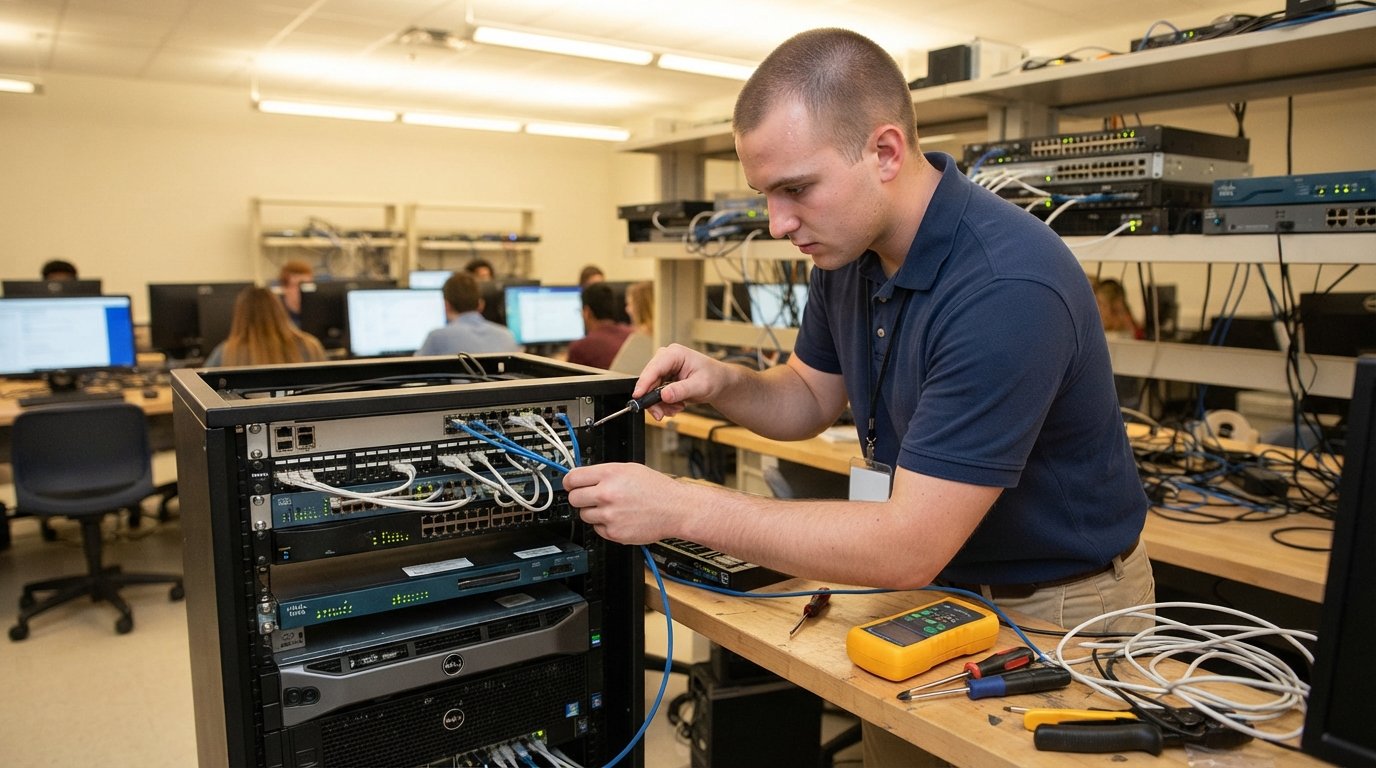
Because the program is delivered in person, students get direct access to physical networking equipment, server racks, and instructors who can walk them through real configuration scenarios. This matters in a field where hands-on repetition builds confidence. Reading about subnetting is one thing; configuring a router in a lab with an instructor looking over your shoulder is another. Many students also prepare for industry certifications such as CompTIA Network+, CompTIA Security+, and Cisco Certified Network Associate (CCNA) while enrolled, which can strengthen a resume before graduation.
The degree is built around a logical progression. Early semesters focus on foundational IT concepts, hardware, and operating systems. Middle semesters move into networking, server administration, and security. Final semesters often include advanced topics, a capstone project, and an internship or practicum that places students in a real work environment. This structure helps students build skills incrementally and graduate with a portfolio of completed labs and projects they can discuss in job interviews.
For students who are also considering broader business or management paths, it helps to compare technology degrees with other two-year and four-year options. If you are weighing a business-focused program alongside this one, our guide on choosing the best online colleges for business administration explains how to evaluate accreditation, cost, and career outcomes across program types.
Why Choose an In-Person Program at Blackhawk Technical College
Online degrees are flexible, but they are not the best fit for every learner. Network administration is a tactile discipline. Cables need to be crimped, switches need to be configured, and servers need to be racked. An in-person program at Blackhawk Technical College gives students structured access to a lab environment and a schedule that keeps them accountable. For students who thrive on routine, face-to-face interaction, and immediate feedback, this format can dramatically improve completion rates and skill retention.
Blackhawk Technical College serves the Janesville and Beloit region of Wisconsin and has strong ties to local employers in manufacturing, healthcare, logistics, and public services. These relationships often translate into internship opportunities, guest speakers, and job placement support. Students who attend in person can also take advantage of campus resources such as tutoring, advising, and student organizations, which are harder to replicate in a fully online setting.
Another advantage is cost predictability. Wisconsin technical colleges generally offer lower tuition than four-year universities, and students who live at home while attending can reduce living expenses significantly. For families comparing options, the total cost of attendance matters as much as the sticker price. Community and technical colleges often provide a strong return on investment for career-focused programs, especially when students graduate with minimal debt and enter the workforce quickly.
Cost, Financial Aid, and Return on Investment
Understanding the full cost of a two-year technical degree is essential before enrolling. Tuition at Wisconsin technical colleges is typically charged per credit, and the Network and System Administration program usually requires around 60 to 65 credits to complete. Students should also budget for books, certification exam fees, and a reliable laptop. While exact figures change year to year, the overall cost is generally far below that of a four-year bachelor's degree at a public or private university.
Financial aid options are available for eligible students. The Free Application for Federal Student Aid (FAFSA) is the starting point for Pell Grants, federal work-study, and subsidized loans. Wisconsin also offers state grant programs, and Blackhawk Technical College has a foundation that awards scholarships to students in technical programs. Employer tuition reimbursement is another avenue worth exploring, particularly for working adults whose current employers need IT staff.
When evaluating return on investment, look at both starting salaries and job stability. Entry-level network and system administrator roles in Wisconsin typically offer salaries in the $45,000 to $60,000 range, with room for growth as certifications and experience accumulate. Senior administrators, network engineers, and security specialists can earn considerably more. Because the degree takes only two years, graduates can begin earning and gaining experience while peers in four-year programs are still in school.
Students should also consider the cost of certification exams. Many programs build exam preparation into coursework, but the exam fees themselves are usually paid separately. Budgeting for two or three certification exams during the program is a smart move, since these credentials often carry as much weight with employers as the degree itself.
Admission Requirements and How to Apply
Admission to the Network and System Administration/Administrator Associate's degree at Blackhawk Technical College is generally accessible, but students should plan ahead. Applicants typically need a high school diploma or equivalent, and some programs require placement testing in math and English or completion of prerequisite coursework. Because the program is in person, students should also consider transportation, childcare, and work schedules before committing to a full-time course load.
The application process usually follows a clear sequence. While specific steps can change, most students can expect a process similar to the following:
- Complete the college application and pay any application fee.
- Submit official high school transcripts or equivalency documents.
- Complete placement assessments or provide ACT scores if required.
- Meet with an academic advisor to map out a program plan and register for classes.
- Apply for financial aid by completing the FAFSA and exploring scholarship options.
Prospective students should also ask about credit for prior learning. If you have already earned industry certifications such as CompTIA A+ or Network+, or if you have relevant military or work experience, you may be able to receive credit toward the degree. This can shorten the time to completion and reduce overall costs. Advisors can review transcripts and certifications to determine eligibility.
It is also worth visiting campus or attending an information session before applying. Seeing the labs, meeting instructors, and talking to current students provides a clearer picture of what the program demands and what it delivers. For students comparing multiple schools, these visits can be the deciding factor.
Career Outcomes and Job Outlook
Graduates of network and system administration programs enter a job market that continues to need skilled professionals. Nearly every organization, from small clinics to large manufacturers, depends on networked systems and needs people who can keep them secure and operational. The U.S. Bureau of Labor Statistics projects steady demand for network and computer systems administrators, with opportunities concentrated in healthcare, education, finance, and information services.
Typical job titles for graduates include network administrator, systems administrator, IT support specialist, help desk technician, network technician, and security administrator. With experience and additional certifications, graduates can move into roles such as network engineer, systems engineer, cloud administrator, or IT manager. Some students use the associate's degree as a stepping stone to a bachelor's degree in cybersecurity, information technology, or computer science, often transferring credits to a four-year institution.
Career planning resources can help students understand the day-to-day realities of these roles before committing to a program. For example, Careers.org provides occupation profiles that describe typical duties, work settings, and the education and certification paths each role requires. Reading these profiles alongside program materials can clarify whether network administration matches your interests and strengths.
Internships and part-time IT jobs are valuable during the program. Many students start in help desk roles while enrolled, gaining troubleshooting experience that makes them more competitive for administrator positions after graduation. Local employers often partner with Blackhawk Technical College to hire students before they finish their degrees.
Comparing This Program With Other Options
The Network and System Administration/Administrator Associate's degree, usually 2 years In-person at Blackhawk Technical College, is one of several paths into IT. Students should compare it with online associate's degrees, bachelor's programs, and bootcamps before deciding. Each option has trade-offs in cost, time, flexibility, and depth of preparation.
- Online associate's degrees: More flexible for working adults, but may lack hands-on lab access and in-person instructor support.
- Bachelor's degrees in IT or cybersecurity: Deeper theoretical foundation and more management opportunities, but two additional years and higher total cost.
- IT bootcamps: Faster and often focused on specific certifications, but less comprehensive and sometimes more expensive per month than community college.
- Apprenticeships and on-the-job training: Earn while you learn, but availability varies and formal credentials may be limited.
For students who want a structured, affordable, hands-on education close to home, the in-person associate's degree is often the most balanced choice. It provides enough depth to qualify for administrator roles while keeping costs and time commitments manageable. Students who later decide to pursue a bachelor's degree can usually transfer a significant portion of their credits.
It is also worth comparing financial aid packages across schools, not just tuition rates. A slightly higher sticker price at one college may come with more grant aid or scholarship support, changing the net cost. Families should use net price calculators and speak with financial aid offices before making a final decision.
Tips for Success in the Program
Students who succeed in network administration programs tend to share a few habits. They treat labs as practice for real jobs, they ask questions when they get stuck, and they build relationships with instructors and classmates who can serve as references later. Because the material is cumulative, falling behind in one course can make later courses harder, so staying current with assignments matters.
Building a home lab is one of the best investments a student can make. A used desktop, a couple of network switches, and free virtualization software can turn a spare room into a practice environment. Students who experiment outside class often grasp concepts faster and perform better on certification exams. Joining student IT clubs or online communities can also provide support and expose students to topics not covered in the curriculum.
Finally, students should start thinking about internships and job searches early. Visiting the campus career center during the first year, updating a resume each semester, and attending job fairs can make the transition to employment smoother. Employers value candidates who can demonstrate projects, certifications, and a willingness to keep learning.
The Network and System Administration/Administrator Associate's degree, usually 2 years In-person at Blackhawk Technical College, is a practical, affordable route into a field that rewards hands-on skill and continuous learning. By understanding the curriculum, costs, admission steps, and career outcomes, prospective students can decide with confidence whether this program aligns with their goals. For those who prefer structure, face-to-face instruction, and a fast path to employment, it is a strong option worth serious consideration.