
Carpentry Associate's Degree at Coahoma: 2-Year Path
Earn a Carpentry/Carpenter Associate's degree, usually 2 years In-person at Coahoma Community College, and build hands-on skills with lower tuition costs.

Choosing a hands-on trade program can feel like a major decision, especially when you want a credential that leads directly to work without four years of tuition bills. A Carpentry/Carpenter Associate's degree, usually 2 years In-person at Coahoma Community College, offers exactly that kind of focused pathway: a two-year, face-to-face program built around the tools, materials, and job-site skills employers actually hire for. For students in Mississippi and the surrounding region, it is a practical way to combine affordable tuition with structured, supervised training that online courses simply cannot replicate.
This guide walks through what the program covers, how in-person learning works at Coahoma, what it costs, how to pay for it, and how to decide whether a two-year carpentry degree is the right move compared with a shorter certificate or a four-year construction management track. Along the way, you will see how the credential fits into broader conversations about college affordability and value, which matter just as much in the trades as they do in traditional academic fields.
What a Carpentry Associate's Degree Actually Prepares You For
A carpentry associate's degree is not just a longer version of a certificate. Where a short certificate often focuses on one skill set, such as framing or finish work, a two-year associate's program typically blends technical carpentry training with general education and business basics. That combination matters because carpentry careers increasingly reward workers who can read blueprints, estimate materials, communicate with clients, and eventually supervise crews or run their own small contracting businesses.
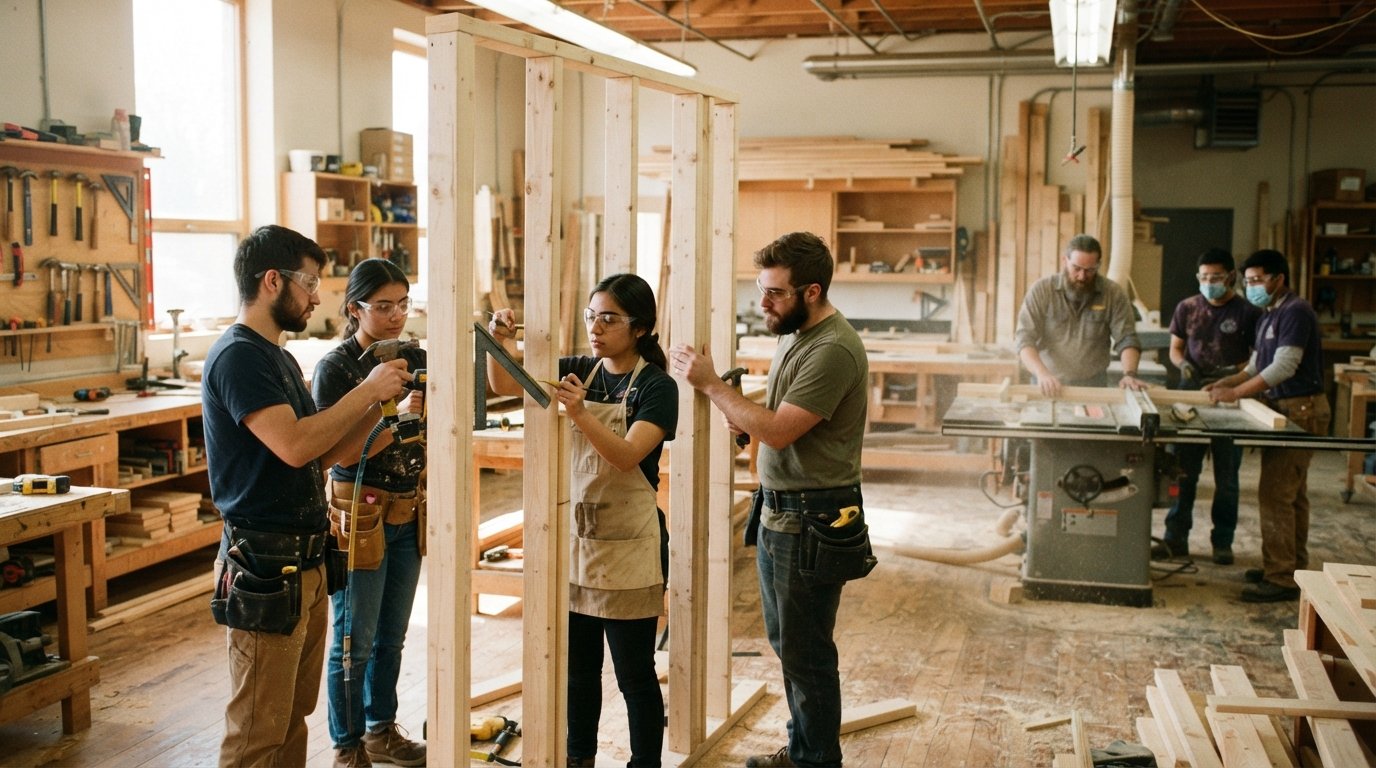
At Coahoma Community College, the in-person format means students spend substantial time in labs and on practice builds rather than watching videos. Carpentry is a tactile trade: you learn saw safety by using a saw, and you learn layout by snapping lines on real lumber. Face-to-face instruction also gives instructors the chance to correct unsafe habits immediately, which is difficult to do remotely. Graduates typically leave with a working knowledge of hand and power tools, framing and rough carpentry, interior and exterior finish work, and basic construction math.
Because the program spans two years, there is room to layer in employability skills. Students often practice job-site communication, teamwork, and basic project planning, all of which show up in entry-level job descriptions. The degree also creates a bridge to further study: some graduates later pursue construction management or building inspection credentials, and having an associate's degree can shorten that path or satisfy prerequisites.
Why the In-Person Format at Coahoma Community College Matters
Coahoma Community College sits in Clarksdale, Mississippi, and serves a region where construction and renovation work is a steady part of the local economy. The in-person requirement is not a bureaucratic detail; it is central to how the program works. Carpentry students need access to shop space, lumber, scaffolding, and a supervised environment where mistakes are caught early. A two-year, in-person schedule also builds the kind of routine and accountability that employers value on a job site.
There is a financial angle to the format as well. In-person community college programs in Mississippi are generally priced well below four-year institutions, and students who live at home or nearby can keep housing costs low. That combination, low tuition plus low living expenses, is one reason trade-focused associate's degrees often deliver strong returns relative to their cost. Families comparing options should look beyond the sticker price and consider total cost of attendance, including tools, transportation, and any required safety equipment.
Prospective students should confirm current program details directly with the college, since course sequences, lab requirements, and admission steps can change from year to year. Still, the broad structure is consistent: a Carpentry/Carpenter Associate's degree, usually 2 years In-person at Coahoma Community College, delivered through a mix of technical courses, labs, and general education requirements that round out the credential.
Courses and Skills You Can Expect to Build
While exact course titles vary, most two-year carpentry programs follow a logical progression from safety and fundamentals to advanced construction techniques. Early semesters usually emphasize tool identification, safety protocols, and basic measurement and layout. Later semesters move into framing, roofing, exterior finishes, and interior trim, often with a capstone project that pulls the skills together.
Here is a representative set of skill areas that a carpentry associate's program typically covers:
- Job-site safety, including OSHA awareness and proper use of personal protective equipment
- Blueprint reading, construction drawing interpretation, and basic estimating
- Framing, sheathing, and structural rough carpentry
- Interior and exterior finish work, including trim, doors, and cabinetry basics
- Construction math and materials selection
General education courses, such as communication and applied math, are often woven into the degree. These are not filler: contractors consistently report that employees who can write a clear estimate, explain a delay to a client, or do quick math on the job site advance faster. Students who plan to run their own businesses later may also benefit from introductory business or supervision courses if the program offers them.
Cost, Financial Aid, and Ways to Pay
Cost is where a two-year community college program often shines. Mississippi community colleges generally charge per-credit tuition rates that are a fraction of four-year university rates, and carpentry programs usually do not require expensive textbooks. The bigger variable expenses tend to be tools, safety gear, and transportation to and from campus and job sites. Students should budget for these early rather than discovering them mid-semester.
Federal financial aid, state grants, and institutional scholarships are all worth exploring for trade programs. Completing the FAFSA is the starting point for most aid, and Mississippi residents should also check state-specific workforce grants that sometimes target high-demand fields like construction. Students who are still comparing schools can review a broader overview of affordable college cost and tuition strategies to understand how aid packages and net price calculations work, even though this particular carpentry program is in-person.
Scholarships deserve special attention because they do not need to be repaid and can be stacked with other aid. National databases and search tools can surface trade-specific awards, local civic club scholarships, and employer-sponsored tuition assistance. Students and parents who want a single starting point for scholarship searching can use Scholarship.Education to browse opportunities across levels and fields, then filter for construction and trades awards. Applying to several small scholarships is often more realistic than chasing one large award, and even modest awards reduce the amount borrowed.
Employer tuition assistance is another underused option. Some construction companies will reimburse part of tuition for employees pursuing trade credentials, especially when the coursework aligns with the company's work. Students who already work in the field should ask about these programs before assuming they must pay entirely out of pocket.
Admissions Steps and What to Prepare
Admission to a community college carpentry program is generally straightforward, but it does involve several steps that are easy to delay. Students should start by completing the college application, submitting high school transcripts or equivalency documentation, and taking any required placement assessments. Because the program is in-person and lab-based, seats can be limited, so applying early improves scheduling options.
A practical sequence looks like this:
- Complete the college application and submit transcripts.
- Take placement tests or provide qualifying scores if required.
- Meet with an advisor to map the two-year course sequence.
- Complete the FAFSA and apply for state and local scholarships.
- Budget for tools and safety equipment before the first lab session.
Students with no construction background should not be discouraged. Most programs assume students are starting from the basics, and instructors typically prefer teachable beginners over students with unsafe self-taught habits. A short conversation with an advisor can clarify whether any preparatory math or reading coursework is recommended before the technical courses begin.
Career Outcomes and Advancement After Graduation
Entry-level carpentry jobs are available in residential construction, commercial construction, remodeling, and maintenance. Wages vary by region and experience, but the more important point for prospective students is the advancement path. Carpenters who can read plans, lead small crews, and communicate clearly often move into lead carpenter, foreman, or estimator roles within a few years. Some eventually launch their own contracting businesses, where the business and communication coursework from an associate's degree becomes especially useful.
The degree also supports lateral moves. Graduates sometimes move into building inspection, code enforcement, facilities maintenance, or construction management assistant roles. In each case, having a two-year credential on a resume signals completion and follow-through, which matters when employers are choosing between candidates with similar hands-on experience.
Students should also think about licensing and certification requirements in their area, which vary by state and by type of work. A program advisor can explain which local credentials are worth pursuing and which are unnecessary for a given career goal.
Is a Two-Year Carpentry Degree Right for You?
The honest answer depends on your goals, timeline, and finances. A two-year associate's degree makes the most sense for students who want a structured, in-person learning environment, who plan to advance into supervisory or business roles, or who may later pursue additional credentials. It also suits students who want the credibility of a degree when competing for jobs against applicants with only informal experience.
A shorter certificate can be a faster route into the workforce, and some students prefer to earn while they learn through apprenticeships. Neither path is wrong; they simply trade speed against depth. Students weighing the options should compare total cost, time to completion, and the kinds of jobs each credential opens. For many people in the Coahoma region, the two-year in-person format offers the best balance of affordability, hands-on training, and long-term flexibility.
Before enrolling, visit the campus if possible, talk to instructors, and ask current students about lab time and job placement support. Those conversations usually reveal more than any brochure. With a clear budget, a financial aid plan, and realistic expectations, a Carpentry/Carpenter Associate's degree, usually 2 years In-person at Coahoma Community College, can be a solid, low-debt step into a trade that rewards skill and reliability.