
Chemistry Associate's Degree at CCD: 2-Year Guide
Earn a Chemistry, General Associate's degree, usually 2 years In-person at Community College of Denver, and transfer lab credits at a fraction of university tuition.

By Lisa Bennett
Choosing a science pathway after high school often comes down to balancing cost, transferability, and hands-on learning. The Chemistry, General Associate's degree, usually 2 years In-person at Community College of Denver sits at the intersection of all three: it delivers foundational lab science at a community college price, keeps you close to professors and equipment, and creates a structured route into a four-year chemistry or biochemistry program. For students in the Denver metro area who want a rigorous start without taking on university-level debt in the first two years, this program deserves a close look.
Chemistry is a gateway field. It feeds into pharmacy, materials science, environmental testing, secondary teaching, chemical engineering transfer tracks, and dozens of allied health roles. A general associate's degree in chemistry is not a terminal professional credential, but it is a deliberate academic building block. The Community College of Denver (CCD) version is designed for students who plan to transfer, which means the value calculation is different from a career-focused two-year degree. You are buying credit hours that should count toward a bachelor's degree, and you are buying them at a tuition rate that is typically a fraction of what a four-year residential campus charges.
This guide walks through what the program covers, how the in-person format shapes the student experience, what it costs and how financial aid fits in, how transfer works in practice, and which careers reward this pathway. It also flags the questions you should ask an advisor before you register for your first semester of general chemistry.
What the Chemistry, General Associate's Degree at CCD Actually Covers
The degree is built on the standard lower-division science sequence: general chemistry with laboratory, organic chemistry with laboratory, calculus, physics, and the general education core in English, humanities, and social sciences. The word "General" in the program title signals breadth rather than specialization. You are not choosing an analytical chemistry concentration or an industrial track; you are completing the foundational coursework that most four-year chemistry programs expect during the freshman and sophomore years.
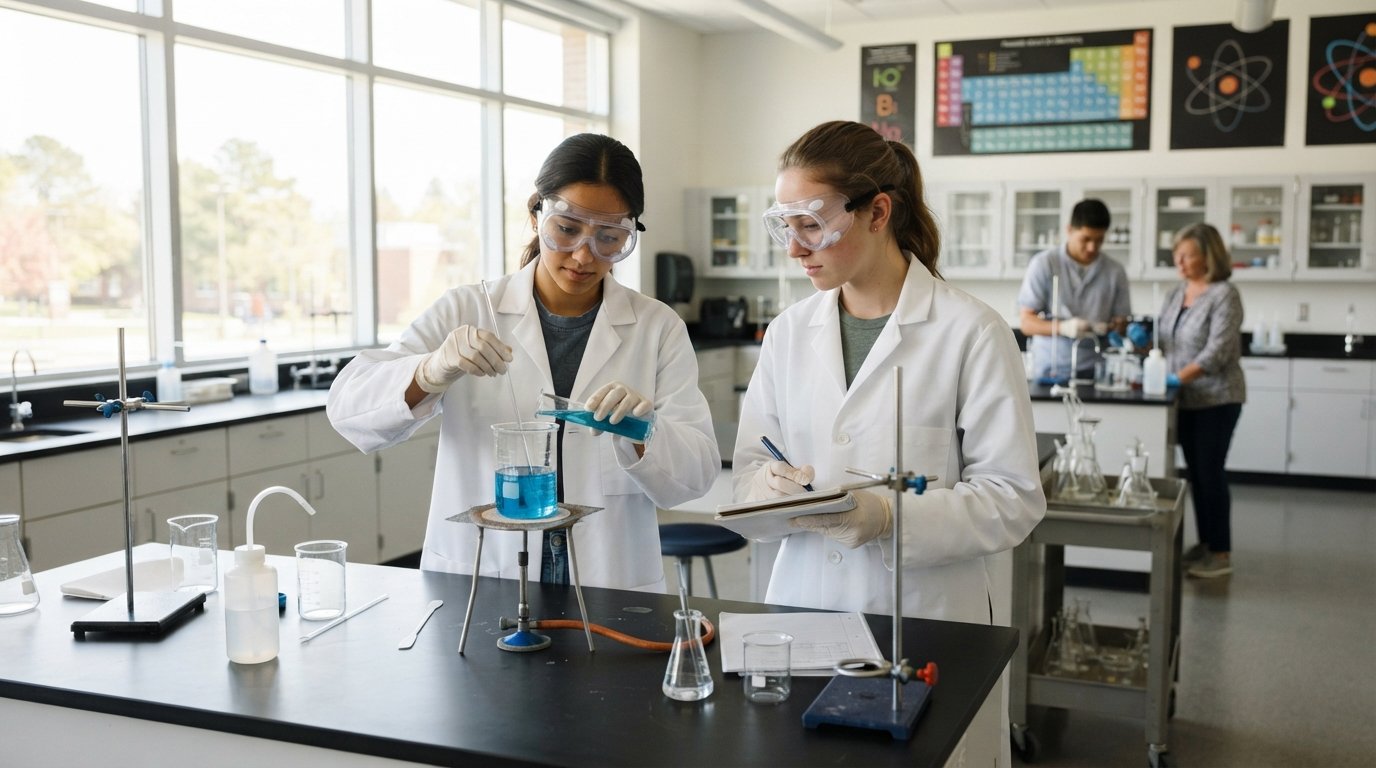
Because the program runs in person at the Community College of Denver campus, the laboratory component is central rather than supplemental. Students handle glassware, titrations, spectrophotometers, and instrumentation under direct supervision, and they do it in smaller sections than many university general chemistry courses allow. That matters for transfer students: admissions committees and scholarship reviewers look favorably on applicants who can describe actual bench experience, not just lecture grades.
A typical course load across the two years includes the following elements:
- General Chemistry I and II with labs, usually taken in the first two semesters
- Organic Chemistry I and II with labs, typically in the second year
- Calculus I and II, plus a physics sequence with labs
- English composition, communication, and humanities or social science electives
- Transfer electives chosen with an advisor to match a specific four-year institution's requirements
That last bullet is where students get into trouble. Two-year science degrees are not interchangeable across states or even across institutions within Colorado. A course that satisfies a requirement at one university may transfer as an elective at another. The practical fix is to identify your target bachelor's program before you finish your first semester and to keep a written transfer plan on file with an advisor. CCD's advising office can map coursework against articulation agreements, and Colorado's statewide guaranteed transfer framework covers many general education courses, though upper-level science sequencing still requires careful checking.
Why the In-Person Format Matters for Chemistry Students
Online chemistry degrees exist, but laboratory science is one of the fields where the in-person format earns its keep. Titration technique, safe handling of reagents, and instrument calibration are psychomotor skills. They are learned by doing, with someone watching who can correct your grip on a pipette or catch a ventilation problem before it becomes an incident. Students who complete a fully online general chemistry sequence sometimes arrive at four-year programs needing to retake labs, which erases the cost savings of the online format.
The Community College of Denver setting adds a second layer of value: access. The campus sits in the Denver metro area, which means students can combine coursework with part-time lab assistant jobs, hospital volunteer shifts, or internships at environmental and water quality organizations along the Front Range. Those experiences strengthen transfer applications and give you a realistic preview of what chemistry work feels like day to day. If you are still mapping out which science careers fit your interests, a resource like Careers.org can help you compare typical duties, work settings, and the degrees each occupation requires before you commit to a specialization.
In-person scheduling also creates accountability. Chemistry is cumulative: fall semester material reappears on spring exams, and organic chemistry assumes fluency in general chemistry. Students in face-to-face sections tend to form study groups and use office hours more consistently, and those habits correlate with surviving the organic chemistry sequence, which is the traditional filter course for science majors. If your schedule allows only evening or part-time enrollment, ask an advisor early about course rotation, because lab sections fill quickly and not every course runs every term.
Cost, Financial Aid, and the Transfer Value Calculation
The financial case for starting at a community college is straightforward arithmetic. Lower-division credit hours cost substantially less at CCD than at a four-year university, and chemistry is a lab-heavy major, which means lab fees on top of tuition. Completing general and organic chemistry at the community college rate and transferring those credits can shave thousands of dollars off the total cost of a bachelor's degree. Students who want to benchmark that savings against other options can review this guide to finding the most affordable community colleges for lower tuition and compare published rates before committing.
Financial aid works the same way at a community college as at any accredited institution. Complete the FAFSA, check whether the chemistry program qualifies for federal grants and loans, and ask about Colorado state aid and institutional scholarships. Many chemistry students qualify for workforce development grants or STEM-specific scholarships that are less competitive at two-year schools than at research universities. The key deadline is the FAFSA itself: file early, because some aid is distributed first come, first served.
There is one cost trap worth naming. Transfer students sometimes lose credits, and lost credits are wasted tuition. Before you register for second-year courses, confirm in writing that your target four-year school will accept your organic chemistry sequence, your calculus credits, and your physics labs. If a university requires a specific course that CCD does not offer, take it as a transient student at the four-year school rather than assuming it will transfer later. A fifteen-minute advising appointment can prevent a five-thousand-dollar mistake.
Transfer Pathways and Four-Year Degree Planning
Most students who earn this degree intend to continue. The common destinations are chemistry, biochemistry, chemical engineering (which requires additional math and physics), pharmaceutical sciences, and secondary education with a science endorsement. Each destination has different lower-division requirements, and the differences are not trivial: chemical engineering programs typically want calculus through differential equations and a full calculus-based physics sequence, while a B.A. in chemistry may accept a lighter math track.
A practical planning sequence looks like this:
- Identify two or three target bachelor's programs and download their degree requirement sheets.
- Meet with a CCD advisor to map those requirements onto your associate's degree plan.
- Confirm articulation in writing with the four-year institution's transfer office.
- Apply to transfer one full semester before you intend to enroll, and track scholarship deadlines separately.
Students who follow that sequence rarely lose credits, and they often transfer with a stronger GPA than they would have earned while adjusting to a university's larger lecture halls. The associate's degree also functions as a safety net: if life intervenes and you need to work full time before finishing a bachelor's, you exit with a credential rather than a transcript of unfinished coursework.
Careers and Next Steps After the Degree
An associate's degree in chemistry alone will not make you a chemist in the professional sense; most research and analytical roles require a bachelor's degree or higher. What the degree does do is qualify you for laboratory technician and assistant roles, quality control positions in manufacturing and food science, environmental sampling work, and educational support roles. It also satisfies the lower-division requirements for pharmacy school and other professional programs, provided you complete the specific prerequisite courses those programs list.
Students who continue to a bachelor's degree typically move into analytical chemistry, pharmaceutical development, materials testing, environmental compliance, or teaching. Those roles reward the lab habits built during the in-person associate's program: careful documentation, instrument familiarity, and the discipline to follow protocols exactly. If you are weighing whether the two-year investment is worth it, compare the entry-level wages for laboratory technicians in Colorado against the cost of your first two years at CCD. For most Denver-area students, the math favors starting locally and transferring.
The most useful next step is a conversation, not a decision. Meet with a CCD academic advisor, bring a list of target four-year programs, and ask three questions: which courses transfer, which semester each lab sequence runs, and what the program's recent transfer outcomes look like. Then file your FAFSA and apply for admission. The Chemistry, General Associate's degree, usually 2 years In-person at Community College of Denver is a starting point, and like any starting point in science, its value depends on where you plan to go next.