
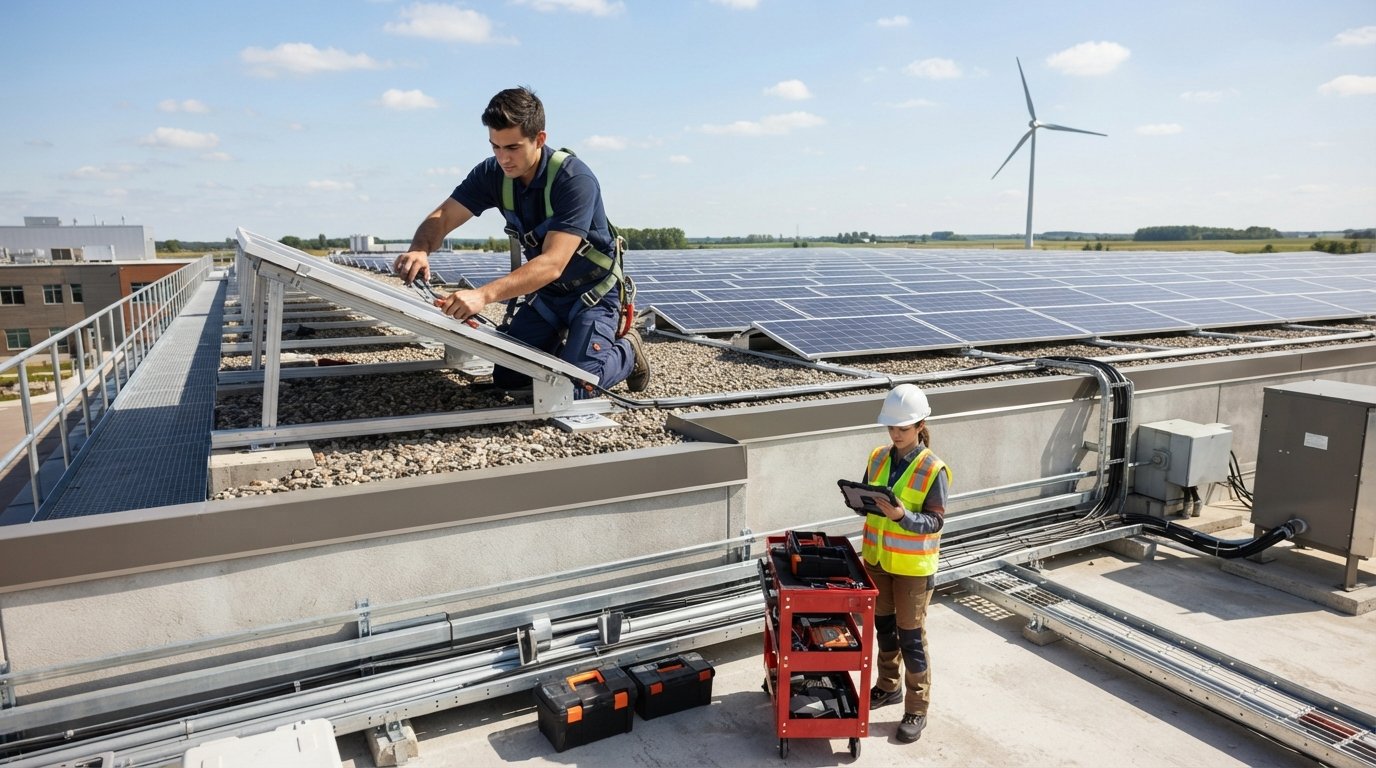
Clean Energy Trade School Programs: Career Outlook
Clean energy trade school programs offer strong career growth, high pay, and job security. Explore the top roles and how to choose the right training.

By Ethan Brooks
The transition to renewable energy is reshaping the American workforce, and trade schools are stepping up to meet the demand. For students who want a hands-on career with strong job security, clean energy trade school programs offer a direct path. The career outlook for graduates in this field is not just promising; it is backed by federal investments, state-level mandates, and a growing private sector commitment to sustainability. This article explains what these programs involve, the job market you can expect, and how to choose a path that fits your goals and budget.
Why Clean Energy Trades Are Booming
The Bureau of Labor Statistics projects that occupations related to renewable energy, such as wind turbine technicians and solar photovoltaic installers, will grow much faster than the average for all occupations. In fact, wind turbine service technician roles are often cited as one of the fastest-growing jobs in the United States. This growth is driven by several factors: declining costs of solar and wind technology, corporate sustainability pledges, and government incentives like the Inflation Reduction Act, which extends tax credits for clean energy projects through the next decade.
For students, this translates into a stable career that does not require a four-year degree. Most clean energy trade jobs require a certificate, an associate degree, or an apprenticeship. The training is practical, often taking less than two years to complete. After graduation, workers enter fields where the median pay often exceeds the national average for all occupations. For example, the median annual wage for solar installers was over $48,000 in 2024, and wind turbine technicians earned over $61,000. Those figures are expected to rise as demand increases.
Moreover, the clean energy sector is not limited to sunny states. Offshore wind projects on the East Coast, geothermal development in the West, and battery storage installations everywhere are creating regional job hubs. Trade schools are partnering with local utilities and construction firms to tailor curricula to specific regional needs, which means your training can be highly relevant to the job market right where you live. For a broader look at how educational programs align with career growth, see our guide on best colleges with graduate programs for career growth.
Core Clean Energy Trade School Programs
Clean energy trade school programs are not a single, monolithic track. They span multiple technologies and skill sets. Here are the main areas of study you will encounter:
- Solar Photovoltaic (PV) Installation: Learning to install and maintain solar panels on rooftops and in utility-scale arrays.
- Wind Turbine Technology: Training to inspect, repair, and maintain wind turbines, often involving work at significant heights.
- Energy Efficiency and Auditing: Focusing on building retrofits, insulation, HVAC upgrades, and energy management systems.
- Battery Storage and Microgrids: Preparing to install and service energy storage systems that complement renewable generation.
- Electric Vehicle (EV) Infrastructure: Specializing in charging station installation and maintenance, a rapidly growing niche.
Each of these specialties has its own certification requirements and career ladder. For instance, the North American Board of Certified Energy Practitioners (NABCEP) offers the most recognized solar certification, while wind technician programs often align with safety standards from the Occupational Safety and Health Administration (OSHA). When choosing a program, verify that it prepares you for these industry-recognized certifications, not just a generic diploma.
Career Outlook by Role
The clean energy trade school programs career outlook is best understood by looking at specific job titles. The table below summarizes the projected growth and median pay for three key roles, based on data from the Bureau of Labor Statistics.
| Job Title | Projected Growth (2024-2034) | Median Annual Pay (2024) |
|---|---|---|
| Solar Photovoltaic Installers | 18% (much faster than average) | $48,620 |
| Wind Turbine Technicians | 21% (much faster than average) | $61,590 |
| Energy Auditors (with trade cert) | 13% (faster than average) | $64,340 |
These numbers underscore the value of specialized training. A solar installer with a NABCEP certification can command a higher starting salary and has more opportunities for advancement into lead technician or project manager roles. Wind technicians, who often work for turbine manufacturers or independent service providers, may also receive overtime pay for travel and emergency repairs.
Beyond the entry-level positions, there is a clear pathway to supervisory roles. Many trade school graduates move into field supervisor positions within five years, overseeing crews and ensuring safety compliance. Others transition into sales, system design, or training roles. The breadth of opportunity is a key reason that the clean energy trade school programs career outlook remains positive for the foreseeable future.
How to Choose the Right Program
Selecting a clean energy trade school program requires careful research. Not all programs are equal in terms of curriculum, lab facilities, and employer connections. Here is a step-by-step approach to making an informed decision:
- Check accreditation and certification alignment. Look for programs accredited by recognized bodies and that explicitly prepare you for industry certifications like NABCEP or OSHA 10/30.
- Evaluate hands-on training components. The best programs have working solar arrays, wind simulators, or lab equipment that mimic real-world conditions.
- Review job placement rates. Ask for recent graduate employment data. A program with a 90% placement rate is a stronger choice than one with a 50% rate.
- Compare costs and financial aid. Tuition can range from $5,000 to $20,000. Explore scholarships, grants, and employer-sponsored training options. Understand what you will owe and what your expected starting salary will be.
- Consider program length and schedule. Some programs are intensive, full-time six-month certificates, while others are two-year associate degrees that allow for part-time study.
After narrowing down your options, speak with alumni and current students. Ask about the quality of instruction, the condition of the equipment, and the school's relationships with local employers. A program that partners with nearby solar companies or utilities can offer internships and direct job placement, which is invaluable when you are starting out.
Financing your education is a major consideration. Trade school is often more affordable than a four-year degree, but it is not free. You can use federal financial aid, including Pell Grants, if the program is accredited. Some states offer workforce development grants for clean energy training. Also, check with the school's financial aid office about payment plans and scholarships. Remember that the cost of your education is an investment. With starting salaries in the range of $40,000 to $60,000, the payback period is typically short.
Comparing Trade School vs. Community College vs. Apprenticeship
Your path into clean energy trades does not have to be through a traditional trade school. Community colleges often offer similar certificate and associate degree programs at a lower cost. Apprenticeships, such as those sponsored by the Department of Labor, combine paid on-the-job training with classroom instruction. Each option has trade-offs.
Trade schools tend to be faster and more focused. They often have modern equipment and instructors with deep industry experience. However, they can be more expensive per credit hour than community colleges. Community colleges may offer more general education courses and financial aid flexibility, but their equipment might be older, and the program may be longer if you need remedial courses. Apprenticeships are ideal if you want to earn while you learn, but they can be competitive to enter and may require you to relocate for the right sponsor.
As you weigh these options, consider your personal learning style and financial situation. If you are a hands-on learner who wants a quick entry into the workforce, a private trade school might be the best fit. If you prefer a slower pace and a lower cost, a community college or apprenticeship could be better. Regardless of the path, the clean energy trade school programs career outlook remains strong because employers care more about your skills and certifications than the name of the institution on your diploma.
Financing and Scholarships for Clean Energy Training
The cost of clean energy trade school programs can be a barrier, but there are many financial resources available. The federal government offers the Solar Training Network and other initiatives that sometimes include scholarships. Several non-profits, like the Interstate Renewable Energy Council (IREC), provide directories of accredited training providers and occasionally offer financial assistance.
State-level workforce boards also allocate funds for high-demand industry training. For example, California's Solar on Multifamily Affordable Housing program and New York's Offshore Wind Training Institute provide free or subsidized training for eligible residents. Additionally, many employers in the clean energy sector are willing to sponsor training for new hires, particularly for wind technicians and EV installers. When negotiating a job offer, ask about tuition reimbursement or apprenticeship opportunities.
Your local community college financial aid office is another resource. They can help you apply for federal Pell Grants, which do not need to be repaid, and state need-based aid. Some trade schools also offer private scholarships based on merit or demographic criteria. It is worth spending an afternoon researching these options, as a few thousand dollars in grants can make a significant difference in your student debt load.
The Future of Clean Energy Careers
The clean energy transition is not a passing trend. It is an industrial shift that will require millions of skilled workers over the next decade. The Department of Energy's 2024 employment report showed that clean energy jobs grew by 4.9% in 2023, outpacing the overall economy. As grid modernization and electrification continue, the demand for trained technicians will only increase.
Moreover, the nature of the work is evolving. Solar installers are now learning to integrate battery storage systems. Wind technicians are being trained on larger, more efficient turbines. Energy auditors are using advanced software to model building performance. Trade school curricula must keep pace with these changes, and the best programs do so by maintaining close ties with industry partners. When you enroll in a top-tier program, you are not just learning a static skill set. You are entering a field where continuous learning is part of the job.
For those who are just beginning their educational journey, it is also worth considering how clean energy trades can complement further education. Some technicians later pursue associate or bachelor's degrees in engineering technology or business management. That path can lead to roles in project development, operations management, or policy. The foundation you build in a trade school, however, is what sets you apart. Employers value practical experience and certifications, which you will have in abundance.
Key Takeaways and Next Steps
If you are ready to explore clean energy trade school programs, start by identifying the technology that interests you most. Research local programs using the criteria above, and compare their costs and outcomes. Reach out to the schools directly to schedule a campus tour or speak with an instructor. Ask about their placement rates and what kind of support they offer for certification exams.
Also, consider your long-term career goals. Do you want to be a technician who works with your hands every day, or are you interested in becoming a crew leader or business owner? Your answer will influence whether you choose a short certificate or a more comprehensive associate degree. Remember that the clean energy trade school programs career outlook is not just about getting a job. It is about building a career that is both financially rewarding and personally meaningful.
The clean energy revolution needs skilled workers, and trade schools are the gateway. By investing in your education now, you can secure a stable, well-paying job that contributes to a sustainable future. For additional help in finding the right educational path, you might explore resources at CollegeDegree.Education, which can connect you with accredited programs. The future is bright for those who are willing to learn, and your first step is to enroll in a program that matches your ambition.
Take the time to evaluate your options, visit campuses, and talk to people in the field. The demand for clean energy professionals is real, and the time to act is now. With the right training, you can be part of a workforce that is building a cleaner, more resilient energy system for the entire country.