
College of the Desert Kinesiology Associate's Degree
Earn a Sports, Kinesiology, and Physical Education/Fitness, General Associate's degree at College of the Desert in about two years, in person and affordably.

By Michael Grant
If you live in the Coachella Valley and want to turn a passion for fitness, coaching, or athletic training into a real career, the Sports, Kinesiology, and Physical Education/Fitness, General Associate's degree, usually 2 years In-person at College of the Desert could be one of the smartest, lowest-cost starting points available to you. This is a hands-on, face-to-face program built for students who learn best by moving, demonstrating, and practicing skills in a gym or classroom rather than staring at a screen alone at midnight. It is also one of the most affordable ways to begin a four-year degree in kinesiology, exercise science, or physical education without taking on crushing student loan debt in your first two years.
In this guide, we break down what the program covers, who it is designed for, what it costs, how to transfer to a bachelor's degree, and the careers that open up once you finish. If you are comparing this option against online alternatives, it also helps to understand how program format affects overall cost and value, which is why our breakdown of online degree cost and tuition is a useful companion read for understanding the broader affordability picture in higher education.
What This Associate's Degree in Kinesiology Actually Covers
The Sports, Kinesiology, and Physical Education/Fitness, General Associate's degree, usually 2 years In-person at College of the Desert is a broad foundation program. It is not a single-track certification. Instead, it introduces you to the science of human movement, the practical skills of coaching and instruction, and the health and wellness concepts that underpin every fitness career. Because it is a general kinesiology degree, it functions as a launchpad: you can use it to enter the workforce in entry-level fitness roles, or you can transfer into a bachelor's program and specialize later.
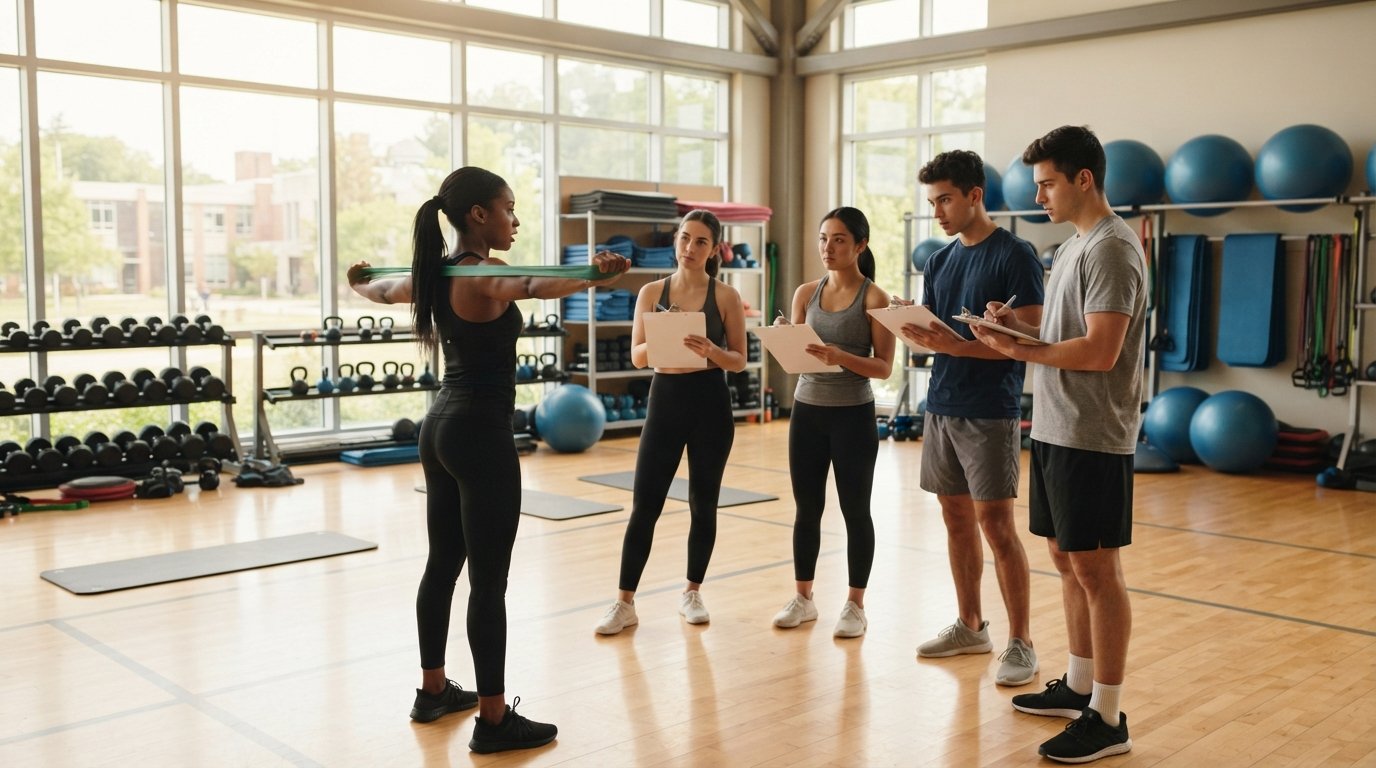
Core coursework typically blends lecture and lab experiences, covering topics such as anatomy and physiology, biomechanics, exercise physiology, nutrition for fitness, first aid and CPR, sport psychology, and the principles of coaching and physical education instruction. You will also build practical competencies like designing workout programs, teaching group exercise, assessing fitness levels, and managing a weight room or training facility safely. Because the program is delivered in person, you get direct feedback from instructors on your form, cueing, and teaching style, something that is genuinely difficult to replicate through a purely online format.
Students who thrive in this program tend to enjoy physical activity, working with people, and understanding how the body responds to training. If you are the type of person who wants to help a client lose weight safely, coach a high school team, or eventually work in physical therapy or athletic training, this degree gives you the vocabulary and the hands-on experience to move forward with confidence.
Why In-Person Learning Matters for Kinesiology and Fitness
Kinesiology is an applied science, and fitness is an applied profession. That distinction matters when you choose a program. You cannot fully learn how to teach a squat, spot a bench press, or run a group fitness class by watching videos alone. The Sports, Kinesiology, and Physical Education/Fitness, General Associate's degree, usually 2 years In-person at College of the Desert is built around that reality, which is why the in-person format is a feature rather than a limitation.
In a classroom and gym setting, you practice in real time, make mistakes, and correct them immediately. You learn to read body language, manage a class of twenty people with different fitness levels, and adapt exercises for someone with an injury. These are the soft skills that employers and transfer institutions value, and they are exactly the skills that are hardest to build in isolation. In-person programs also give you access to campus fitness facilities, intramural sports, and instructor networks that can lead to internships, assistant coaching roles, and job references.
That said, cost and flexibility still matter. Many students pair an in-person kinesiology program with online general education courses to reduce their on-campus time and overall expenses. If you are weighing formats across different fields, our guide on the cost of online IT degrees is a helpful example of how tuition and fees can vary dramatically by delivery method, and the same logic applies when you compare in-person versus hybrid options in kinesiology.
Admission Requirements and Who Should Apply
Community college associate's degree programs in kinesiology are generally designed to be accessible. The Sports, Kinesiology, and Physical Education/Fitness, General Associate's degree, usually 2 years In-person at College of the Desert typically requires a high school diploma or equivalent, and you may need to complete placement assessments in English and math before enrolling in college-level coursework. Some students also need to satisfy a physical activity or health requirement, which is naturally aligned with the program's focus.
This program is a strong fit for several groups:
- Recent high school graduates who want an affordable start before transferring to a four-year university.
- Career changers who currently work in retail, hospitality, or office jobs and want to move into fitness, coaching, or wellness.
- Current fitness enthusiasts who want to formalize their knowledge with a recognized credential.
- Student-athletes who want to stay connected to sport while building an academic foundation in kinesiology.
- Future physical education teachers who need a transfer pathway into a teaching credential program.
If you are already certified as a personal trainer, this degree can deepen your scientific understanding and open doors to better-paying roles, supervisory positions, or specialized training niches. If you are starting from scratch, it provides structure, mentorship, and a clear sequence of courses that keeps you on track toward graduation.
Cost, Financial Aid, and Why Community College Is a Smart First Step
One of the biggest advantages of earning this degree at College of the Desert is cost. Community college tuition is dramatically lower than four-year university tuition, especially for California residents. For many students, the total cost of the associate's degree is a fraction of what a single year at a private university would cost. That difference can mean graduating with little or no debt, which gives you far more freedom when you transfer or enter the workforce.
Financial aid can reduce your costs even further. In California, programs like the California College Promise Grant can waive tuition for eligible students, and federal aid such as Pell Grants and work-study can help cover books, transportation, and living expenses. You should also apply for scholarships, including niche awards for kinesiology, education, and health sciences students. Resources like Scholarship.Education can help you discover, evaluate, and apply for scholarships and financial aid opportunities, which is especially useful if you plan to continue into a bachelor's degree after finishing your associate's.
Here is a simple framework for keeping costs manageable:
- Complete the FAFSA as early as possible each year to maximize grant and work-study eligibility.
- Apply for the California College Promise Grant if you are a California resident who qualifies.
- Stack local and national scholarships, even small ones, because they add up quickly.
- Buy used textbooks or rent them, and use campus fitness facilities instead of paying for an outside gym.
- Meet with a financial aid advisor each semester to confirm you are not missing new aid opportunities.
When you compare the total cost of this pathway against a four-year university from day one, the savings are often tens of thousands of dollars. That is money you can put toward a bachelor's degree, certification exams, or simply starting your career with a healthier financial foundation.
Transfer Pathways: Turning Two Years Into a Bachelor's Degree
The Sports, Kinesiology, and Physical Education/Fitness, General Associate's degree, usually 2 years In-person at College of the Desert is often used as a transfer degree. Many students complete their lower-division requirements here and then transfer to a California State University or University of California campus to earn a bachelor's in kinesiology, exercise science, physical education, or a related field. The key is planning early and working closely with a counselor to ensure your courses align with your target university's requirements.
Transfer admission for kinesiology majors can be competitive, particularly at popular CSU campuses, so your GPA and course selection matter. Courses in anatomy, physiology, chemistry, and statistics are frequently required for upper-division kinesiology programs, and completing them at the community college level is usually far cheaper than taking them after transfer. If you know you want to pursue a career in physical therapy, athletic training, or sports medicine, you should also check whether your target graduate programs have specific prerequisites that you can begin satisfying during your associate's degree.
Some students choose to enter the workforce immediately after earning the associate's degree and then return for a bachelor's later, often with employer tuition assistance. Both paths are valid. What matters is that you understand the requirements of your next step before you finish your last semester, not after.
Career Outcomes and Earning Potential
An associate's degree in kinesiology does not limit you to one job. It opens a range of entry-level positions in fitness, recreation, education, and wellness, and it also positions you for advancement once you gain experience or additional certifications. Typical roles include personal trainer, group fitness instructor, strength and conditioning assistant, wellness coach, physical education aide, recreation program leader, and front desk or membership manager at a gym or community center.
Earnings vary widely by role, location, and certification. Personal trainers and group fitness instructors often earn an hourly rate plus commissions, and income can rise substantially with specialized certifications, a strong client base, and experience. Full-time positions in recreation departments, school districts, and corporate wellness programs tend to offer more stable salaries and benefits. With a bachelor's degree and the appropriate credential, you can move into teaching physical education, athletic training, exercise physiology, or rehabilitation roles, which typically pay more and offer clearer advancement paths.
It also helps to think beyond the first job. The fitness and wellness industry continues to grow as more people prioritize preventive health, and employers increasingly value candidates who understand exercise science rather than just workout routines. A formal kinesiology education signals that you can design safe, effective programs, work with special populations, and communicate professionally with clients and healthcare providers.
How to Succeed in the Program
Success in this program comes down to a few practical habits. Attend labs and practical sessions consistently, because that is where the real learning happens. Build relationships with your instructors, since they often know about internships, assistant coaching openings, and transfer tips that never make it to a formal job board. Stay current on certifications like CPR, AED, and first aid, and consider earning a personal training certification while you are still a student, since many employers prefer to hire candidates who already hold one.
Finally, treat your associate's degree as part of a longer plan. Whether your goal is to become a physical education teacher, a strength coach, a physical therapist, or a wellness director, mapping out the next three to five years now will save you time and money later. The Sports, Kinesiology, and Physical Education/Fitness, General Associate's degree, usually 2 years In-person at College of the Desert gives you an affordable, hands-on foundation. What you build on top of it is up to you.