
Cornell Mechanical Engineering Bachelor's: 4-Year Guide
Cornell's mechanical engineering bachelor's takes 4 years in person. Call 8772187081 to plan costs and aid.

By Sarah Thompson
A Bachelor of Science in Mechanical Engineering from Cornell University is one of the most respected credentials in American engineering education. The program typically takes four years of full-time, in-person study in Ithaca, New York, and it opens doors to careers in robotics, aerospace, energy, automotive design, manufacturing, and beyond. But what does the experience actually involve, and how do families plan for the cost? This guide walks through the curriculum, admission expectations, tuition realities, and the financial aid strategies that make a Cornell engineering degree more reachable than many students assume.
Cornell's mechanical engineering program sits inside the Sibley School of Mechanical and Aerospace Engineering, part of the College of Engineering. That structure matters because it shapes everything from course sequencing to research access. Students are not just earning a Mechanical Engineering Bachelor's degree, usually 4 years In-person at Cornell University; they are joining a cohort-based engineering community with labs, design projects, and faculty mentorship built into the experience from the first year.
What the Cornell Mechanical Engineering Program Actually Looks Like
The Sibley School's undergraduate curriculum blends foundational math and science with hands-on design. The first two years build the base: calculus, differential equations, physics, chemistry, statics, dynamics, thermodynamics, and materials science. By junior year, students move into fluid mechanics, heat transfer, machine design, and systems courses. Senior year typically centers on a capstone design project, often sponsored by industry partners, where teams solve real engineering problems from concept to prototype.
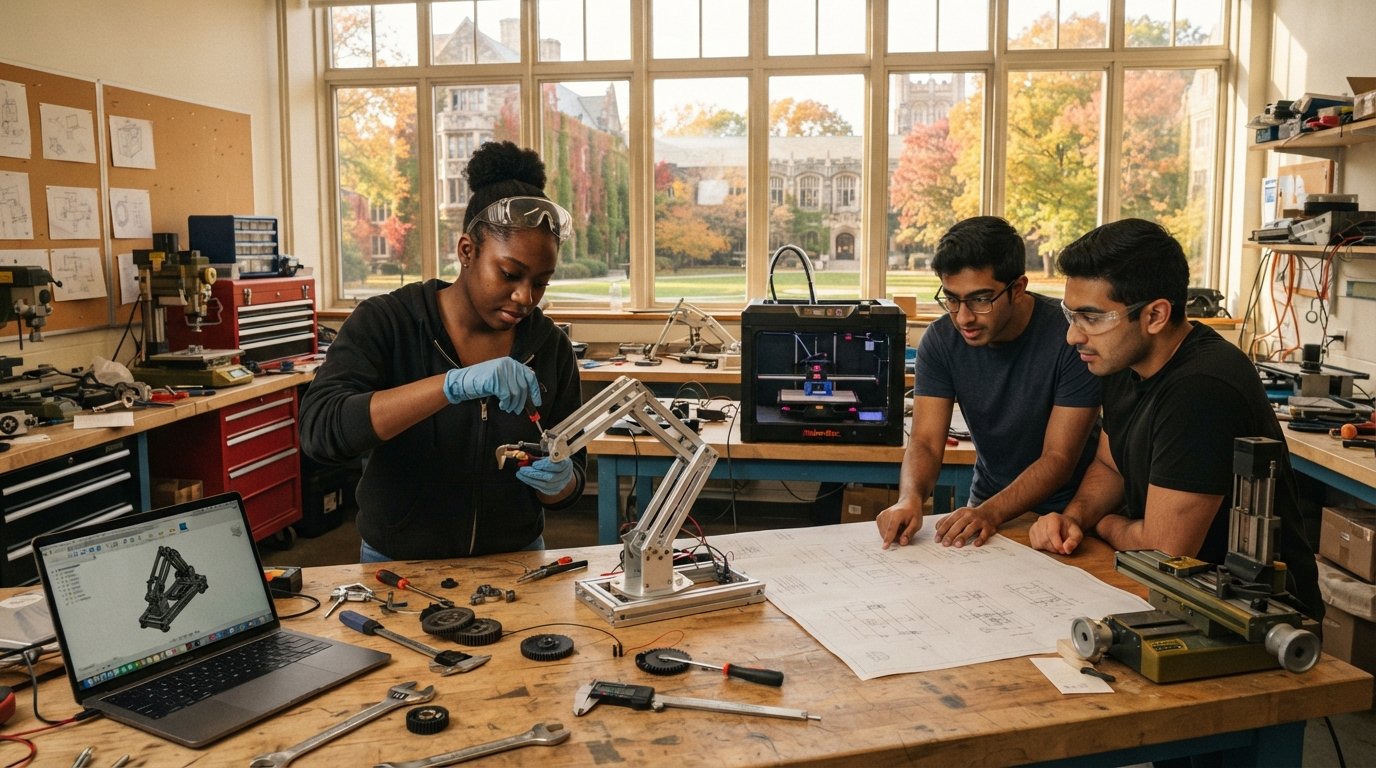
What distinguishes Cornell from many other mechanical engineering programs is the emphasis on project-based learning from the start. First-year students can enroll in introductory design courses that involve building and testing physical systems. The university also maintains extensive maker spaces, including a student project team ecosystem where undergraduates build race cars, drones, and robotic systems outside of class. These experiences matter to employers, who consistently rank Cornell engineering graduates among the most prepared in the country.
Students also have unusual flexibility within the degree. Mechanical engineering majors can pursue concentrations or minors in areas such as aerospace, robotics, energy systems, or business. Dual-degree and accelerated master's pathways exist for students who want to compress a bachelor's and master's into five years. For students comparing this path against other options, understanding how online bachelor's degrees compare in cost and structure can provide useful context, though Cornell's program remains firmly residential and in-person.
Core Coursework and Technical Depth
The technical core of the degree is rigorous and sequenced. Students generally complete the following categories of coursework before graduating:
- Mathematics and basic sciences: calculus through differential equations, physics with lab, chemistry with lab
- Engineering fundamentals: statics, dynamics, mechanics of materials, thermodynamics, fluid mechanics
- Design and manufacturing: machine design, CAD and prototyping, manufacturing processes
- Systems and analysis: heat transfer, control systems, vibrations, numerical methods
- Capstone design: a year-long team project solving an open-ended engineering problem
Beyond the required core, students choose technical electives that shape their career direction. Someone aiming for aerospace might take compressible flow and orbital mechanics. Someone interested in energy might focus on combustion, renewable systems, or nuclear engineering courses offered elsewhere in the College of Engineering. This elective space is where students begin to specialize and where they often discover the subfield that becomes their career.
Admissions: What It Takes to Get In
Cornell's College of Engineering is among the most selective undergraduate engineering programs in the United States. Admission is holistic, but the academic bar is high. Most admitted students present strong grades in the most challenging math and science courses available at their high school, including calculus and physics. Standardized test scores, while sometimes optional depending on the year's policy, are typically strong when submitted.
Beyond numbers, Cornell looks for evidence of genuine engineering interest. That might mean participation in robotics competitions, science fairs, coding projects, or independent building and tinkering. Essays matter because they reveal how a student thinks about problems and why they want to study engineering specifically. Demonstrated curiosity and persistence often carry more weight than a perfect GPA.
Transfer admission is also possible, though competitive. Students from other colleges or community colleges sometimes enter Cornell as sophomores or juniors, provided they have completed the right math and science prerequisites. For transfer students, careful course planning is essential because the mechanical engineering sequence is tightly structured, and missing a prerequisite can add a semester or more.
Cost, Financial Aid, and Planning Ahead
Cost is the factor that most often determines whether a Cornell mechanical engineering degree is realistic for a family. As a private university, Cornell's tuition and fees are substantial, and living costs in Ithaca add to the total. However, Cornell also maintains one of the most generous financial aid programs among private universities, and engineering students are frequently eligible for significant need-based grants.
The key is to understand the difference between sticker price and net price. Sticker price is the published tuition, fees, housing, and food cost. Net price is what a family actually pays after grants and scholarships, and for many families that number is dramatically lower. Cornell's aid packages generally include no loans for families below certain income thresholds, and they meet full demonstrated need for admitted students who qualify.
Families should also plan for costs beyond tuition. Engineering students often need laptops capable of running CAD software, and some purchase specialized calculators, tools, or project materials. Study abroad, co-op terms, and unpaid internships can also affect the total cost of attendance. Building a four-year budget that includes these variables prevents unpleasant surprises later.
Merit scholarships from outside organizations can help close gaps that need-based aid does not cover. Professional societies, local engineering foundations, and national scholarship programs all offer awards for engineering students. Applying broadly to these programs, even in small amounts, can reduce loan burdens over four years.
Career Outcomes and Return on Investment
Mechanical engineering graduates from Cornell consistently report strong starting salaries and high employment rates. Typical first destinations include roles in aerospace and defense, automotive and transportation, energy and utilities, consumer products, robotics, and consulting. Many graduates also continue to graduate school in engineering, business, or law.
The return on investment calculation for a Cornell mechanical engineering degree depends heavily on how much a family actually pays. A student who graduates with modest debt and steps into a well-paying engineering role will typically recover the cost of attendance within a few years. A student who borrows heavily for the full sticker price faces a longer timeline. This is why financial aid strategy and cost planning matter as much as admission strategy.
Cornell's alumni network is another long-term asset. Engineering graduates join a global community that includes founders, executives, and technical leaders across industries. That network often translates into internships, job referrals, and mentorship opportunities that are difficult to replicate elsewhere. For students who can manage the cost, the combination of technical training and network access is a powerful career foundation.
Is the In-Person Format Worth It for Mechanical Engineering?
Mechanical engineering is one of the fields where in-person study offers clear advantages. Hands-on labs, machine shops, physical prototyping, and face-to-face team design work are difficult to replicate fully online. Cornell's program leans heavily on these resources, and students who thrive there tend to be those who take full advantage of them.
That said, online and hybrid engineering programs have improved significantly, and some students begin their studies online before transferring to a residential program. For adult learners and career changers, exploring accredited online degree options can be a smart first step before committing to a full residential program. The important thing is to verify accreditation and confirm that credits will transfer into a program like Cornell's if that is the eventual goal.
For traditional-age students who are ready for a residential experience, Cornell's four-year, in-person model provides structure, mentorship, and immersion that accelerate both technical growth and professional readiness. The intensity is real, but so is the payoff.
How to Prepare Before You Apply
Strong preparation starts well before the application deadline. Students who plan to apply to Cornell's mechanical engineering program should focus on building both academic depth and evidence of engineering interest. The following steps provide a practical framework:
- Complete the most advanced math and science courses your school offers, including calculus and physics.
- Pursue at least one sustained engineering-related activity, such as a robotics team, coding project, or design competition.
- Research financial aid early by running net price calculators and gathering tax documents well before deadlines.
- Apply for outside scholarships in junior and senior year to reduce future borrowing.
- Visit campus if possible, and speak with current students or alumni to understand the culture and workload.
Each of these steps builds a stronger application and a more realistic financial plan. Students who treat the process as a multi-year project rather than a last-minute scramble tend to fare better on both fronts.
Cornell's mechanical engineering bachelor's degree is demanding, expensive, and highly rewarding. It rewards students who prepare academically, plan financially, and commit fully to the in-person experience. For families weighing the investment, the combination of rigorous training, strong career outcomes, and generous need-based aid makes it a serious contender among the nation's top engineering programs. DegreesOnline.Education