
CUNY LaGuardia Electrical Engineering Associate's Degree
Earn an Electrical and Electronics Engineering Associate's degree, usually 2 years In-person at CUNY LaGuardia Community College. Low tuition, hands-on labs, strong job outcomes.

By Lisa Bennett
Finding a hands-on engineering program that gets you into the workforce in two years without burying you in debt is harder than it should be. CUNY LaGuardia Community College offers an Electrical and Electronics Engineering Associate's degree, usually 2 years In-person, and it has become one of the most practical on-ramps to a technical career in New York City. The program combines classroom theory with lab work, so you graduate with skills employers actually recognize. If you are weighing whether a two-year engineering degree is worth your time, this guide breaks down the curriculum, costs, transfer options, and career outcomes, and shows how to compare it against other affordable paths.
Why a Two-Year Engineering Degree Makes Financial Sense
Four-year engineering degrees carry serious price tags. According to national data, the average annual tuition at a public four-year institution runs well into five figures once you add fees, housing, and materials. An associate's degree at a community college like LaGuardia typically costs a fraction of that, especially for New York City residents. You finish faster, borrow less, and start earning sooner. For students who want a technical career without a decade of loan payments, that math matters.
The Electrical and Electronics Engineering Associate's degree, usually 2 years In-person at CUNY LaGuardia Community College, is designed around that reality. LaGuardia is part of the City University of New York system, which means in-state students pay some of the lowest tuition rates in the country. The program is also eligible for federal financial aid, New York state grants, and private scholarships, which can push the net cost even lower. Many students combine Pell Grants with the Excelsior Scholarship or similar aid and graduate with little or no debt.
There is another financial angle that gets overlooked: earning power during and after the program. Electrical and electronics engineering technicians in the New York metro area earn median wages well above the citywide average for workers with only a high school diploma. That gap compounds over a career. Choosing a two-year degree is not settling; it is a calculated trade of prestige for cash flow and speed.
What the Electrical and Electronics Engineering Program at LaGuardia Covers
LaGuardia's engineering program is not a generic electronics certificate. It is a structured associate's degree that mirrors the first two years of a bachelor's program in electrical engineering technology. You take calculus, physics, circuit analysis, digital systems, and programming, plus general education courses in English and social sciences. The in-person format matters here: engineering labs require equipment, supervision, and teamwork that online programs struggle to replicate.
Coursework typically includes:
- Circuit analysis and network theorems
- Digital logic and microprocessor fundamentals
- Electronic devices and amplifiers
- Programming for engineers (C, Python, or similar)
- Calculus I and II, plus calculus-based physics
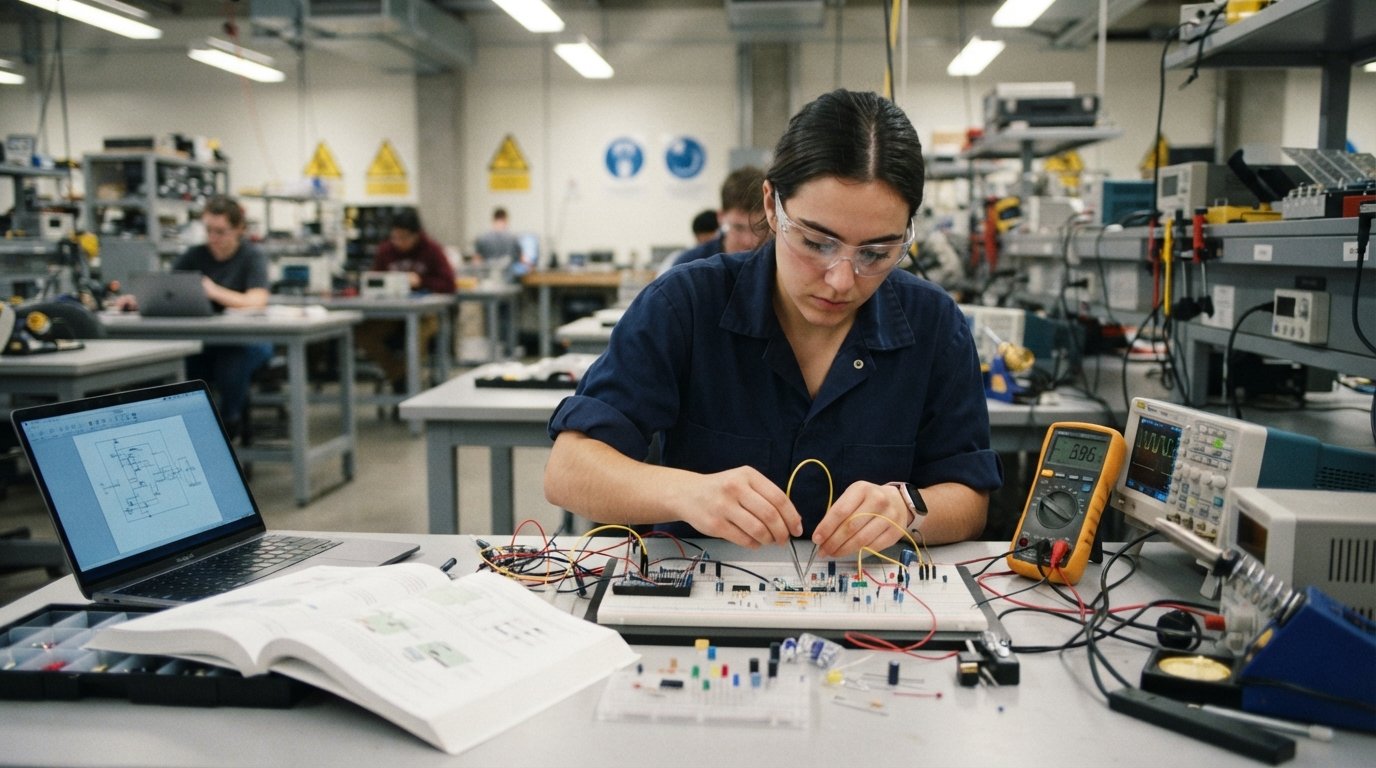
Those courses build toward a capstone or project-based experience where you design, build, and troubleshoot a working system. Employers consistently say that this hands-on portfolio is what separates community college engineering graduates from candidates who only have theory. If you are comparing programs, look closely at lab hours and equipment. A program that lets you solder, wire, and program real hardware is worth more than one that keeps you in a lecture hall.
Because the degree is in-person, you also get access to faculty office hours, study groups, and the kind of informal mentorship that is hard to find in asynchronous online courses. For a field as technical as electrical engineering, that support structure improves completion rates and job readiness.
Admission Requirements and How to Apply
LaGuardia is an open-admission institution, which means you do not need a competitive GPA to get in. You do need a high school diploma or equivalent, and you will take placement tests in math and English unless you have qualifying SAT, ACT, or Regents scores. The engineering program is more demanding than general studies, so strong math preparation helps. If you place into developmental math, you can still start, but expect to spend an extra semester or two building up to calculus.
The application process follows a predictable sequence:
- Submit the CUNY application online and select LaGuardia Community College.
- Send official high school transcripts or proof of equivalency.
- Complete placement testing or submit exempting scores.
- Attend orientation and meet with an engineering advisor to map your first-semester schedule.
- File the FAFSA and any state aid applications before the priority deadline.
Advisors at LaGuardia are used to working with students who are the first in their family to attend college, career changers, and adults returning after years away from school. That support matters. Students who meet with an advisor in their first semester are more likely to stay on track and graduate within two years.
Tuition, Fees, and Financial Aid Options
Cost is where the Electrical and Electronics Engineering Associate's degree, usually 2 years In-person at CUNY LaGuardia Community College, really stands out. For New York City residents, full-time tuition at a CUNY community college is a small fraction of what private universities charge. Out-of-state and international students pay more, but still far less than at a four-year private engineering school. Add books, lab fees, and transportation, and you can estimate a realistic annual budget before you commit.
Financial aid can bring that number down dramatically. Here are the main sources to pursue:
- Federal Pell Grants for low-income students
- New York State Tuition Assistance Program (TAP) awards
- Excelsior Scholarship for eligible NY residents
- Private scholarships from engineering societies and employers
- Work-study positions on campus
Students who want to find additional funding can use databases like Scholarship.Education, which aggregates scholarships for two-year, four-year, and non-traditional students. Stacking a few small awards on top of federal and state aid often covers the remaining balance. The key is to apply early and to reapply every year, because many scholarships are renewable.
It also helps to think about return on investment, not just sticker price. If the program costs a few thousand dollars per year and graduates earn starting salaries in the $50,000 to $65,000 range in the New York area, the break-even point arrives quickly. Compare that to a four-year degree that adds two more years of tuition and lost wages.
Career Outcomes for Electrical and Electronics Engineering Graduates
Graduates of two-year electrical engineering technology programs work in fields that keep the lights on and the machines running. Common job titles include electrical engineering technician, electronics technician, field service technician, test technician, and controls technician. Employers range from utility companies and transit authorities to hospitals, manufacturers, and telecom firms. In a dense urban market like New York, demand for technicians who can troubleshoot and maintain complex systems is steady.
Typical entry-level tasks include:
- Assisting engineers with circuit design and testing
- Installing and calibrating electronic equipment
- Reading schematics and wiring diagrams
- Performing preventive maintenance on electrical systems
- Documenting test results and preparing reports
Many graduates also use the degree as a stepping stone. After working for a few years, some return to school part-time for a bachelor's in electrical engineering technology or a related field. Employers often reimburse tuition, which makes the upgrade almost free. Others move into project coordination, sales engineering, or entrepreneurship, where technical knowledge plus people skills command a premium.
If you are still exploring options, it helps to compare this program against other two-year technical degrees in fields like computer networking, HVAC, or drafting. Each has different labor market dynamics. Electrical and electronics engineering tends to offer more variety and a clearer path to supervisory roles.
Transfer Pathways to a Bachelor's Degree
One concern students raise about community college is whether credits transfer. At LaGuardia, the engineering program is built with articulation agreements in mind. Many graduates transfer into bachelor's programs at CUNY schools like City College, New York City College of Technology, or Queens College, as well as private universities in the region. Because the associate's degree includes calculus, physics, and core engineering courses, it satisfies most lower-division requirements.
To protect your transfer options, keep a few rules in mind. First, confirm that your target bachelor's program is accredited by ABET or a similar body. Second, save every syllabus; transfer credit evaluators sometimes ask for course descriptions. Third, work with an advisor early, ideally in your first semester, so you choose electives that count toward both degrees. Students who plan ahead can enter a four-year program as juniors and finish in two more years.
It is also worth noting that some employers value experience over an additional degree. A technician with three years of hands-on work and a strong portfolio may out-earn a fresh bachelor's graduate. The associate's degree gives you the flexibility to choose either path.
Is This Program Right for You?
The Electrical and Electronics Engineering Associate's degree, usually 2 years In-person at CUNY LaGuardia Community College, fits students who like solving concrete problems and do not want to spend four years and six figures before starting a career. It suits recent high school graduates with decent math skills, career changers who want a technical credential fast, and working adults who need evening or weekend lab access. It is less suited to students who want a fully online experience or who are targeting research and development roles that require a Ph.D.
Before you enroll, visit the campus, meet the faculty, and look at the lab equipment. Ask about job placement rates, internship partnerships, and transfer agreements. Talk to current students about workload and support services. A two-year program is a significant commitment, but it is also one of the most affordable ways to enter a stable, well-paying field.
If cost is your main concern, run the numbers with a financial aid office and use free scholarship search tools to reduce your out-of-pocket expenses. The combination of low CUNY tuition, federal and state grants, and private awards often makes this degree cheaper than a single semester at a private university. For many students, that is the difference between a career they settle for and a career they choose.