
Dutchess CC: Electrical Engineering Tech Associate's Degree
Earn your Electrical, Electronic, and Communications Engineering Technology/Technician Associate's degree in 2 years at Dutchess Community College. Call 8772187081 for guidance.

By Olivia Martin
Choosing the right associate's degree can feel like standing at a busy intersection with no map. For students who enjoy solving technical problems, building circuits, and understanding how communication systems connect the world, the Electrical, Electronic, and Communications Engineering Technology/Technician Associate's degree, usually 2 years In-person at Dutchess Community College, offers a focused, affordable, and career-ready path. This program blends hands-on laboratory work with classroom instruction, preparing graduates for entry-level roles in electronics, telecommunications, and engineering support. If you are weighing your options and want a degree that delivers practical skills without four years of tuition, this two-year credential deserves a close look.
What This Associate's Degree Covers
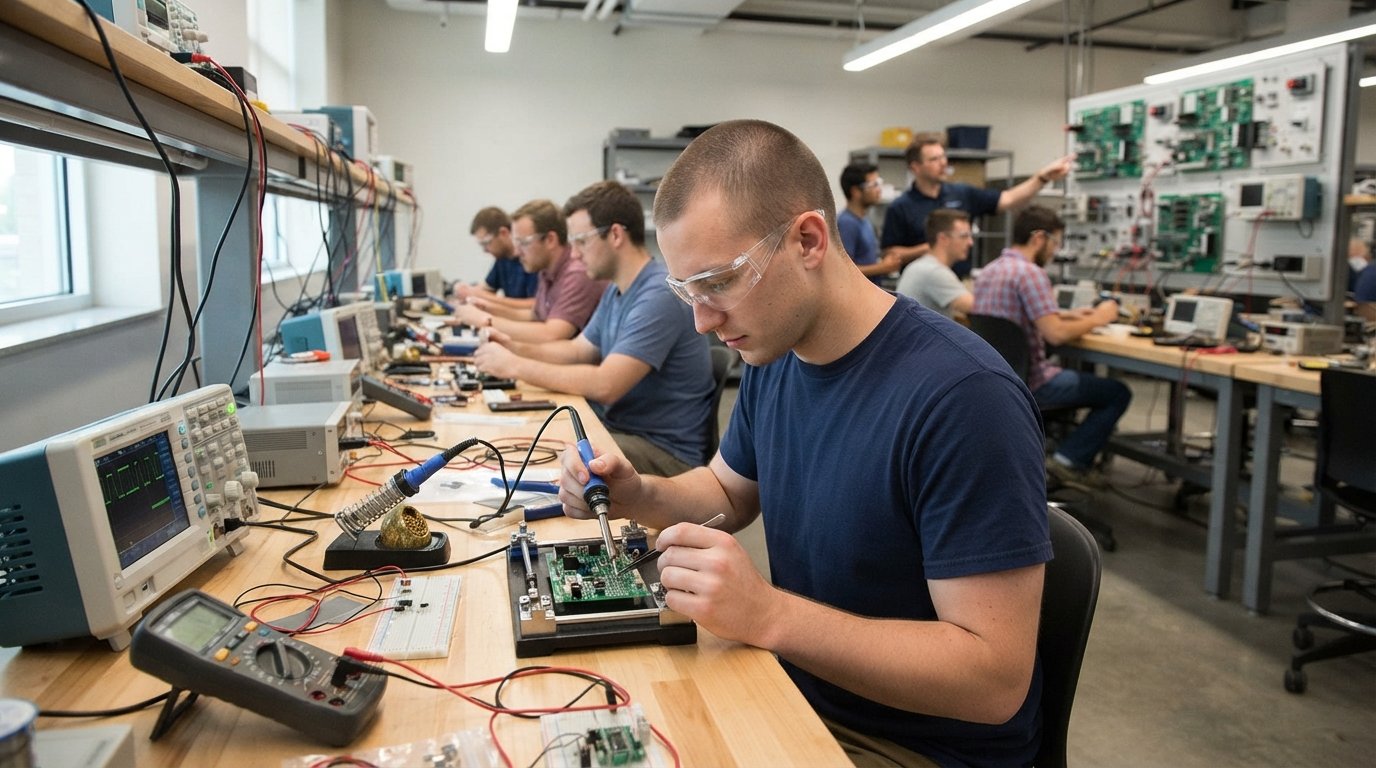
The Electrical, Electronic, and Communications Engineering Technology/Technician Associate's degree at Dutchess Community College is built around a simple idea: technicians need to understand both theory and application. Students learn how electrical circuits behave, how electronic components work together, and how communication signals travel through wires, fiber, and wireless networks. The curriculum typically includes courses in DC and AC circuits, digital electronics, microprocessors, telecommunications, and programmable logic controllers. Because the program is delivered in person, students spend significant time in labs, soldering components, using oscilloscopes, troubleshooting circuits, and building systems that mirror real workplace equipment.
Unlike a purely academic engineering transfer degree, this program leans toward applied technology. That means less abstract calculus and more practical problem-solving. You will still encounter math and physics, but they are taught in context. For example, when you study impedance matching, you do it while testing an actual antenna or transmission line. This hands-on approach helps students who learn by doing and who want to enter the workforce quickly. It also builds a foundation for those who later decide to pursue a bachelor's degree in engineering technology or a related field.
The degree usually takes two years of full-time study, though part-time options may exist. Because it is in person at Dutchess Community College, students benefit from face-to-face instruction, immediate feedback from professors, and access to campus labs and equipment. That structure can be especially valuable for first-generation college students or anyone who thrives with a consistent schedule and direct support.
Why Dutchess Community College Stands Out
Dutchess Community College, located in Poughkeepsie, New York, has a long history of serving students in the Hudson Valley. The college emphasizes affordable access, small class sizes, and transfer pathways. For a technical program like Electrical, Electronic, and Communications Engineering Technology/Technician, the in-person format is a major advantage. Employers in this field value candidates who have actually handled test equipment, diagnosed faults, and worked in teams to solve technical problems. Dutchess provides those experiences in a structured environment.
Another strength is cost. Community college tuition is significantly lower than four-year institutions, and Dutchess participates in federal and state financial aid programs. Students can often complete the associate's degree with minimal debt, especially if they qualify for grants or scholarships. For families comparing college costs, this program offers a strong return on investment. Graduates can enter the workforce sooner and start earning while their peers are still accumulating tuition bills.
Dutchess also maintains relationships with local employers and four-year schools. That means students can pursue internships, cooperative education, or transfer agreements. If you are exploring technology careers more broadly, you might also review our guide to the best IT degrees and schools to see how this program fits into the larger technology education landscape. The key point is that Dutchess offers a specific, hands-on credential that can lead directly to employment or serve as a stepping stone.
Admission Requirements and How to Apply
Admission to the Electrical, Electronic, and Communications Engineering Technology/Technician Associate's degree at Dutchess Community College is generally open to students with a high school diploma or equivalent. While competitive, the program is designed to be accessible. Prospective students should expect to submit an application, high school transcripts, and possibly placement test scores in math and English. Because the curriculum includes technical courses, strong preparation in algebra and basic physics is helpful, but developmental courses are available for those who need to brush up.
The application process typically follows a few clear steps. First, complete the online application and pay any required fee. Second, send official transcripts from all previous schools. Third, take placement exams or provide SAT/ACT scores if available. Fourth, meet with an academic advisor to plan your course sequence. Finally, register for classes and attend orientation. Because the program is in person, you will also want to confirm lab schedules and campus logistics.
Financial aid is a critical part of the planning process. Students should file the FAFSA as early as possible to qualify for federal grants, work-study, and loans. New York State residents may also be eligible for the Excelsior Scholarship or Tuition Assistance Program (TAP). Dutchess Community College has a financial aid office that can help you understand your options. For students searching for additional funding, external resources like Scholarship.Education provide databases and guidance on applying for scholarships worldwide. Combining institutional aid with outside scholarships can reduce out-of-pocket costs significantly.
Core Courses and Hands-On Skills You Will Build
The curriculum for this associate's degree is packed with technical content. While exact course titles may vary, most programs include a mix of electrical fundamentals, electronics, communications, and general education. You will learn to analyze circuits using Ohm's law and Kirchhoff's laws, understand semiconductor devices, and work with digital logic. Communications courses cover modulation, transmission lines, antennas, and networking basics. Many programs also include microprocessor programming and industrial controls.
Hands-on skills are the heart of the degree. In lab courses, you will:
- Construct and test DC and AC circuits using breadboards and multimeters
- Use oscilloscopes and signal generators to observe waveforms
- Solder and desolder components on printed circuit boards
- Program microcontrollers and troubleshoot embedded systems
- Set up and analyze basic communication links, including fiber optic and wireless
These skills are directly transferable to the workplace. Employers often say that technicians who can troubleshoot methodically and document their work are the most valuable. The lab environment at Dutchess simulates real-world conditions, so you graduate with confidence and a portfolio of practical experience.
General education courses round out the degree. You will take English composition, mathematics, and perhaps a social science or humanities elective. These courses strengthen communication and critical thinking, which are essential for advancing beyond entry-level roles. The balance between technical and general education ensures you are not just a button-pusher but a well-rounded technologist.
Career Outcomes and Salary Potential
Graduates with an Electrical, Electronic, and Communications Engineering Technology/Technician Associate's degree are prepared for a variety of job titles. Common roles include electrical engineering technician, electronics technician, communications technician, field service technician, and test technician. Industries that hire these graduates include telecommunications, manufacturing, utilities, aerospace, and medical device companies. Because the program is hands-on, employers know that graduates can contribute quickly.
Salary potential varies by region and industry. According to the U.S. Bureau of Labor Statistics, electrical and electronics engineering technicians earned a median annual wage of around $72,000 in recent years, with the highest 10 percent earning more than $100,000. Communications technicians may earn slightly less, but experienced technicians with specialized skills can command strong pay. In the Hudson Valley region, cost of living and demand influence wages, but the associate's degree provides a solid entry point.
Career advancement often comes through additional certifications or a bachelor's degree. Many technicians pursue vendor certifications in networking, fiber optics, or industrial automation. Others transfer to a four-year engineering technology program. Dutchess Community College has transfer agreements that make this transition smoother. Whether you want to work immediately or continue studying, the associate's degree opens doors.
Cost, Financial Aid, and Return on Investment
Affordability is a major reason students choose community college. Tuition at Dutchess Community College is a fraction of the cost of a private four-year school or even a public university. For New York residents, the savings are even greater. When you factor in living at home or working part-time, the total cost of the degree can be very manageable. Many students graduate with little or no debt.
Financial aid options include federal Pell Grants, New York TAP, Excelsior Scholarship, and institutional scholarships. The FAFSA is the key to accessing most of these. Dutchess also offers payment plans to spread costs over the semester. It is worth speaking with the financial aid office to explore every possibility. For a deeper dive into managing college costs, our article on IT degree pathways includes tips on evaluating return on investment for technology programs.
Return on investment for this degree is strong. With two years of study, you can enter a field with median salaries above the national average for associate's degree holders. The hands-on nature of the program means you are not just paying for credits; you are paying for skills that employers need. That combination of low cost and high demand makes the Electrical, Electronic, and Communications Engineering Technology/Technician Associate's degree at Dutchess a smart financial choice.
Is This Program Right for You?
This degree is ideal for people who like to understand how things work, enjoy fixing problems, and prefer learning in a structured, face-to-face environment. If you are a high school student who excels in math and science, a career changer looking for a stable technical job, or a veteran seeking civilian skills, this program can be a great fit. It is also a good option for students who want to enter the workforce quickly without sacrificing quality.
You should consider other options if you prefer fully online learning or if you want a broad liberal arts education. The in-person format at Dutchess is a strength for hands-on learning, but it does require campus attendance. If you need maximum flexibility, you might explore online technology degrees. However, for many students, the lab experience and face-to-face interaction are exactly what they need to succeed.
Before enrolling, visit the campus, meet with faculty, and talk to current students. Ask about job placement rates, internship opportunities, and transfer agreements. These conversations will help you decide if the program aligns with your goals. Dutchess Community College is proud of its technical programs, and the faculty are usually eager to share their insights.
Next Steps to Enroll
If you are ready to move forward, start by visiting the Dutchess Community College website and reviewing the specific requirements for the Electrical, Electronic, and Communications Engineering Technology/Technician Associate's degree. Request information, schedule a campus tour, and speak with an admissions counselor. Gather your transcripts and financial documents. File the FAFSA. Apply for scholarships, including those you find through Scholarship.Education. Then register for classes and prepare for an exciting two years of hands-on learning.
The demand for skilled engineering technicians continues to grow as technology becomes more integrated into every industry. By earning this associate's degree, you position yourself for a rewarding career with room for advancement. The combination of affordable tuition, in-person instruction, and practical skills makes Dutchess Community College a compelling choice. Take the first step today and build a future in electrical, electronic, and communications technology.