
ECPI Dental Assisting Associate Degree: 2-Year Path
The Dental Assisting/Assistant Associate's degree, usually 2 years In-person at ECPI University, blends labs and externships for a fast start in dental care.

By Lisa Bennett
If you are searching for a fast, hands-on route into health care, the Dental Assisting/Assistant Associate's degree, usually 2 years In-person at ECPI University deserves a close look. ECPI University offers this program at several campus locations, and it is designed for students who want to move into a dental office quickly while earning a credential that employers recognize. Unlike many online-only options, this program requires in-person attendance because dental assisting is a contact sport: you learn by working with instruments, models, and eventually patients under supervision.
This article breaks down what the degree covers, how long it takes, what it costs, how financial aid works, and how to decide whether ECPI is the right fit for your career goals. If you are a parent helping a student plan, a career changer leaving retail or hospitality, or a high school senior mapping out next steps, the details below will give you a realistic picture rather than a sales pitch.
What the ECPI Dental Assisting Associate's Degree Actually Covers
ECPI University's dental assisting program is a career-focused associate degree, not a general studies transfer degree. That distinction matters. The curriculum is built around the tasks a dental assistant performs daily: preparing treatment rooms, sterilizing instruments, taking and developing radiographs, assisting chairside during restorative procedures, managing patient records, and teaching patients basic oral hygiene. You will also study dental anatomy, infection control, pharmacology for dentistry, and practice management.
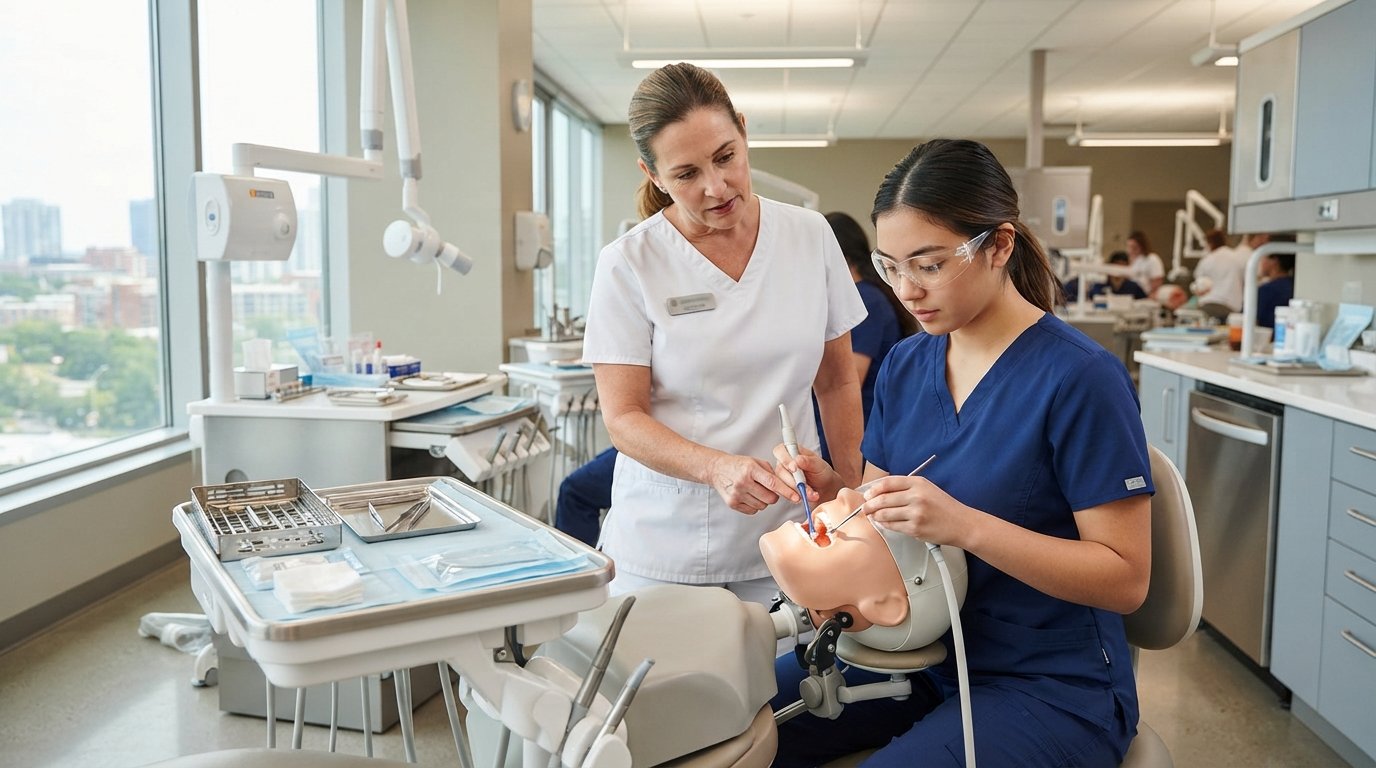
Because the program is delivered in person, students spend substantial time in labs and simulation environments before moving into clinical externships at dental offices. That hands-on component is a major selling point for employers, who generally prefer to hire assistants who have already handled real instruments and real patient interactions. Graduates are prepared to sit for recognized certification exams, including the Dental Assisting National Board (DANB) Certified Dental Assistant (CDA) credential, depending on state requirements.
It is worth noting what the degree is not. It does not make you a dental hygienist, and it does not qualify you for dental school. If your long-term goal is hygiene, you will need a separate associate or bachelor's program in dental hygiene. If your goal is dental school, you would follow a pre-dental science track. The ECPI program is best understood as a direct pathway into the assisting role, with the option to build on it later.
How Long It Takes and What the Schedule Looks Like
The keyword phrase says "usually 2 years," and that is an accurate framing. ECPI structures many of its health science programs on an accelerated calendar, so a motivated student who attends full time and passes every course may finish in roughly 18 to 24 months. Part-time attendance, course failures, or externship scheduling delays can extend that timeline. Always confirm the current schedule with an admissions representative, because program lengths shift as curricula are updated.
In-person attendance has practical implications beyond tuition. You need to plan for commuting, parking, and time away from work. Many ECPI students are working adults, so it helps to map out class blocks in advance and confirm whether evening or weekend sections exist at your chosen campus. Dental assisting programs also typically require immunizations, background checks, and CPR certification before externships, and those steps take time to complete.
Here is a realistic look at the main phases you will move through:
- Admissions and pre-enrollment: application, transcripts, financial aid paperwork, and campus visit.
- General education and foundational courses: anatomy, microbiology, communication, and introductory dental science.
- Clinical and lab coursework: chairside procedures, radiography, sterilization, and materials handling.
- Externship: supervised placement in a dental practice or clinic, often the bridge to a first job offer.
That externship deserves special attention. It is frequently where students get hired, because the practice already knows your work habits. Treat it as an extended interview, not a checkbox.
ECPI University Accreditation and What It Means for You
Before enrolling in any dental program, verify accreditation. ECPI University is regionally accredited, which matters for federal financial aid eligibility and for transferring credits to other institutions. Separately, dental assisting programs may hold programmatic accreditation through the Commission on Dental Accreditation (CODA). Programmatic accreditation signals that the curriculum meets national standards for dental assisting education.
Ask admissions directly which accreditations apply to the specific campus and program you are considering, and confirm the status on the accreditor's website rather than relying on a brochure. Accreditation affects whether your credits transfer, whether you can sit for certain exams, and how employers view your credential. It is one of the few questions where a little skepticism pays off.
If you are comparing multiple programs, our breakdown of an accounting associate degree at Diablo Valley College shows how to evaluate a two-year program's structure, transfer options, and cost profile, and the same checklist applies here.
Tuition, Fees, and the Real Cost of Attendance
ECPI University is a private institution, so tuition runs higher than at a public community college. The sticker price also does not capture the full cost. Dental assisting students typically pay for uniforms, clinical supplies, background checks, immunizations, certification exam fees, and transportation to externships. Those add-ons can total several hundred to a few thousand dollars over the program.
The honest comparison is not "ECPI versus nothing." It is "ECPI versus a public community college dental assisting program versus an online diploma mill." Community college programs are often far cheaper, but they can be impacted, with long waitlists for clinical slots. ECPI's pitch is speed and structure: a defined schedule, in-person labs, and externship placement support. Whether that is worth the premium depends on your timeline and how quickly you need to start earning.
Before you commit, request a written cost breakdown that includes:
- Tuition per credit and total program tuition
- Lab, technology, and campus fees
- Estimated supply and uniform costs
- Certification exam and background check fees
- Any required tools or equipment you must buy personally
With that number in hand, you can compare financing options realistically instead of guessing. For students exploring degree pathways more broadly, platforms such as CollegeDegree.Education connect prospective students with accredited colleges and programs, which can help you benchmark ECPI against alternatives in your region.
Financial Aid, Scholarships, and Paying for the Program
Because ECPI is regionally accredited, students who qualify can use federal student aid, including Pell Grants and Direct Loans. The Free Application for Federal Student Aid (FAFSA) is the starting point; file it early, because some aid is first come, first served. ECPI also maintains its own scholarship and grant programs, and admissions staff can walk you through institutional aid options.
Outside scholarships for dental assisting are less plentiful than for nursing, but they exist. Look at state dental association foundations, local dental societies, and community organizations. Employer tuition assistance is another underused option: if you already work in a dental office as a front-desk staffer or sterilization technician, ask whether your practice will contribute.
Be careful with private loans. They often carry variable interest rates and lack the income-driven repayment protections of federal loans. If you must borrow, exhaust federal aid first and borrow only what covers tuition and essential living costs. A dental assisting salary is solid but not enormous, so keeping debt modest protects your long-term budget.
Career Outcomes: What Dental Assistants Earn and Where They Work
Dental assistants work in private general dentistry practices, specialty offices (orthodontics, oral surgery, endodontics), community health clinics, and public health programs. The Bureau of Labor Statistics projects steady demand for dental assistants over the next decade, driven by an aging population and growing awareness of oral health's connection to overall health. Employment is not recession-proof, but it is less cyclical than many fields because routine care continues even in downturns.
Pay varies widely by state and setting. New graduates typically start at the lower end of the range and move up with certification, experience, and expanded duties allowed under state law. Some states permit assistants to perform additional functions, such as coronal polishing or sealant application, after extra training, which can increase earning potential.
Career mobility is a real advantage of this credential. Assistants can move into office management, dental sales, insurance claims processing, or teaching in dental assisting programs. Some use the role as a stepping stone toward hygiene or dental school. The degree is a platform, not a dead end.
Is In-Person Learning at ECPI the Right Fit for You?
In-person training is a feature, not a bug, for dental assisting. You cannot learn to hold a suction device or take a diagnostic radiograph through a video lecture. The question is whether ECPI's specific campus, schedule, and price fit your life.
Consider ECPI seriously if you want a structured, accelerated path with labs and externship support, you live near a campus with the program, and you are prepared to commit to full-time study for roughly two years. Look elsewhere, or at least compare carefully, if cost is your dominant concern and a local community college has open clinical slots, if you need maximum schedule flexibility, or if you are unsure whether dental assisting is right for you. In that last case, shadowing a dental office for a week costs nothing and tells you more than any brochure.
Whatever you decide, verify the details directly with the school: current tuition, accreditation status, externship placement rates, and graduation outcomes. A two-year associate degree is a significant investment of time and money, and the best decision is an informed one. With clear numbers and a realistic schedule in hand, you can choose the path that actually fits your career and your budget.