
EFSC CNC Machinist Certificate: 12-Week Career Path
The CNC Machinist Certificate at Eastern Florida State College takes 12 weeks to under a year, blending online and in-person training for quick entry into manufacturing.

Manufacturing careers are back in demand, and skilled machinists are at the center of that resurgence. If you want to move quickly from training to a paycheck, the Computer Numerically Controlled (CNC) Machinist Technology/CNC Machinist Certificate at Eastern Florida State College offers a focused path: 12 weeks to less than 1 year, with a mix of in-person and online coursework. This program is designed for people who want hands-on skills without committing to a full degree. In this guide, we break down what the certificate covers, how the hybrid format works, what it costs, and how it can position you for entry-level roles in aerospace, medical device manufacturing, and other precision industries.
What Is the CNC Machinist Certificate at Eastern Florida State College?
The CNC Machinist Certificate at Eastern Florida State College (EFSC) is a short-term workforce credential. It falls under the broader Computer Numerically Controlled (CNC) Machinist Technology umbrella, which includes both certificate and associate degree options. The certificate is built for students who need practical, job-ready skills in a compressed timeframe. Instead of spending two years on general education requirements, you focus almost entirely on machining theory, blueprint reading, precision measurement, and CNC programming and operation.
EFSC is a public state college in Brevard County, Florida, with campuses in Cocoa, Melbourne, Palm Bay, and Titusville. The college has strong ties to the local aerospace and defense industry, and its machining programs reflect that. The certificate is part of the college's career and technical education offerings, which are designed to align with regional employer needs. That means the curriculum is reviewed with input from local manufacturers, so what you learn in class maps directly to what shops are hiring for.
The program length is one of its biggest selling points. The 12 weeks to less than 1 year window means you can finish a credential in as little as one semester, depending on course availability and whether you attend full time. For adults balancing work or family obligations, that flexibility matters. You are not signing up for a multi-year commitment; you are signing up for a concentrated skill-building sprint that can lead to employment relatively quickly.
How the Hybrid Format Works: In-Person and Online
The mix of in-person and online instruction is a practical response to how modern training programs operate. CNC machining is inherently hands-on: you cannot learn to set up a lathe or mill by watching videos alone. But not every component of the curriculum requires your physical presence in a lab. EFSC splits the program so that foundational knowledge is delivered online, while hands-on practice happens on campus in equipped machine shops.
Online coursework typically covers topics like safety fundamentals, blueprint reading, geometric dimensioning and tolerancing, machining math, and introductory CNC programming concepts. These are areas where lectures, readings, and interactive assignments work well in a digital format. You can complete them on a schedule that fits your life, which is especially useful if you are commuting or working part time.
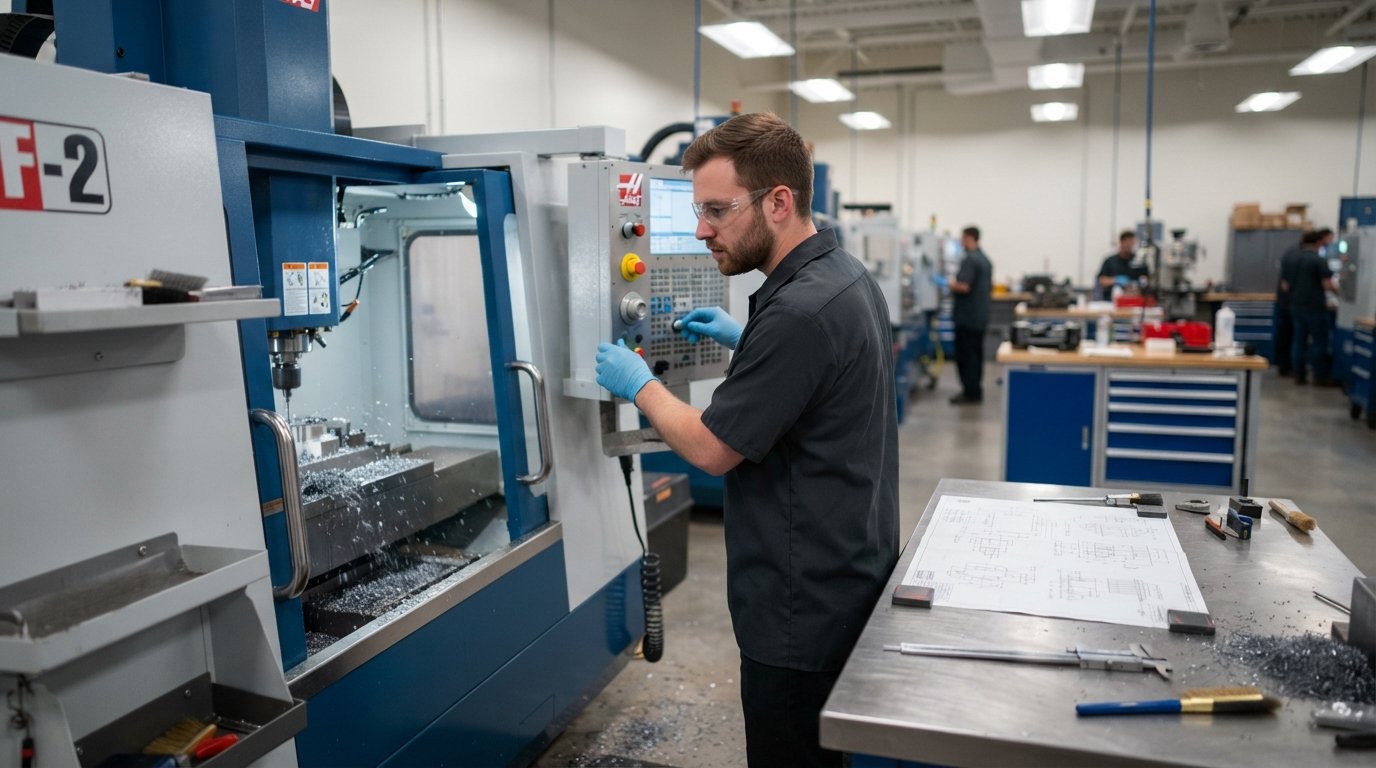
In-person sessions focus on what you cannot replicate remotely: operating manual lathes and mills, setting up CNC machines, measuring parts to tolerances, and troubleshooting programs at the control panel. You work with real tools and real materials, and you get immediate feedback from instructors who have industry experience. This hybrid structure is increasingly common in technical education because it balances flexibility with the rigor of hands-on practice.
For students comparing programs, it is worth noting that the in-person component means you need to be near an EFSC campus or able to travel to one. The college's locations in Brevard County are convenient for residents of Melbourne, Palm Bay, Cocoa, and Titusville, but if you live farther away, you should factor commute time into your decision. The online portion reduces the number of days you need to be on campus, but it does not eliminate them entirely.
What You Will Learn: Core Skills and Curriculum
The curriculum for the CNC Machinist Certificate is built around the competencies employers expect from entry-level machinists. While specific course titles and sequencing can change, the core skill set is consistent across EFSC's machining programs. You will learn to read and interpret engineering drawings, including GD&T symbols, which are critical for producing parts that meet specifications. You will also learn precision measurement using calipers, micrometers, and other instruments, because machining is as much about verification as it is about cutting metal.
On the manual side, you will operate lathes and milling machines to understand the fundamentals of material removal. These skills form the foundation for CNC work, where the same principles apply but are executed through programmed instructions. You will learn to write and edit G-code, set up work offsets and tool lengths, and run parts on CNC mills and lathes. Safety is woven throughout, because machine shops are environments where attention to detail is not optional.
Here is a look at the core skill areas the certificate typically covers:
- Blueprint reading and geometric dimensioning and tolerancing (GD&T)
- Precision measurement and quality inspection
- Manual lathe and milling machine operations
- CNC programming (G-code) and machine setup
- Shop safety and preventive maintenance basics
Beyond the technical skills, the program emphasizes workplace habits that employers value: punctuality, documentation, and the ability to work from a process plan. In a shop environment, a machinist who can read a traveler, follow setup sheets, and communicate clearly about tolerances is more valuable than one who only knows how to push buttons. The certificate aims to produce that kind of worker.
If you are considering further education, the certificate can also stack into EFSC's CNC Machinist Technology associate degree or other advanced manufacturing credentials. That makes it a low-risk entry point: you can start with the certificate, get a job, and return for more training later if you want to move into programming, quality control, or supervision.
Admissions, Costs, and Financial Aid
Admission to the CNC Machinist Certificate at EFSC is generally open to students who meet the college's basic requirements for career and technical programs. That usually means a high school diploma or equivalent, completion of placement testing or exemption criteria, and submission of an application to the college. Because it is a workforce certificate, it does not carry the same selective admission hurdles as competitive degree programs. The goal is to make training accessible to people who are ready to learn a trade.
Cost is a major consideration for any short-term program, and EFSC's status as a public institution helps keep tuition relatively affordable compared with private trade schools. Florida residents pay lower in-state rates, and there may be additional fees for lab supplies, tools, or certification exams. Prospective students should check the college's current catalog for exact tuition and fee figures, because these change over time. It is also worth asking about tool kits or personal protective equipment requirements, since those can add to the total cost.
Financial aid options may include federal grants, state workforce grants, and scholarships targeted at career and technical education students. EFSC's financial aid office can help you determine eligibility for Pell Grants, Florida Bright Futures (for eligible students), and other programs. Some students qualify for workforce development funding through local agencies, especially if they are transitioning from another industry or are unemployed. The key is to apply early and ask specific questions about what the certificate program qualifies for.
For a broader look at how private college costs can vary by location, see our guide on private college rates in St. George Utah. While that article focuses on a different region and institution type, it illustrates why comparing published tuition with actual net cost is essential. The same principle applies here: the sticker price of a certificate program is only part of the story. Ask about total program cost, including fees and tools, and compare that with the starting wages in your local job market.
Time Commitment and Scheduling
The 12 weeks to less than 1 year timeframe is flexible by design, but it requires planning. If you attend full time and courses are available in the sequence you need, you can finish in one semester. If you are working full time or have family obligations, you might spread the coursework over two semesters, which still keeps you within the less-than-one-year window. The hybrid format helps here because online components can be completed during evenings or weekends, while in-person lab sessions are scheduled on specific days.
It is important to be realistic about the time commitment. Machining labs are not self-paced in the same way as online lectures; you need to be present for demonstrations, supervised practice, and safety briefings. Missing a lab session can set you back, especially in a compressed schedule. Prospective students should review the course schedule carefully and speak with an advisor about how the program fits their availability. The college's academic advisors can map out a plan that accounts for work and family responsibilities.
Another scheduling consideration is tool and material access. Some programs allow open lab hours for practice, while others rely on scheduled class time only. EFSC's machining labs are equipped for the courses offered, but you should ask about extra practice time if you feel you need it. The more hands-on time you get, the more comfortable you will be with setups and operations, which directly affects your employability.
Career Outcomes and Job Outlook for CNC Machinists
CNC machinists are employed in a wide range of industries, including aerospace, medical devices, automotive, defense, and general manufacturing. In Florida, and particularly in Brevard County, the aerospace and defense sectors are significant employers. Companies that manufacture precision components for aircraft, spacecraft, and medical equipment rely on machinists who can hold tight tolerances and work from complex drawings. The certificate is designed to prepare you for entry-level roles such as CNC operator, machine operator, or entry-level machinist.
According to the U.S. Bureau of Labor Statistics, employment of machinists and tool and die makers is projected to remain steady, with demand driven by the need to replace retiring workers and by growth in precision manufacturing. Pay varies by region and industry, but entry-level machinists typically earn a living wage with opportunities for overtime and advancement. As you gain experience and additional skills, such as CAD/CAM programming or quality inspection, your earning potential increases.
Career planning resources can help you understand the broader landscape of manufacturing jobs and how to position yourself for them. For general career exploration, Careers.org offers profiles of occupations, including the training and education paths that lead to them. It is a useful complement to the program-specific information you get from EFSC, because it helps you see how a certificate fits into a longer career trajectory.
It is also worth noting that the certificate is not a dead end. Many machinists continue their education part time while working, pursuing associate degrees or certifications in CNC programming, quality assurance, or manufacturing management. Employers sometimes offer tuition assistance, which can make further education more affordable. The key is to treat the certificate as a foundation, not a final destination.
Why Choose Eastern Florida State College?
EFSC offers several advantages for students seeking CNC training. First, it is a public institution with a track record in workforce education. Its programs are accredited, and its machining curriculum is aligned with industry standards. Second, the college's location in Brevard County puts it near a concentration of advanced manufacturing employers, which can help with job placement and internships. Third, the hybrid format provides flexibility without sacrificing hands-on learning.
The college also provides support services that matter for adult learners: academic advising, financial aid counseling, and career services. These resources can help you navigate the enrollment process and connect with employers. For students who are unsure about the program, EFSC offers information sessions and campus tours, which are a good way to see the labs and meet instructors before committing.
Compared with for-profit trade schools, EFSC's tuition is generally lower, and its credits are more likely to transfer if you decide to pursue further education. That matters if you want to keep your options open. The certificate is a credential in its own right, but it can also serve as a stepping stone to an associate degree or additional certifications.
How to Enroll: Steps to Get Started
Enrolling in the CNC Machinist Certificate program involves several steps, and starting early helps ensure you get a seat in the courses you need. The process is straightforward, but it does require attention to deadlines and paperwork. Here is a general sequence to follow:
- Apply to Eastern Florida State College and obtain a student ID.
- Submit official transcripts and complete any required placement testing.
- Meet with an academic advisor to review the certificate requirements and plan your schedule.
- Complete the Free Application for Federal Student Aid (FAFSA) to determine financial aid eligibility.
- Register for classes and pay tuition and fees by the deadline.
After these steps, you will need to attend orientation and obtain any required safety equipment or tools. The college will provide a list of what you need before the first lab session. It is also a good idea to connect with the program's faculty advisor, who can answer questions about course content and expectations.
One practical tip: apply for financial aid even if you think you will not qualify. Many students are surprised by what they are eligible for, and the FAFSA is also used for some scholarships and workforce grants. The earlier you file, the better your chances of receiving funds before the semester starts.
Comparing Your Options: Certificate vs. Degree
The CNC Machinist Certificate is one of several pathways into manufacturing. A related option is the associate degree in CNC Machinist Technology, which includes general education courses and more advanced technical training. The certificate is faster and more focused, while the degree provides a broader foundation and may open doors to supervisory or engineering technician roles. Which one is right for you depends on your goals and timeline.
If your priority is getting a job quickly, the certificate is the more direct route. If you want more long-term flexibility, the degree may be worth the extra time. Some students start with the certificate, work for a while, and then return for the degree with employer support. That approach can reduce the financial burden and give you practical context for advanced coursework.
It is also worth comparing EFSC's program with other options in Florida. Private trade schools may offer similar training, but costs can be higher and credits may not transfer. Community and state colleges generally offer better value, especially for residents. The hybrid format at EFSC is another differentiator, because it allows you to keep working while you train.
Final Thoughts
The Computer Numerically Controlled (CNC) Machinist Technology/CNC Machinist Certificate at Eastern Florida State College is a practical, time-efficient way to enter a skilled trade. With a 12 weeks to less than 1 year completion window and a mix of in-person and online instruction, it is designed for people who need flexibility without compromising hands-on training. The program's alignment with local industry and its affordability as a public college make it a strong option for career changers and new students alike. If you are ready to invest a few months in a skill that can lead to a stable career, this certificate is worth a close look. Visit EFSC's website or speak with an advisor to confirm current details and start your application.