
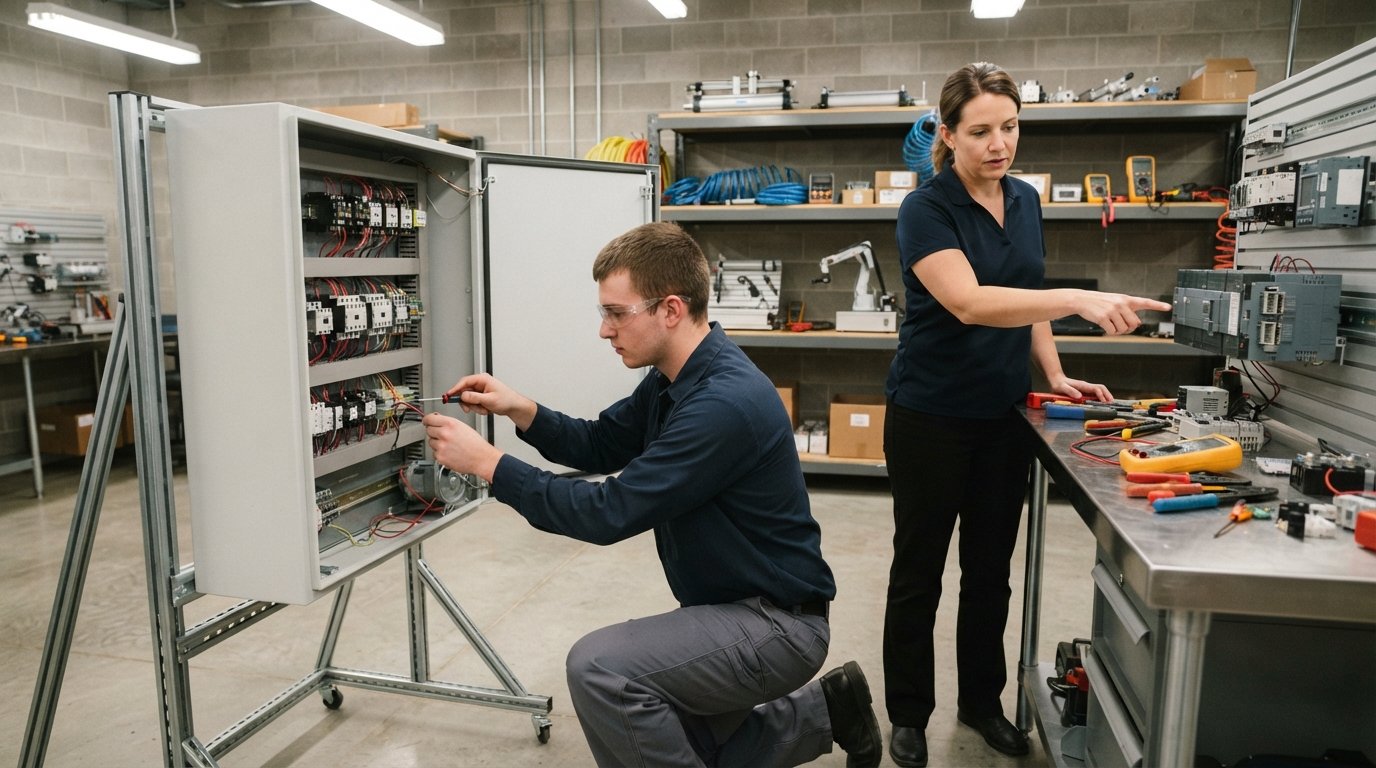
Electromechanical Associate's Degree at Fayetteville Tech
Earn an Electromechanical Technologies/Technicians, Other Associate's degree, usually 2 years In-person at Fayetteville Technical Community College. Call 8772187081 for guidance.

By Sophia Clark
Electromechanical technicians keep the machines that power modern industry running, from automated assembly lines to robotic packaging systems. If you are searching for a hands-on, two-year path into a stable and well-paid technical career, the Electromechanical Technologies/Technicians, Other Associate's degree, usually 2 years In-person at Fayetteville Technical Community College, offers one of the most direct routes available in North Carolina. This program blends electrical theory, mechanical systems, and computer controls into a single practical credential that employers actively recruit for.
What makes this option stand out is its format. The program is delivered in person, which means you spend real time in labs wiring motor controls, troubleshooting pneumatic circuits, and programming programmable logic controllers (PLCs). That face-to-face instruction matters in a field where muscle memory and diagnostic instinct are built through repetition. Fayetteville Technical Community College (FTCC) has built its reputation on workforce training, and this degree sits squarely at the center of that mission.
What Is an Electromechanical Technologies/Technicians, Other Associate's Degree?
The word "Other" in the official program title signals that this credential does not fit neatly into a single traditional category. Instead, it is an interdisciplinary degree that pulls from electrical engineering technology, mechanical engineering technology, and industrial automation. Students learn how these systems interact, because in a real plant, a jammed conveyor is rarely just a mechanical problem. It might be a sensor failure, a wiring fault, a logic error, or all three at once.
Over four semesters, the curriculum typically moves from foundations to specialization. Early courses cover DC and AC circuits, industrial safety, print reading, and basic machining or mechanical drives. Later courses dive into motor controls, hydraulics and pneumatics, robotics, and advanced PLC programming. General education courses in math, communication, and computer applications round out the degree so graduates can read technical documentation, write clear maintenance reports, and work effectively on teams.
This structure is what separates an associate's degree from a short certificate. A certificate can teach you one narrow skill, but an associate's degree builds a framework you can grow into for years. When equipment changes, and it always does, graduates with broad fundamentals adapt faster than those trained on a single machine model.
Why Fayetteville Technical Community College Is a Strong Fit
FTCC serves the greater Fayetteville and Fort Bragg region, an area with a dense concentration of manufacturing, food processing, pharmaceutical production, and defense-related industries. That local economy creates steady demand for technicians who can install, maintain, and repair automated equipment. The college's programs are designed with input from regional employers, which is why graduates often step into maintenance and controls roles without lengthy on-the-job ramp-up periods.
The in-person requirement is a feature, not a limitation. Lab access gives students time on real industrial hardware: motor starters, variable frequency drives, sensor arrays, and training rigs that mimic production environments. Many students also benefit from internship or apprenticeship connections that FTCC maintains with area companies. These relationships frequently turn into job offers before graduation.
For students comparing options, it helps to understand how technical colleges differ from other training providers. Our guide on technical colleges vs technical schools explains how accreditation, transferability, and employer recognition vary between institution types, a useful filter when you are weighing programs in this field.
Admission Requirements and How to Apply
Admission to the Electromechanical Technologies/Technicians, Other Associate's degree, usually 2 years In-person at Fayetteville Technical Community College, follows the college's standard associate degree pathway. Applicants generally need a high school diploma or equivalent, and placement testing in math and English helps advisors slot students into the right starting courses. Students who need developmental math can still finish on time by starting in summer or by taking accelerated refresher sections.
The application process itself is straightforward. Most students complete it in a few steps:
- Submit the FTCC online application and pay any required fee (fee waivers are often available).
- Request official transcripts from your high school and any prior colleges.
- Complete placement testing or submit qualifying ACT, SAT, or prior college coursework.
- Meet with an academic advisor in the engineering and trades division to map your course sequence.
- Apply for financial aid by completing the FAFSA and explore scholarship options.
Because the program is in person and lab sections have limited seats, applying early matters. Fall, spring, and summer start terms are typically available, but popular lab courses fill quickly. Advisors can also help you decide whether to pursue the full associate's degree or stack credentials by earning a certificate first and continuing toward the degree later.
Cost, Financial Aid, and Return on Investment
Community college tuition in North Carolina is among the most affordable in the country, and FTCC is no exception. For in-state students, the total cost of this two-year degree is often a fraction of what a single year at a four-year university would cost. Books, tools, and lab fees add some expense, but many of these items double as starter equipment you will use on the job.
Financial aid options are broad. Federal Pell Grants, state grants, and the FAFSA-based aid process cover much of the cost for qualifying students. Scholarships specifically targeted at trade and technology students are also common, and resources like Scholarship.Education maintain searchable databases that help students find awards by field of study, state, and background. Employer tuition assistance is another underused path: many manufacturers will reimburse part or all of your tuition if you work part time while enrolled.
From a return-on-investment standpoint, the math is compelling. Graduates of electromechanical programs frequently start in the $40,000 to $55,000 range, with experienced technicians and controls specialists earning well above that. When you compare two years of modest tuition against those starting salaries, the payback period is short. That is a key reason this degree appears on many lists of high-value technical credentials.
Career Outcomes and Job Outlook
Electromechanical technicians work in nearly every industry that touches physical production: automotive, aerospace, food and beverage, pharmaceuticals, textiles, energy, and defense contracting. Job titles vary, and that variety is a strength because it gives graduates multiple doors to walk through.
Common roles include:
- Industrial maintenance technician
- Electromechanical technician
- Controls or automation technician
- Field service technician
- Manufacturing equipment specialist
The Bureau of Labor Statistics projects steady demand for industrial machinery mechanics and maintenance workers over the coming decade, driven partly by retirements in an aging workforce and partly by automation adoption. Companies are installing more sensors, robots, and networked controls, and every one of those systems needs people who can keep it running. That combination of retirements plus automation is why many employers report difficulty filling technician roles, which translates into leverage for graduates.
Advancement paths are clear. Technicians can move into lead maintenance roles, controls engineering support, plant supervision, or field service positions with higher pay and travel. Some graduates eventually pursue a bachelor's degree in engineering technology, often with employer tuition support, to move into design or management.
Online vs In-Person: Why the Format Matters Here
Many degree programs have moved online, and for subjects like business or general education, that shift works well. Electromechanical training is different. You cannot learn to safely wire a three-phase motor starter by watching a video. You need to hold the meter, torque the terminals, and see how a miswired circuit behaves before it matters in a live plant.
That is why this program is delivered in person, with substantial lab hours built into the schedule. If you are comparing this option with fully online technical degrees, be honest about what you need. Online programs can supplement theory, but hands-on credential programs give employers evidence that you have already worked with the equipment they use. If flexibility is your priority, some hybrid options exist in related fields, but for pure electromechanical training, the in-person format at FTCC remains the stronger choice for most students.
Tips for Success in the Program
Students who thrive in this degree tend to share a few habits. They show up to lab prepared, they ask questions when a concept does not click, and they treat safety as a discipline rather than a formality. The workload is manageable, but it is not trivial. Expect a mix of lecture, hands-on practice, and homework that reinforces both.
A few practical moves can make the two years smoother:
- Build a relationship with one instructor early; mentorship matters in technical fields.
- Join or form a study group for math and circuits courses, which are the usual stumbling blocks.
- Keep a personal notebook of wiring diagrams and troubleshooting steps you encounter in lab.
- Pursue a part-time job or internship in maintenance while enrolled, even if it starts in a helper role.
- Stack short-term certificates along the way so you have credentials to show employers before graduation.
These steps cost little but compound over time. By the time you graduate, you will have a portfolio of practical experience, professional references, and a credential that employers recognize.
Is This Degree Right for You?
The Electromechanical Technologies/Technicians, Other Associate's degree, usually 2 years In-person at Fayetteville Technical Community College, suits people who like solving physical problems, working with their hands, and seeing immediate results. If you enjoy figuring out why something stopped working and then making it run again, this field rewards that instinct with steady demand and solid pay.
It is also a smart choice for career changers. Many students enter the program after years in jobs that offered little advancement, and they graduate into roles with clear ladders and portable skills. Military veterans and transitioning service members in the Fayetteville area frequently find this program aligns well with their technical backgrounds and benefits.
Before committing, visit the campus, tour the labs, and talk with an advisor about your goals. Ask about job placement rates, employer partnerships, and transfer options if you might pursue a bachelor's degree later. A short conversation can clarify whether the in-person format fits your schedule and whether the career outcomes match your expectations.
Two years of focused, hands-on training can change the trajectory of a career. For students in and around Fayetteville who want a practical, affordable, and employer-valued credential, this program deserves a serious look. Compare it against other options, run the numbers on cost and salary, and make the decision that fits your life.