
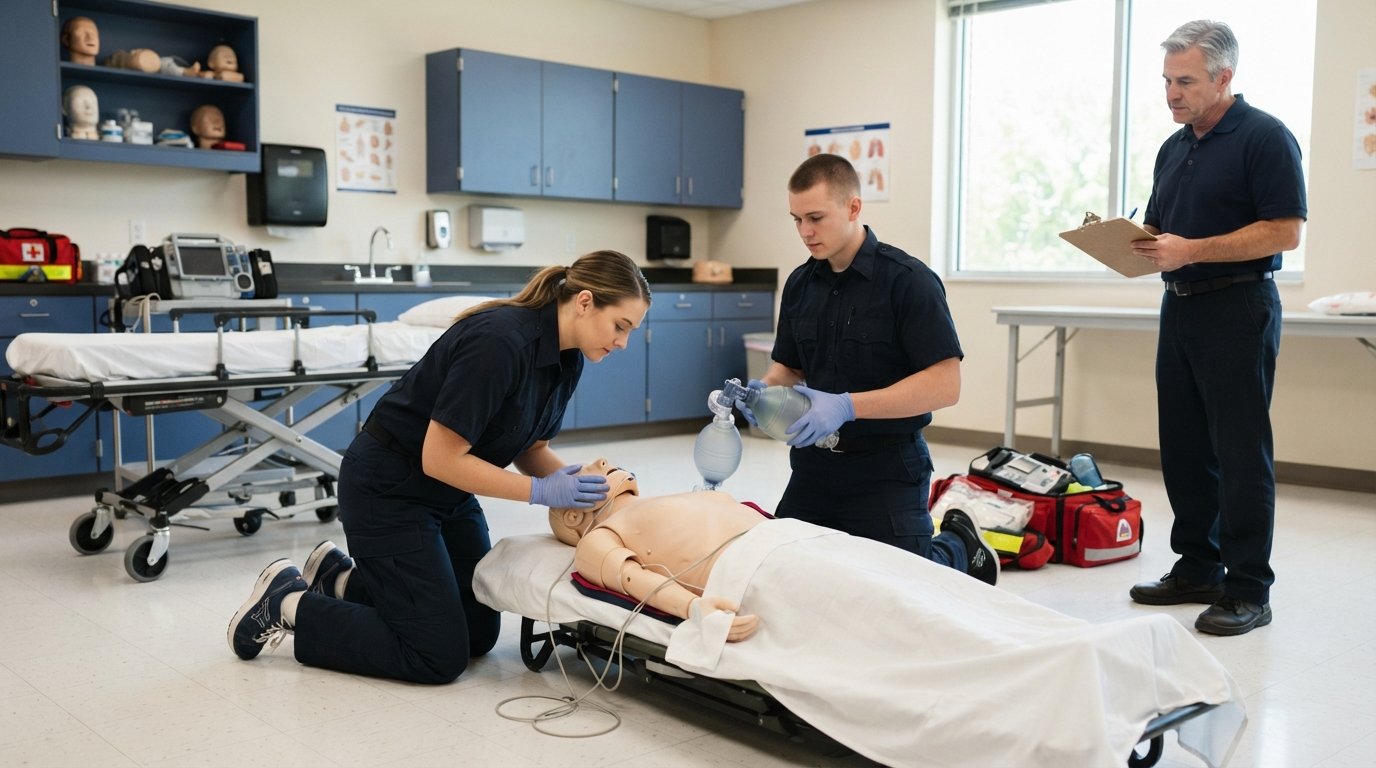
EMT Paramedic Certificate at College of the Mainland
The EMT Paramedic Certificate at College of the Mainland takes 12 weeks to under a year in person, preparing you for NREMT exams and fast entry into emergency medical services.

By Sarah Thompson
When a cardiac arrest, a highway collision, or a diabetic emergency happens, the first trained professional on scene is often an EMT or paramedic. If you are looking for a fast, affordable, and hands-on route into emergency medicine, the Emergency Medical Technology/Technician (EMT Paramedic) Certificate, 12 weeks to less than 1 year In-person at College of the Mainland offers one of the quickest paths from zero experience to a credentialed role on an ambulance or in an emergency department. The program is built for students who want to start working sooner rather than later, and it delivers the clinical hours, skills labs, and exam preparation that Texas employers expect.
College of the Mainland, located in Texas City, Texas, has trained EMS professionals for decades. Its emergency medical technology track is approved by the Texas Department of State Health Services and prepares graduates for the National Registry of Emergency Medical Technicians (NREMT) exams. Because the certificate can be completed in as little as 12 weeks at the EMT level and under a year for advanced credentials, it is a practical choice for career changers, recent high school graduates, and working adults who need to keep their total education costs low.
What the EMT Paramedic Certificate Covers
The certificate pathway at College of the Mainland is structured in stacked credentials. Most students begin with the Emergency Medical Technician (EMT) level, which is the entry point into the field. This first stage typically runs about 12 weeks and covers patient assessment, airway management, CPR, bleeding control, splinting, emergency childbirth, and safe ambulance operations. After passing the EMT course and the NREMT cognitive and psychomotor exams, you can work on a basic life support (BLS) unit while continuing your education.
The advanced stages build on that foundation. The Advanced Emergency Medical Technician (AEMT) level adds IV therapy, advanced airway devices, and expanded medication administration. The Paramedic level is the most comprehensive and includes cardiac monitoring, 12-lead interpretation, pharmacology, endotracheal intubation, and complex trauma management. Across the full certificate, students complete classroom instruction, skills laboratory practice, hospital clinical rotations, and field internships with local EMS agencies.
Because the program is in-person, students get direct feedback from instructors who have worked in the field. Skills like intubation, defibrillation, and medication dosing cannot be mastered through a screen alone, and the hands-on format ensures you log the patient contacts and procedures required for certification. Expect a mix of lecture, simulation, and real-world rotations, with schedules that may include evenings and weekends to accommodate working students.
Admission Requirements and How to Apply
Admission to the emergency medical technology program at College of the Mainland is selective but straightforward. You must first apply to the college and complete any required placement testing. Most applicants also need to submit proof of immunizations, a clear criminal background check, a drug screen, and current CPR certification at the healthcare provider level. Some clinical sites require additional health insurance documentation and a physical exam.
Before you register for the first EMT course, confirm that you meet these baseline requirements:
- High school diploma or GED
- College application and admission to College of the Mainland
- Texas Success Initiative (TSI) assessment or approved exemption
- Current American Heart Association BLS provider card
- Completed health and safety compliance packet for clinical placement
Once admitted, students typically meet with an advisor to map out the sequence of courses. Because the certificate is cohort-based, seats fill quickly, and missing a registration window can delay your start by a full semester. Advisors also help you decide whether to stop at the EMT level or continue through AEMT and Paramedic, depending on your career goals and how much time you can commit.
One cost-saving step many students overlook is outside scholarship funding. National databases such as Scholarship.Education aggregate awards for healthcare and public safety students, and applying before your program starts can reduce or eliminate out-of-pocket tuition. Pairing those awards with federal financial aid and Texas workforce grants is often the difference between graduating debt-free and carrying a loan balance.
Cost, Financial Aid, and Value
Cost is one of the strongest arguments for choosing a community college certificate over a private academy. At College of the Mainland, tuition is charged per credit hour at in-district rates for local residents, with higher rates for out-of-district and international students. Beyond tuition, budget for uniforms, stethoscope, trauma shears, immunizations, background checks, NREMT exam fees, and licensing costs. These ancillary expenses can add several hundred dollars, so plan for them early.
Financial aid options for this program include:
- Federal Pell Grants and Supplemental Educational Opportunity Grants
- Texas Public Educational Grants and workforce development funds
- Institutional scholarships from the College of the Mainland Foundation
- Employer tuition reimbursement if you already work in healthcare or public safety
- Private scholarships for EMS, fire science, and allied health students
Compared with a four-year degree, the return on investment is fast. EMTs and paramedics in Texas earn competitive hourly wages, and many agencies offer shift differentials, overtime, and education incentives. Because you can enter the workforce in under a year, you can begin earning and gaining seniority while your peers are still in school. That early income often offsets the entire cost of the certificate within the first year of employment.
Career Outcomes and Advancement
Graduates of the program work in a range of settings. The most common is 911 ambulance service, but EMTs and paramedics also staff emergency departments, urgent care centers, industrial sites, oil and gas operations, theme parks, and special events. Some move into fire service, where dual certification as a firefighter and paramedic significantly boosts hiring potential and pay.
Advancement usually follows one of three tracks. The first is clinical: paramedic to critical care paramedic, flight paramedic, or community paramedic. The second is supervisory: field training officer, shift supervisor, operations manager, or EMS chief. The third is educational: instructor, clinical coordinator, or program director, which often requires additional credentials and sometimes a degree. Many paramedics eventually bridge to registered nursing, physician assistant, or medical school, using their field experience as a foundation.
Because the certificate is stackable, you do not have to decide everything upfront. You can earn the EMT credential, work for a semester, and then return for AEMT or Paramedic training when your schedule and finances allow. That flexibility is one reason community college EMS programs attract so many nontraditional students.
Is This Program Right for You?
The Emergency Medical Technology/Technician (EMT Paramedic) Certificate, 12 weeks to less than 1 year In-person at College of the Mainland suits people who learn by doing, stay calm under pressure, and want to help others in tangible ways. It is less suited to students who prefer fully online coursework or who cannot commit to clinical shifts that may include nights and weekends. If you are unsure, start with the EMT course and see how you respond to the pace and the material.
Before enrolling, ask yourself these questions:
- Can I commit to the physical demands of lifting, kneeling, and standing for long shifts?
- Am I comfortable with blood, trauma, and unpredictable emergencies?
- Can I arrange transportation to clinical sites and field internships?
- Do I have a plan to cover tuition, fees, and equipment costs?
- Will I continue to AEMT or Paramedic after earning the EMT credential?
If most answers are yes, the program is worth a serious look. The in-person format, short timeline, and regional employer connections give graduates a realistic shot at employment within weeks of passing their exams. For students comparing options, College & Tuition's program matching tools can help you weigh this certificate against other allied health pathways and identify sponsored programs that fit your budget and schedule.
Emergency medical services reward people who are ready to act. A certificate that takes less than a year to complete, costs a fraction of a degree, and puts you on an ambulance or in an emergency department is a rare combination of speed and value. If you are ready to start, contact College of the Mainland's admissions office, confirm your clinical compliance documents, and lock in your seat before the next cohort fills.