
Environmental Science Associate's Degree: 2 Years at Cayuga
An Environmental Science Associate's degree, usually 2 years In-person at Cayuga County Community College, offers hands-on training and a lower-cost start in the field.

By Lisa Bennett
If you are drawn to clean water, healthy forests, and solving real-world pollution problems, an Environmental Science Associate's degree, usually 2 years In-person at Cayuga County Community College, offers a hands-on, affordable entry point into the field. This program combines laboratory science, fieldwork, and general education in a compact timeline that gets you job-ready or transfer-ready without a four-year commitment right away. For students and families weighing college costs, this degree is worth a close look because it delivers specialized training at community college tuition rates, and it keeps larger university debt at bay while you build a transcript and a resume.
Community colleges like Cayuga County Community College (often called Cayuga) sit at the center of the affordability conversation. An associate's degree in environmental science typically spans four semesters of full-time study, and because it is delivered in person, students gain access to campus labs, local ecosystems, and instructors who know the regional environmental landscape. That in-person format matters in a field where sampling water, identifying plants, and operating instruments are core skills. If you are comparing costs across program types, our guide to online IT degree cost and tuition shows how technical programs price out, and many of the same cost-planning principles apply here.
What the Program Covers and How It Is Structured
Environmental science is an interdisciplinary field, and an associate's degree reflects that breadth. At Cayuga, students typically move through foundational biology and chemistry, then into environmental science courses that apply those concepts to soil, water, air, and ecosystems. General education requirements in English, mathematics, and social sciences round out the degree, which is standard for a transfer-oriented Associate of Science (AS) or Associate of Applied Science (AAS) credential. The exact course sequence depends on your catalog year and math placement, so always confirm with an academic advisor.
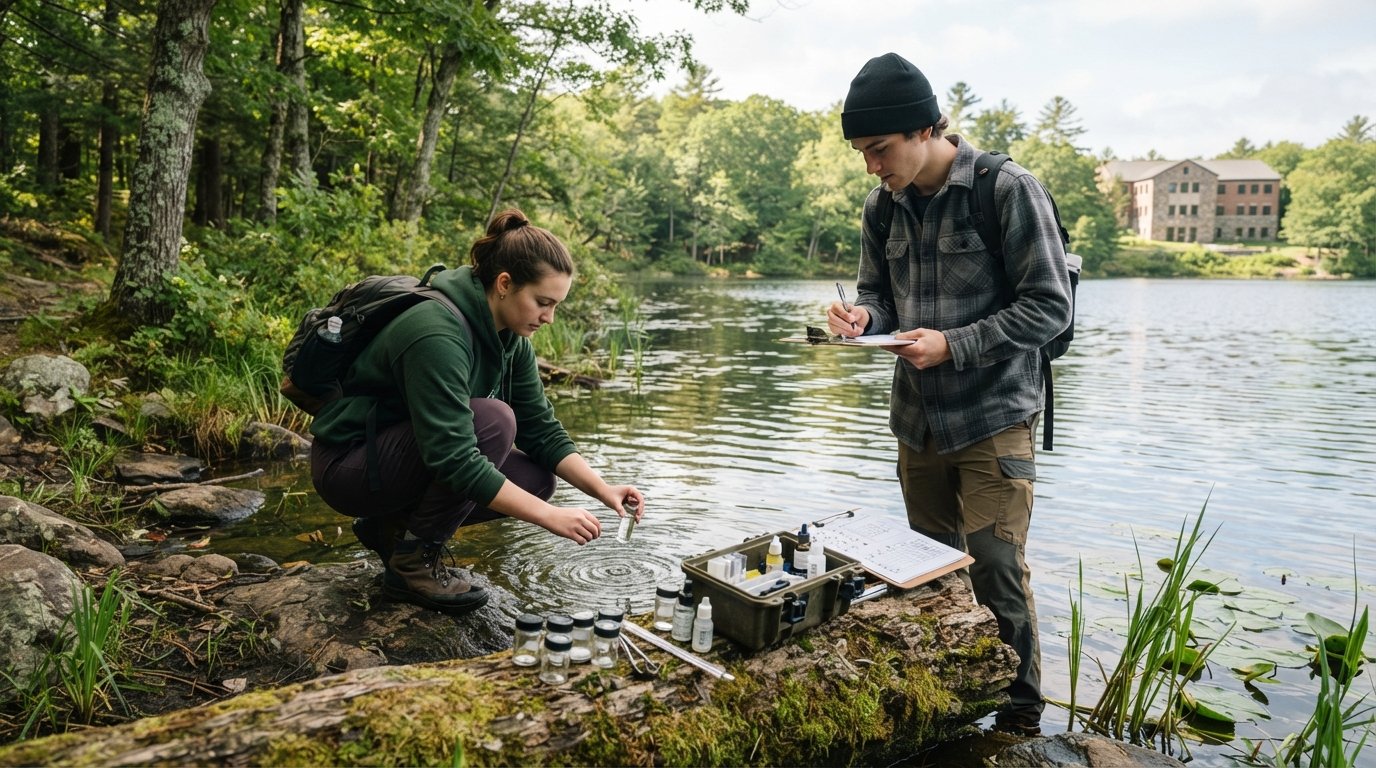
Because the program is in person, lab work and field trips are built into the weekly rhythm. Students might collect water samples from a nearby creek, analyze soil composition, or map vegetation as part of a class project. These experiences are difficult to replicate fully online, and they give graduates concrete examples to discuss in job interviews and transfer applications. The two-year structure also means you are not paying for four years of housing and fees before you decide whether the field is right for you.
Here is how the degree typically breaks down across the two years:
- Year one: General biology, general chemistry, college writing, and mathematics (often statistics or precalculus), plus an introduction to environmental science.
- Year two: Specialized courses such as ecology, environmental geology, hydrology, or geographic information systems (GIS), along with electives and a capstone or fieldwork component.
- Throughout: Lab sections attached to science courses, which carry separate contact hours and sometimes separate fees.
That mix is designed to satisfy the first two years of a bachelor's degree if you choose to transfer, while also providing enough applied skill for entry-level technician roles. Students who plan to transfer should meet with an advisor early and confirm articulation agreements with four-year schools, because course equivalencies vary by institution.
Why the In-Person Format Matters for Environmental Science
Environmental science is a field science. While online courses can teach theory effectively, they cannot fully replace the experience of calibrating a pH meter, performing a titration, or learning how to read a topographic map on a field site. The in-person requirement at Cayuga means students practice these skills under supervision, which builds confidence and safety awareness. Employers and transfer admissions officers recognize lab and field hours as evidence of readiness.
In-person learning also creates access to equipment that would be expensive to purchase individually. Campus laboratories often house microscopes, water quality testing kits, soil augers, and GIS software licenses. Students who commute to campus can use these resources during open lab hours, which is a practical advantage for anyone who cannot afford a full home lab setup. The format also supports study groups and informal mentoring from faculty, both of which improve persistence and completion rates.
There is a tradeoff, of course. In-person attendance requires scheduling flexibility and possibly transportation or childcare arrangements. Students who work full time may need to plan around daytime lab sections or choose part-time enrollment, which can extend the timeline beyond two years. Prospective students should review the course schedule carefully and ask about evening or hybrid options before committing, since program delivery can change.
Cost, Financial Aid, and the Value Proposition
Community college tuition is generally far lower than four-year university tuition, and that is the central financial argument for starting with an associate's degree. At Cayuga, students pay per credit plus fees, and New York residents may benefit from in-district or regional tuition rates. Students should also budget for textbooks, lab supplies, transportation, and any technology requirements. A realistic cost plan includes all of these, not just tuition.
Financial aid is available for eligible students through federal and state programs. The Free Application for Federal Student Aid (FAFSA) is the starting point for Pell Grants, federal work-study, and student loans. New York residents may also qualify for state aid programs such as the Tuition Assistance Program (TAP). Scholarships from community organizations, environmental groups, and employers can further reduce out-of-pocket costs. For students searching beyond institutional aid, Scholarship.Education offers a broad database of scholarship and financial aid opportunities across the US, UK, Canada, Australia, and the EU, which is useful for building a list of additional awards to pursue.
Because the degree is two years and in person, the total cost is easier to estimate than a four-year residential program. Students who live at home and commute can reduce housing expenses significantly. Those who transfer to a four-year school afterward can often enter as juniors, which means paying university tuition for only two years instead of four. That sequencing is one of the most reliable ways to lower the overall cost of a bachelor's degree in environmental science.
Admissions, Prerequisites, and Transfer Pathways
Cayuga County Community College maintains open-access admission policies typical of community colleges, which means a high school diploma or equivalent is generally the main requirement. Placement testing in math and English helps advisors route students into the right starting courses. Students who need developmental coursework should factor that into their timeline, because it can add a semester or more before the science sequence begins.
Transfer planning should start in the first semester, not the last. Many environmental science students intend to earn a bachelor's degree, and the associate's degree can satisfy lower-division requirements if courses are chosen carefully. Students should ask about articulation agreements, guaranteed transfer pathways, and the specific math and science courses required by target universities. Some four-year programs require calculus or organic chemistry, and taking those at the community college level can save money if the credits transfer.
For students who want to enter the workforce directly, the associate's degree prepares them for technician roles in environmental monitoring, conservation, and compliance. Typical entry-level positions include:
- Environmental science technician
- Water and wastewater sampling assistant
- Conservation or parks aide
- Laboratory assistant in environmental testing
- Field data collector for research or consulting firms
These roles often provide on-the-job training and can serve as stepping stones toward supervisory or specialist positions with additional education or certifications. Graduates should review local job postings to understand which software, instruments, and safety certifications employers request, then pursue those skills through electives or short courses.
Career Outlook and Further Education
Environmental science careers span government agencies, consulting firms, nonprofits, and private industry. The work includes monitoring air and water quality, managing natural resources, supporting compliance with environmental regulations, and assisting with remediation projects. An associate's degree is a common entry point for technician-level roles, and it can also support careers in parks and recreation, agriculture, and utilities.
Earnings vary widely by region, sector, and experience. Government positions often follow published pay scales, while consulting firms may offer different compensation structures. Students should research local labor market data and talk with advisors about internship opportunities, because internships frequently convert into job offers. The in-person format at Cayuga can help here, since faculty may have connections with regional agencies and organizations.
For students who want to advance, a bachelor's degree in environmental science, ecology, geology, or a related field opens more opportunities for project management, research, and regulatory roles. The associate's degree is not a dead end; it is a launchpad. Students who plan carefully can transfer with most or all of their credits intact and finish a bachelor's degree with less debt than if they had started at a four-year school.
How to Decide If This Program Fits Your Goals
The right program depends on your timeline, budget, and career target. An Environmental Science Associate's degree, usually 2 years In-person at Cayuga County Community College, is a strong fit for students who want hands-on science training, a lower-cost start, and a clear pathway to either employment or transfer. It is less suitable for students who need fully online flexibility or who cannot attend daytime labs and field trips.
Prospective students should take a few concrete steps before applying: review the college catalog for the current course sequence, contact an academic advisor about transfer agreements, complete the FAFSA, and visit campus to see the labs and meet faculty. Ask about internship placement rates, transfer success, and any program-specific scholarships. These questions turn a general interest into an informed decision.
Cost planning should include a cushion for fees, supplies, and transportation, and students should compare the total two-year cost against the first two years at a four-year school. For many families, the savings are substantial. When combined with scholarships and transfer planning, the associate's degree can be a financially responsible first step toward a career in environmental science.
If you are ready to explore programs and costs further, start with a clear budget, a transfer plan, and a list of scholarships to pursue. The path from a two-year degree to a meaningful environmental career is well worn, and with careful planning, it can be both affordable and achievable.