

How to Find Affordable Schools and College Options
Learn how to identify affordable schools and college options that fit your budget, including online programs, community college transfers, and financial aid strategies.

By William Harris
Rising tuition costs can make higher education feel out of reach, but the truth is that affordable schools and college options exist at every degree level. Whether you are a recent high school graduate, a working parent, or a career changer, the right strategy can cut thousands of dollars from the total price of your degree. The challenge is not finding a low-cost program; it is knowing where to look, what questions to ask, and how to compare the true value of each option.
This guide walks you through the most effective ways to identify affordable schools and college options without sacrificing academic quality or career preparation. You will learn how to use net price calculators, evaluate online programs, leverage financial aid, and avoid the hidden costs that inflate many students' final bills. With a clear framework, you can make a confident decision that protects both your education and your financial future.
Start with Net Price, Not Sticker Price
Many families make the mistake of ruling out colleges based on their published tuition and fees. That sticker price rarely reflects what most students actually pay. After grants, scholarships, and tax credits, the net price often turns out to be significantly lower than the advertised cost. The U.S. Department of Education requires every college to publish a net price calculator on its website, allowing prospective students to estimate their out-of-pocket expenses based on their family income and academic profile.
To get an accurate picture, gather your most recent tax return, bank statements, and any information about assets. Enter those details into the calculator for each school you are considering. Compare the estimated net prices side by side. A college with a high sticker price may end up offering a more generous financial aid package than a cheaper-sounding institution. This is especially true at private colleges that use large endowments to meet full demonstrated need.
When you receive your official financial aid offers, compare the net price after all gift aid (grants and scholarships) is subtracted. Do not include federal student loans in that calculation, because loans must be repaid with interest. The net price you are left with is the amount you will need to cover through savings, income, work-study, or additional aid.
Consider Online Programs for Lower Tuition
Online education has become one of the most practical routes to a degree without the traditional campus costs. Many public universities offer online degrees at the same tuition rate as in-state students, regardless of where you live. This can be a game changer if you live in a state with high tuition or if you want to attend a school far from home without paying out-of-state rates.
Beyond tuition savings, online learning eliminates commuting expenses, housing costs, and campus fees. You also gain the flexibility to continue working while studying, which reduces the opportunity cost of lost income. For working adults, this combination of lower direct costs and preserved earnings makes affordable online colleges a smart financial choice. Many regionally accredited institutions offer fully online bachelor's and master's programs in fields like business, technology, healthcare, and education.
When comparing online programs, verify that the school holds regional accreditation, which is the gold standard for academic quality and transferability of credits. Also ask about any additional fees for online courses, such as technology fees or distance learning charges. Some colleges waive those fees for fully online students, while others add them on top of tuition. A transparent cost breakdown will help you compare apples to apples.
For a deeper look at how to compare tuition costs, see our guide on finding affordable schools with low tuition costs in 2026.
Leverage Community College and Transfer Pathways
Starting at a community college is one of the most effective ways to reduce the total cost of a bachelor's degree. Community colleges typically charge far less per credit hour than four-year institutions, and many have agreements with public universities that guarantee credit transfer for specific majors. Completing your general education requirements at a community college can save you thousands of dollars while keeping you on track to graduate with a degree from a more expensive university.
To maximize this strategy, meet with an academic advisor at both the community college and the four-year university before you enroll. Confirm that the courses you plan to take will satisfy the university's degree requirements. Some states have guaranteed transfer programs, such as California's Associate Degree for Transfer or Florida's statewide articulation agreement. These programs allow students who earn an associate degree to transfer with junior standing, often with automatic admission to a participating public university.
Another option is to attend a community college for the first two years, then transfer to a private college that offers generous merit scholarships to transfer students. Many private institutions reserve significant financial aid for community college transfers because they bring diverse experiences and strong academic records. Be sure to research the transfer scholarship policies at your target schools and apply by the priority deadlines.
Evaluate the Total Cost of Attendance
Tuition is only one piece of the financial puzzle. The total cost of attendance includes room and board, books, supplies, transportation, and personal expenses. When comparing affordable schools and college options, you must look at the full picture. A school with low tuition but high living costs in an expensive city may end up costing more than a school with moderate tuition in a low-cost area.
For online students, the cost of attendance is often lower because you are not paying for housing or meal plans. However, you still need to budget for a reliable computer, internet access, and any required software or lab kits. Some online programs include these items in their tuition, while others charge separately. Always read the fine print on the school's website or request a detailed cost breakdown from the financial aid office.
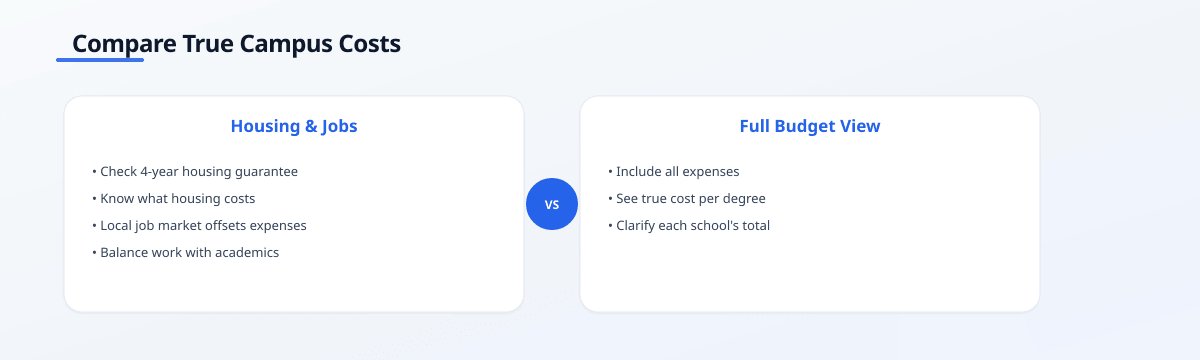
When comparing campus-based programs, look at whether the school guarantees on-campus housing for all four years and what that housing costs. Also consider the local job market: a part-time job can offset living expenses, but you will need to balance work hours with your academic load. A realistic budget that includes all expenses will give you a clear picture of what each school truly costs over the length of your degree.
Maximize Grants, Scholarships, and Work-Study
Before taking out any student loans, exhaust all sources of free money. Federal Pell Grants, state grants, and institutional scholarships do not need to be repaid. You can also receive scholarships from private organizations, professional associations, and local community groups. Every scholarship you win reduces the amount you need to borrow.
To find scholarships, start with your high school guidance counselor or college financial aid office. They often have lists of local scholarships that are less competitive than national ones. Search free online databases such as the College Board's Scholarship Search and Fastweb. Set aside time each week to apply for scholarships that match your background, major, or interests. Even small awards of $500 or $1,000 add up over four years.
Work-study is another valuable resource. Federal work-study programs provide part-time jobs on campus or with approved off-campus employers. The money you earn is meant to help cover educational expenses, and the jobs often offer flexible hours that fit around your class schedule. Work-study earnings do not count against your financial aid eligibility in future years, unlike outside income which can reduce your need-based aid.
Here is a quick summary of the most effective ways to reduce your out-of-pocket costs:
- Use net price calculators to estimate true cost after grants and scholarships.
- Choose an online program to save on housing, commuting, and campus fees.
- Start at a community college and transfer to a four-year university.
- Apply for federal and state grants, as well as private scholarships.
- Consider work-study to earn money without accruing debt.
Each of these strategies works best when combined. For example, a student who attends community college online for two years, then transfers to a state university, may finish a bachelor's degree with no debt if they also receive Pell Grants and work part-time. The key is to plan ahead and apply for aid early.
Understand the Real Cost of Student Loans
If you do need to borrow, understand the long-term impact of your loan choices. Federal student loans offer fixed interest rates and income-driven repayment plans, but they still accrue interest from the moment they are disbursed. Private loans often have variable rates and fewer repayment protections, making them a riskier option.
To minimize borrowing, take out only what you need, not what you are offered. A good rule of thumb is to keep your total student loan debt at graduation below your expected starting salary. For example, if you expect to earn $50,000 in your first job, try to keep your total debt under $50,000. This keeps your monthly payments manageable and reduces the risk of default.
You can also reduce loan costs by making interest payments while you are still in school. Even a small monthly payment on an unsubsidized loan prevents interest from capitalizing, which means it will not be added to your principal balance. If you receive a windfall, such as a tax refund or a bonus from work, consider making an extra payment toward your loans.
Use College Comparison Tools and Resources
With so many factors to consider, a structured approach is essential. The College Scorecard, maintained by the U.S. Department of Education, provides official data on graduation rates, average annual cost, and post-graduation earnings for every college. This free tool allows you to filter schools by degree level, field of study, and location. You can also see the percentage of students receiving federal financial aid and the median debt of graduates.
In addition to federal resources, many nonprofit organizations offer college comparison tools that rank schools by affordability, return on investment, and student satisfaction. These tools can help you narrow your list to a handful of schools that meet your budget and academic goals. When you have a short list, visit each school's website and request more information. Many colleges offer virtual tours and online information sessions, which are free and convenient.
Remember that the cheapest option is not always the best value. A slightly more expensive school that offers strong career services, a robust alumni network, and high graduation rates may lead to a better job and higher lifetime earnings. Weigh the cost against the potential return on investment, including starting salary, job placement rates, and graduate school acceptance rates.
Make a Plan and Stick to It
Finding affordable schools and college options requires research, but the payoff is immense. By starting early and using the tools available, you can reduce your debt burden and graduate with financial freedom. Begin by creating a college budget that includes all expenses, then use net price calculators and financial aid offers to compare your true costs. Explore online programs and community college transfer pathways as low-cost alternatives. Apply for every scholarship you qualify for, and borrow only what you absolutely need.
As you move forward, keep your career goals in mind. A degree is an investment in your future, and the best investment is one that fits your budget and leads to a fulfilling career. With careful planning, you can find a program that offers both quality and affordability. Your future self will thank you for making a smart financial decision today. Learn more