
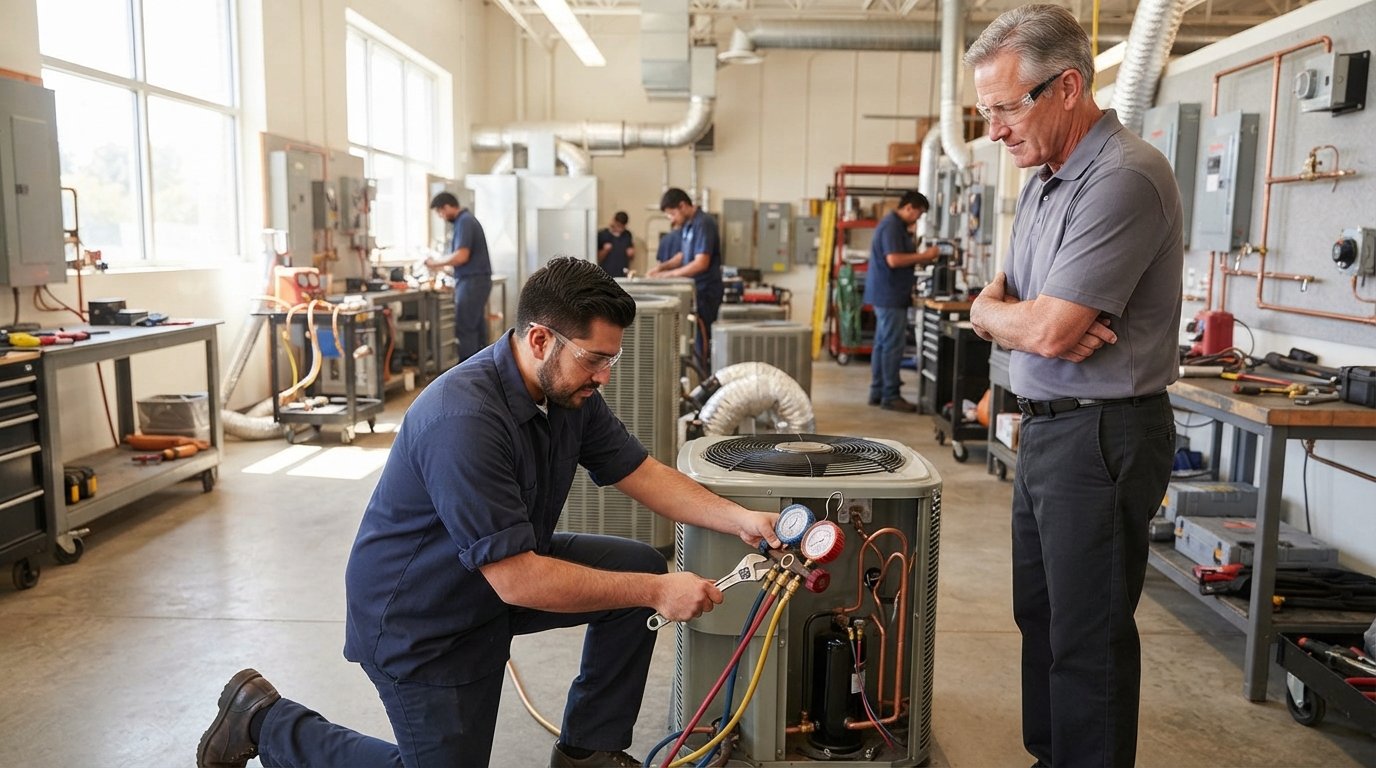
HVAC/R Certificate at East Arkansas Community College
This HVAC/R certificate at East Arkansas Community College can get you job-ready in under a year with hands-on training and lower tuition costs.

By Ethan Brooks
Skilled trades are back in demand, and few fields offer a faster on-ramp to stable wages than heating, air conditioning, ventilation, and refrigeration. If you are weighing a short-term credential over a multi-year degree, the Heating, Air Conditioning, Ventilation and Refrigeration Maintenance Technology/Technician Certificate, 12 weeks to less than 1 year In-person at East Arkansas Community College deserves a close look. It is an entry-level credential designed for people who want hands-on training, a quick transition into the workforce, and a path that does not require four years of tuition payments. This article breaks down what the program covers, who it suits, how to plan the cost, and how to decide whether it is the right fit for your career and budget.
What This HVAC/R Technician Certificate Covers
Heating, ventilation, air conditioning, and refrigeration (often shortened to HVAC/R) is a technical trade built on a handful of core competencies: electrical fundamentals, refrigerant handling, system diagnostics, and equipment installation. A certificate program compresses those competencies into a tight sequence of courses so students can move from classroom theory to supervised lab work quickly. The East Arkansas Community College program is delivered in person, which matters in a trade where torque, gauges, and troubleshooting under real conditions cannot be fully replicated online.
Students should expect a curriculum that blends safety training, electrical theory, and mechanical systems. Typical coursework includes refrigerant recovery and charging, brazing and soldering, reading wiring diagrams, and understanding the refrigeration cycle. Because HVAC/R technicians work in homes, businesses, and industrial settings, the program also emphasizes customer communication and workplace safety habits that employers screen for during hiring.
The 12-weeks-to-less-than-1-year format is one of the credential's strongest selling points. Rather than stretching general education requirements across multiple semesters, the certificate focuses almost entirely on occupational skills. That structure appeals to career changers who need to keep earning while they train, and to high school graduates who want a marketable skill without committing to a two-year or four-year degree.
Core Skill Areas You Will Practice
Though individual course titles vary, certificate programs in this field generally organize learning around a predictable set of skill areas. The following list reflects the competencies employers most often request in entry-level HVAC/R job postings:
- Electrical fundamentals, including motors, controls, and wiring diagrams
- Refrigeration cycle theory and refrigerant recovery, recycling, and charging procedures
- Heating systems, including gas, electric, and heat pump operation
- System installation, preventive maintenance, and troubleshooting diagnostics
- Safety protocols, EPA refrigerant regulations, and professional workplace practices
Each of these areas builds on the one before it. A student who understands electrical controls will diagnose a failed compressor more quickly than one who has only memorized parts names. That is why in-person lab time is so valuable: instructors can watch a student's technique, correct unsafe habits immediately, and simulate the kinds of faults that show up on real service calls.
Why the 12-Week to Under-1-Year Format Works
Time is money in education, and short-term certificates are built around that reality. A program that runs between 12 weeks and less than a year lets students enter the job market faster than associate degree seekers while still earning a credential that signals competence to employers. For adults balancing work and family, the compressed schedule can be the difference between enrolling and putting training off indefinitely.
There is also a financial argument. Fewer months in school generally means fewer tuition installments, less time out of the workforce, and a quicker return on investment. Students who finance the certificate should still calculate the total cost carefully, including tools, exam fees, and any transportation costs for in-person attendance. A short program with a clear completion date makes that math easier to project than a multi-year degree with changing course loads.
It is worth noting that certificates are stackable. Many HVAC/R technicians start with a certificate, work for a few years, and later return for an associate degree or specialized certifications in building automation or commercial refrigeration. The short format is therefore not a dead end; it is a first step that can be built upon as career goals evolve.
Admissions, Eligibility, and What to Expect
Community college certificate programs are generally designed to be accessible. Applicants typically need a high school diploma or equivalent, and some programs require placement testing in math and reading to ensure students can handle technical coursework. Because the East Arkansas Community College program is in person, prospective students should also confirm scheduling details, campus location, and any required safety equipment before applying.
The admissions process usually follows a familiar sequence. Being organized about each step reduces the chance of missing a deadline or overlooking a financial aid form:
- Complete the college application and submit official transcripts or equivalency documentation.
- Take any required placement assessments and meet with an academic advisor to map the certificate sequence.
- File the Free Application for Federal Student Aid (FAFSA) to determine eligibility for grants, work-study, and federal loans.
- Register for classes during the assigned enrollment window and confirm lab fees, tool requirements, and class times.
After registration, students should treat the program like a job. Attendance policies in lab-based courses tend to be strict because missed sessions mean missed hands-on practice. Building a relationship with instructors early also pays off: they often know which local employers are hiring and can write the kind of recommendation that helps a new graduate land a first job.
Cost Planning and Financial Aid for a Short Certificate
Cost is the question most prospective students ask first, and it deserves a careful answer. Certificate tuition at a public community college is typically far lower than tuition at a four-year institution, but the total investment includes more than per-credit charges. Students should budget for lab fees, textbooks, personal protective equipment, basic hand tools, and certification exam fees. Transportation and childcare during in-person class days are real costs too, especially for working adults.
Financial aid works differently for short programs. Federal Pell Grants can apply to eligible certificate programs, and state workforce grants sometimes target high-demand fields like HVAC/R. Students should complete the FAFSA regardless of income assumptions, because eligibility formulas account for factors beyond salary alone. Institutional scholarships and local employer sponsorships are also worth investigating; some HVAC companies pay partial tuition for employees who commit to staying after graduation.
For students comparing multiple programs, a structured approach keeps the decision grounded in numbers rather than impressions. The following steps help clarify the true cost of each option:
- Request the program's total cost of attendance, not just tuition per credit hour.
- Subtract grant and scholarship aid that does not need to be repaid.
- Estimate lost wages or childcare costs during the training period.
- Compare the result against expected entry-level wages in your local job market.
That last comparison matters most. A certificate that costs slightly more but finishes faster and connects to local employers can outperform a cheaper program with a long waitlist or weak job placement. Prospective students should ask advisors about completion rates, licensure exam pass rates where applicable, and employer relationships before committing.
Students who want to explore additional cost-saving strategies and compare programs across institutions can use resources such as CollegeDegree.Education, which helps prospective students connect with accredited colleges and degree programs and research options that fit their budgets and career goals.
Career Outcomes and Earning Potential
HVAC/R technicians are employed by heating and cooling contractors, facilities departments, property management companies, and refrigeration service firms. Entry-level roles often begin as installer helpers or maintenance technicians, with advancement toward service technician, lead installer, or systems specialist as experience accumulates. Because equipment varies by climate and building type, technicians who learn both residential and light commercial systems tend to have more job options.
Earnings vary by region, experience, and specialization. Entry-level pay in many markets is modest at first, but technicians who obtain EPA Section 608 certification, master diagnostic skills, and develop a clean driving record and customer service reputation can see pay climb substantially within a few years. Overtime is common during peak heating and cooling seasons, which can accelerate early-career savings.
The trade also offers self-employment potential. Some technicians eventually launch their own service businesses after building a client base and obtaining required licenses. That path takes time and business acumen, but it illustrates why the certificate can be viewed as a foundation rather than a final destination.
How to Decide If This Certificate Is Right for You
The strongest candidates for this program share a few traits: comfort with hands-on mechanical work, willingness to study electrical theory, and a preference for learning by doing rather than sitting in lectures. If you enjoy troubleshooting, do not mind working in attics, crawl spaces, or rooftop units, and want a credential that leads to employment quickly, the format is a natural fit. If you prefer desk-based analytical work or want a broad liberal arts education, a different pathway may serve you better.
Prospective students should also assess logistics honestly. In-person attendance requires reliable transportation and a schedule that accommodates daytime or evening labs. Financial planning should account for tools and exam fees, not just tuition. And career expectations should be grounded in the local labor market: call a few HVAC companies in your area and ask what they look for in new hires. Their answers will tell you more about the value of the certificate than any brochure.
Finally, compare the certificate against adjacent options. An associate degree in HVAC technology takes longer but may open supervisory or engineering-adjacent roles. A different trade certificate might align better with your interests. The right choice depends on how quickly you need to earn, how much you can invest upfront, and where you want to be in five years.
The Heating, Air Conditioning, Ventilation and Refrigeration Maintenance Technology/Technician Certificate, 12 weeks to less than 1 year In-person at East Arkansas Community College is a practical, time-efficient entry point into a skilled trade that keeps homes and businesses comfortable and operational. For students who want hands-on training, a fast completion timeline, and a credential that employers recognize, it is a serious option worth exploring alongside financial aid and local job market research.