
Phlebotomy Certificate in 12 Weeks at Brookline College
Earn your phlebotomy certificate in 12 weeks at Brookline College-Tucson and start a healthcare career with hands-on training and low tuition.

By James Taylor
Finding a fast, affordable path into healthcare can feel overwhelming, especially when you want hands-on training that leads directly to employment. The Phlebotomy Technician/Phlebotomist Certificate, 12 weeks to less than 1 year In-person at Brookline College-Tucson, offers exactly that: a streamlined, skills-focused program that prepares you to draw blood safely, interact with patients professionally, and sit for national certification exams. If you are a career changer, a recent high school graduate, or someone looking to add a credential without committing to a multi-year degree, this certificate deserves a close look. In this guide, you will learn what the program covers, how much it costs, what to expect from the in-person format, and how to decide whether it fits your budget and career goals.
Why Phlebotomy Training Is a Smart Short-Term Investment
Phlebotomy is one of the most accessible entry points into the healthcare field. Unlike nursing or radiology, which require two or more years of study, a phlebotomy certificate can be completed in a matter of months. That short timeline means you can start earning sooner, reduce the amount of tuition you borrow, and test the waters of patient care before committing to a longer degree. Hospitals, diagnostic laboratories, blood donation centers, and outpatient clinics all rely on trained phlebotomists every day, so demand tends to remain steady even when other sectors slow down.
Another advantage is the low barrier to entry. Most phlebotomy programs, including the one at Brookline College-Tucson, require only a high school diploma or GED. You do not need prior medical experience. What you do need is comfort working with your hands, attention to detail, and the ability to put anxious patients at ease. For many students, the 12-week timeline is the deciding factor: it fits between semesters, alongside a part-time job, or during a career transition without draining savings for years.
From a financial perspective, shorter programs usually mean lower total tuition. That matters because phlebotomists typically enter the workforce at an entry-level wage. Keeping your student loan balance low makes it easier to pay back what you borrow and still cover living expenses. If you are exploring other short-term healthcare credentials, our guide to the Medication Aide Certificate in 12 Weeks at Companions of Ashland shows how similar fast-track programs compare in structure and cost.
Program Overview: What the Brookline College-Tucson Certificate Includes
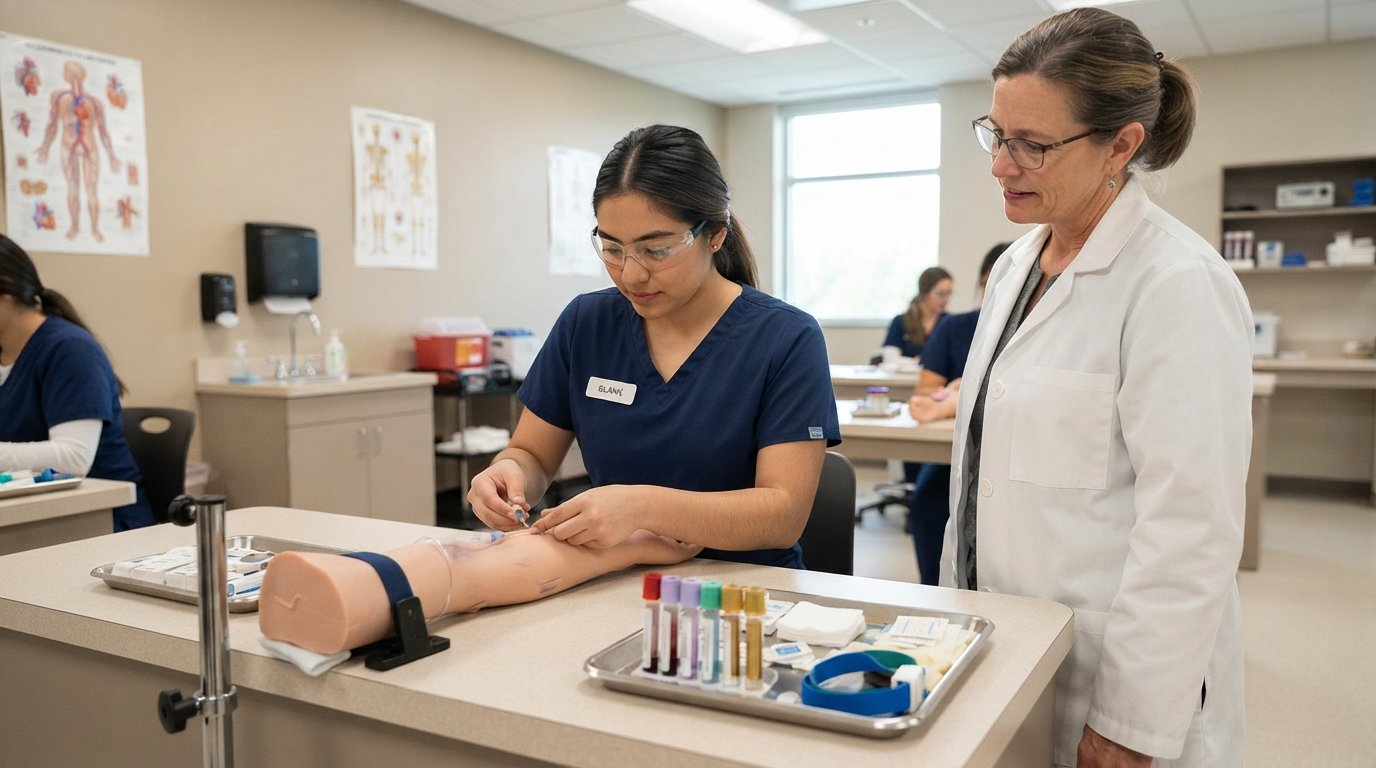
Brookline College-Tucson delivers the phlebotomy technician certificate in person, which means you practice blood collection techniques on real training arms and, in many cases, on classmates under supervision. The curriculum blends classroom instruction with hands-on lab work, covering anatomy and physiology of the circulatory system, infection control, venipuncture, capillary puncture, specimen handling, and patient communication. You also learn about legal and ethical issues such as patient confidentiality and informed consent.
Because the program runs 12 weeks to less than 1 year, it is classified as a short-term certificate rather than a diploma or degree. That distinction matters for financial aid and for how quickly you can enter the job market. Most students complete the required coursework within a single quarter or semester, depending on scheduling and prerequisite completion. The in-person format is a deliberate choice: phlebotomy is a psychomotor skill, and employers want to see that you have logged supervised draws before you apply.
Here is a snapshot of what the certificate typically covers:
- Venipuncture and capillary puncture techniques using evacuated tube systems, syringes, and butterfly needles
- Order of draw, specimen labeling, and handling to prevent hemolysis and rejection
- Infection control, personal protective equipment, and OSHA bloodborne pathogen standards
- Patient identification, consent, and strategies for managing difficult or anxious patients
- Basic anatomy, medical terminology, and documentation practices
After completing the classroom and lab components, you may also complete a clinical externship at a local healthcare facility. Externship hours vary, but they give you real-world experience that strengthens your resume and helps you meet certification eligibility requirements. Before enrolling, confirm the current externship policy and whether placement is guaranteed or competitive.
Admissions, Costs, and Financial Aid Options
Admission to the phlebotomy technician certificate at Brookline College-Tucson is straightforward compared to degree programs. You will need to submit proof of high school graduation or equivalent, complete an admissions interview, and possibly pass a background check or health screening before externship placement. Some programs also require immunizations and a negative TB test, since you will be working in clinical settings. It is wise to ask about these requirements early so you can gather documents without delaying your start date.
Tuition for a 12-week certificate is significantly lower than for an associate degree, but it is not free. Costs typically include tuition, lab fees, a uniform or scrubs, textbooks, and certification exam fees. Ask the admissions office for a written breakdown of all charges, including any retake fees if you need to repeat a course. If you need help covering these expenses, explore scholarship databases and financial aid resources such as Scholarship.Education, which helps students find and apply for awards they may not have considered. You can also ask whether Brookline College-Tucson accepts federal student aid, payment plans, or workforce development grants.
Because phlebotomy is a non-degree certificate, federal aid eligibility can be limited. Many students pay out of pocket or use short-term payment plans. That makes it even more important to compare total program cost against expected starting wages in the Tucson area. A program that costs a few thousand dollars and leads to a job within a few months is usually easier to justify than a longer, more expensive program with the same entry-level outcome.
Certification and Career Outcomes After Graduation
Once you finish the certificate, the next step is national certification. Several organizations offer phlebotomy credentials, including the American Society for Clinical Pathology (ASCP), the National Center for Competency Testing (NCCT), and the American Medical Technologists (AMT). Certification typically requires passing a written exam and documenting a certain number of supervised blood draws. Some employers will hire you before you are certified, but many prefer or require certification because it signals that you meet a recognized standard.
Job prospects for phlebotomists are generally stable. The U.S. Bureau of Labor Statistics projects steady demand in hospitals, medical laboratories, and blood donation centers. In Tucson, major employers include hospital systems, diagnostic labs, and community health clinics. Starting pay varies by setting and shift, but evening, weekend, and hospital-based roles often pay more than daytime clinic positions. Over time, you can add skills such as EKG testing, specimen processing, or medical assisting to increase your earning potential.
If you are comparing short-term healthcare programs, think about how each credential fits your long-term plan. Phlebotomy can be a standalone career or a stepping stone toward nursing, medical assisting, or laboratory science. The hands-on patient contact you gain during the 12-week program will serve you well in any of those paths.
How to Decide If the In-Person Format Is Right for You
The in-person format at Brookline College-Tucson is a major advantage for students who learn best by doing. Watching a video on venipuncture is not the same as performing a draw under the watchful eye of an instructor who can correct your angle and technique in real time. In-person labs also give you access to equipment you may not have at home, including training arms, vacutainer systems, and centrifuges. If you thrive in structured environments with set schedules and face-to-face feedback, this program is likely a good fit.
On the other hand, in-person training requires commuting, fixed class times, and possibly rearranging work or childcare. Before you enroll, map out your weekly schedule and confirm that you can attend every lab session. Missing hands-on time can set you back, since skills build on one another. Ask about class sizes, instructor-to-student ratios, and how much one-on-one practice time you will receive. A smaller cohort usually means more supervised draws and faster skill development.
Finally, visit the campus if you can. Meet the instructors, tour the lab, and ask current students about their experience. A short certificate program is only as good as its teaching and support services. If the staff are responsive and the lab is well equipped, you can feel more confident that your 12 weeks will be time and money well spent.
Choosing a phlebotomy program is a practical decision, not just an academic one. The Phlebotomy Technician/Phlebotomist Certificate, 12 weeks to less than 1 year In-person at Brookline College-Tucson offers a focused, hands-on route to a healthcare career with minimal time and tuition commitment. By comparing costs, confirming certification eligibility, and planning your schedule in advance, you can move from student to certified phlebotomist in a matter of months.