
Anthropology Bachelor's at Augusta University: 4-Year Guide
Explore the Anthropology, General Bachelor's degree, usually 4 years In-person at Augusta University, including curriculum, costs, and career outcomes.

By Emily Wilson
What does it mean to be human? Anthropology tackles that question by examining cultures, languages, biology, and the material traces people leave behind. At Augusta University, the General Anthropology Bachelor's degree offers a four-year, in-person path into that inquiry, blending classroom theory with hands-on research and community engagement. For students and families weighing the cost of a liberal arts education, this program raises practical questions: What will you study? What does it cost? And where can the degree take you after graduation?
This guide walks through the academic structure, admissions process, tuition considerations, and career outcomes of the Anthropology, General Bachelor's degree, usually 4 years In-person at Augusta University. Along the way, we will connect the program to broader college planning decisions, including how to compare costs, find financial aid, and evaluate whether a residential liberal arts degree fits your budget and goals.
Why Study Anthropology at Augusta University?
Anthropology sits at the intersection of the social sciences and the humanities. Students learn to analyze cultural practices, interpret archaeological evidence, study human biological variation, and examine how language shapes social life. The General Anthropology track at Augusta University is designed for breadth: rather than specializing narrowly in one subfield, students sample cultural anthropology, archaeology, biological anthropology, and linguistic anthropology before choosing upper-level electives that match their interests.
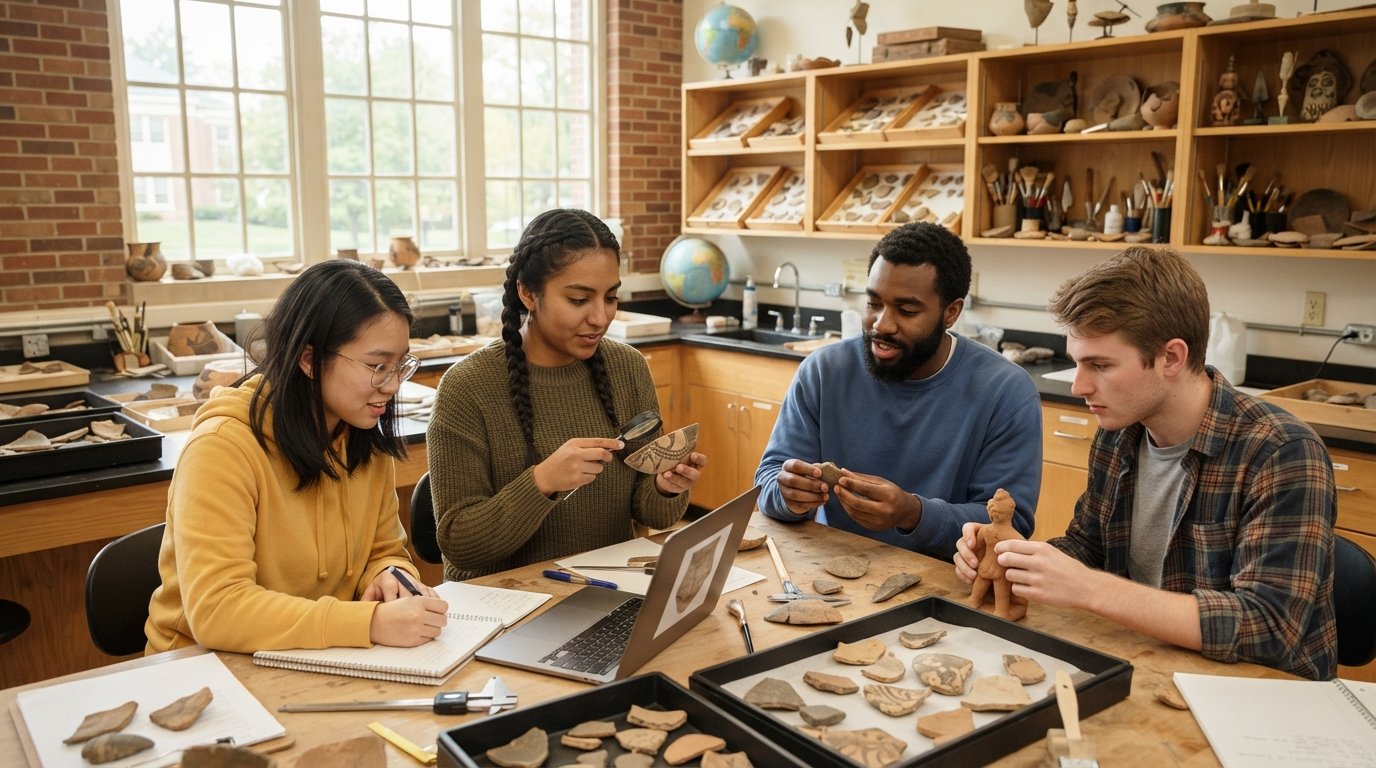
The in-person format matters here. Anthropology is a discipline built on fieldwork, observation, and discussion. Sitting in a seminar room debating ethnographic methods or handling artifacts in a lab component gives students a kind of learning that is hard to replicate fully online. Augusta University's location in a mid-sized Southern city also provides access to local museums, historical sites, and community organizations that can serve as research partners or internship hosts.
Four-year residential programs like this one also offer something less tangible: the chance to build relationships with faculty who can write recommendation letters, mentor undergraduate research, and connect students to graduate programs or entry-level positions. For students who thrive in a structured campus environment, that support network can be a decisive advantage.
What the Four-Year Curriculum Looks Like
The General Anthropology Bachelor's degree at Augusta University follows a typical four-year structure, with the first two years devoted largely to general education requirements and foundational courses, and the final two years focused on upper-division anthropology coursework and electives. While specific course offerings vary by catalog year, the overall arc is consistent: build a broad base, then deepen your expertise.
In the first year, students typically complete core requirements in writing, mathematics, and the natural and social sciences, alongside an introductory anthropology course that surveys the discipline. The second year introduces methods courses, such as ethnographic research techniques or archaeological field methods, and begins to fulfill distribution requirements across the four subfields.
By the junior and senior years, students take advanced seminars, complete electives in areas like medical anthropology, environmental anthropology, or museum studies, and often pursue an internship or independent research project. A capstone experience, whether a thesis, a portfolio, or a senior seminar, helps students synthesize what they have learned and prepare for the job market or graduate school.
Because the program is in-person, students can take advantage of laboratory spaces, artifact collections, and face-to-face advising that support this progression. The four-year timeline also leaves room for study abroad, a minor in a complementary field, or a second major, all of which can strengthen a resume.
Admissions and Enrollment Steps
Applying to Augusta University as a first-year student follows a standard undergraduate admissions process. Prospective students submit an application, high school transcripts, standardized test scores if required or optional under current policy, and any required essays or recommendations. Transfer students should be prepared to submit college transcripts for credit evaluation.
Once admitted, students declare anthropology as their major or enter as an undeclared student and declare later. Because the program is in-person, applicants should also plan for housing, meal plans, and campus orientation. Meeting with an academic advisor early helps ensure that general education courses align with anthropology prerequisites, reducing the risk of extra semesters.
For students comparing options, it helps to sequence the process: apply to the university, confirm the major, meet with the department, and map out a four-year plan. Families should also file the Free Application for Federal Student Aid (FAFSA) each year to qualify for grants, work-study, and federal loans.
Tuition, Fees, and Financial Aid
Cost is often the deciding factor in choosing a four-year residential program. Tuition at Augusta University varies by residency status, with in-state students paying significantly less than out-of-state students. Beyond tuition, families should budget for mandatory fees, housing, dining, books, and personal expenses. These indirect costs can add thousands of dollars per year, so a realistic cost estimate matters.
Financial aid can close much of the gap. Students may qualify for federal Pell Grants, Georgia state grant programs, institutional scholarships, and private awards. The anthropology department may also offer small scholarships or research stipends, though these are typically competitive. Filing the FAFSA early and applying for departmental awards are practical steps that reduce out-of-pocket costs.
For students exploring alternatives or comparing multiple degree paths, resources that connect learners with accredited programs can simplify the search. One option is an educational matching service for accredited degree programs, which helps prospective students discover schools and request information without obligation. Such tools are useful for side-by-side comparisons, especially when weighing in-person liberal arts programs against online or accelerated options.
It also helps to think beyond the sticker price. A four-year anthropology degree may lead to careers in museums, nonprofits, education, or public health, where starting salaries vary widely. Calculating the total cost of attendance against realistic post-graduation earnings gives families a clearer picture of value.
Skills You Gain and Career Outcomes
Anthropology graduates develop a distinctive skill set: qualitative research, cross-cultural communication, critical reading, writing, and ethical reasoning. These competencies translate into roles in museums and cultural institutions, community outreach, international development, education, and user research in technology companies. Some graduates pursue graduate study in anthropology, archaeology, public health, or law.
Because the degree is broad rather than pre-professional, students should pair it with internships, a minor, or a second major to sharpen their employability. For example, combining anthropology with public health coursework can lead to roles in community health organizations, while adding a data analysis minor can open doors to research positions.
Prospective students often ask whether a four-year in-person degree is worth it compared with faster or cheaper alternatives. The answer depends on goals. Students who want laboratory access, faculty mentorship, and a traditional campus experience may find the residential model valuable. Those who need to work full-time or live far from campus might explore online or hybrid options. Either way, comparing total costs and outcomes is essential.
Comparing In-Person and Online Anthropology Degrees
The Anthropology, General Bachelor's degree, usually 4 years In-person at Augusta University is one path among many. Online anthropology degrees exist, but they often lack lab components, fieldwork, and the face-to-face seminar discussions that define the discipline. In-person programs also provide structured access to faculty office hours, research assistantships, and campus resources like writing centers and career services.
That said, online and hybrid programs can be more affordable and flexible, particularly for adult learners or students with family obligations. When comparing, weigh factors such as accreditation, total tuition, time to completion, and available support services. A program that fits your life circumstances is more likely to be completed, which matters more than prestige alone.
For students interested in creative or studio-based fields, similar trade-offs apply. Our guide to the Art Center animation degree explores how a four-year in-person bachelor's program balances hands-on training with cost and career preparation, offering a useful comparison point for evaluating residential liberal arts and studio degrees.
Is the Augusta University Anthropology Program Right for You?
Choosing a major and a college is a personal decision. The General Anthropology Bachelor's degree at Augusta University suits students who are curious about human diversity, comfortable with reading and writing, and interested in research that involves people and communities. It rewards those who take initiative: seeking internships, building relationships with professors, and connecting coursework to real-world problems.
Before committing, visit campus, sit in on a class, and talk with current students and faculty. Ask about graduation rates, typical class sizes, and available research opportunities. Also run the numbers: estimate four-year costs, explore financial aid, and compare against other programs you are considering.
For families navigating these decisions, the key is to treat college as an investment of both time and money. A four-year in-person anthropology degree can be a strong foundation for a range of careers, provided students plan intentionally and keep costs under control. With the right research and financial planning, the program can offer both intellectual breadth and practical preparation for life after graduation.