
Chabot College Manufacturing Engineering Certificate
Earn a Manufacturing Engineering Certificate at Chabot College in 12 weeks to less than 1 year. Call 8772187081 to plan your in-person training.
By Michael Anderson
Finding a fast, affordable route into advanced manufacturing often means sorting through degree programs that take years to finish. Chabot College in Hayward, California, offers a different kind of on-ramp: a Manufacturing Engineering Certificate that can be completed in as little as 12 weeks and in less than 1 year, delivered fully in person. For students who want hands-on training, industry-recognized skills, and a quick transition into the workforce, this short-term certificate deserves a close look.
This guide explains what the program covers, who it is designed for, how much it may cost, and how it fits into the broader landscape of affordable career training. It also shows how to compare this option with other pre-engineering pathways, so you can decide whether a certificate or a longer degree track matches your goals.
What Is the Manufacturing Engineering Certificate at Chabot College?
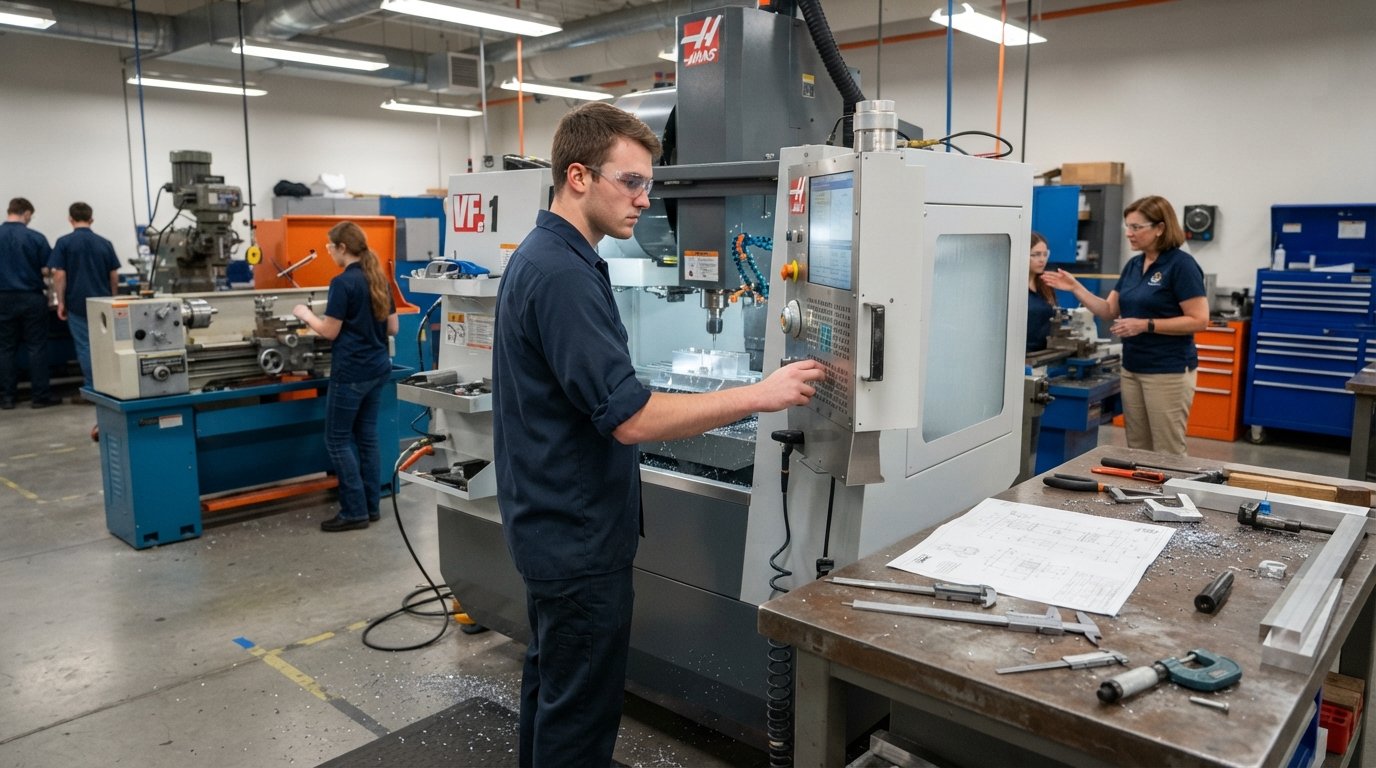
The Manufacturing Engineering Certificate at Chabot College is a career-focused credential built around the practical skills that modern production facilities need. Instead of spending two or four years on general education requirements, students move quickly through technical coursework in machining, computer numerical control (CNC), blueprint reading, quality control, and manufacturing processes. The program is offered in person, which means students spend time in labs and shops using the same types of equipment found on real production floors.
Because the certificate can be finished in 12 weeks to less than 1 year, it appeals to several groups: recent high school graduates who want to start earning sooner, adult learners changing careers, and working technicians who need formal credentials to move up. The compressed timeline also reduces the total tuition bill compared with a full associate degree, an important factor for anyone paying out of pocket or balancing school with a job.
Chabot College is part of the California Community College system, which is known for low per-unit costs and strong local industry connections. That matters for manufacturing students because employers in the Bay Area and surrounding regions actively recruit from community college programs. The certificate signals to hiring managers that a candidate has completed structured, hands-on training rather than only on-the-job experience.
How Long Does the Program Take and What Is the Format?
Timing is one of the strongest selling points. The Manufacturing Engineering Certificate is described as taking 12 weeks to less than 1 year, depending on how many courses a student takes each term and whether any prior coursework transfers in. Accelerated students who enroll full time can finish the shortest version in about three months. Others spread the coursework across two or three semesters to accommodate work or family obligations.
The format is in person, not online. That distinction is important in manufacturing education because employers want to see that a candidate can operate equipment, interpret measurements, and troubleshoot problems with their hands. Lab time also gives students a chance to build a small portfolio of parts or projects they can discuss in interviews.
Before enrolling, students should confirm the current course sequence, start dates, and any prerequisites with an academic advisor. Requirements can shift from term to term, and some courses may fill quickly. Planning ahead also helps students line up financial aid, tool kits, or employer tuition assistance if those resources are available.
Core Skills and Coursework You Can Expect
Manufacturing engineering certificates tend to cover a blend of theory and practice. The goal is not to turn students into full engineers in a few months but to prepare them for entry-level roles such as machine operator, quality technician, production assistant, or manufacturing aide. From there, graduates can gain experience and pursue additional credentials or an associate degree.
Typical topics include:
- Blueprint reading and geometric dimensioning and tolerancing
- Manual machining and lathe or mill operations
- CNC programming and setup fundamentals
- Quality inspection, measurement, and process control
- Shop safety, materials, and manufacturing workflows
Each of these areas builds on the others. For example, a student who learns to read a blueprint can then apply that skill to set up a CNC machine and inspect the finished part against tolerances. That sequence mirrors how work actually flows through a production environment, which is why employers value certificate holders who have practiced the full cycle.
Students should also expect some math and communication coursework. Manufacturing roles increasingly involve documenting processes, reporting defects, and collaborating with engineers, so clear writing and basic algebra or geometry are part of the package. The best programs weave these skills into technical courses rather than treating them as separate hurdles.
Admission Steps and What to Prepare
Community college certificate programs are generally open-access, but that does not mean students should skip preparation. A typical path looks like this:
- Apply to Chabot College and obtain a student ID.
- Complete placement or assessment steps for math and English, if required.
- Meet with a program advisor to map out the certificate sequence.
- Register for courses and confirm lab fees, tools, and materials.
- Apply for financial aid or fee waivers before the payment deadline.
Each step matters because manufacturing courses often have limited lab seats. Students who wait until the last minute may find that a required course is full, which can push completion past the one-year mark. Meeting with an advisor early also surfaces any transfer credit from previous college work, which can shorten the timeline further.
Prospective students should ask about support services as well. Tutoring, veteran benefits, and workforce development programs can all reduce the cost and difficulty of finishing a certificate. For students comparing multiple short-term options, a guide such as the BridgeValley Pre-Engineering Certificate: In-Person Path shows how another in-person program structures its pre-engineering track, which can help you benchmark Chabot against similar offerings.
Cost, Financial Aid, and Return on Investment
Affordability is a major reason students choose community college certificates over four-year degrees. California community college tuition is among the lowest in the country, and many students qualify for the California College Promise Grant, which can waive per-unit fees for eligible residents. Even without a waiver, the total cost of a 12-week to less-than-1-year certificate is typically a fraction of a bachelor's degree.
Beyond tuition, students should budget for tools, safety equipment, textbooks, and possibly parking or transportation. These costs vary, so requesting a current estimate from the program office is worthwhile. Employers sometimes cover part of these expenses through tuition reimbursement or tool allowances, especially if the student is already working in a related role.
Financial aid options include federal grants, state programs, institutional scholarships, and private awards. Students should fill out the Free Application for Federal Student Aid (FAFSA) as early as possible and search for manufacturing-specific scholarships. Resources like Scholarship.Education aggregate scholarship and financial aid opportunities for students in the US, UK, Canada, Australia, and the EU, which can help offset costs for certificate programs as well as degrees.
Calculating return on investment means comparing the certificate's total cost with the starting wages for entry-level manufacturing roles in your area. In many regions, CNC operators and quality technicians earn enough to recoup certificate costs within the first year of full-time work. That math is far more favorable than taking on debt for a longer program that does not lead to a job.
Career Outcomes and Industry Demand
Advanced manufacturing faces a well-documented skills gap. As experienced machinists and technicians retire, employers struggle to find workers who can program, operate, and maintain modern equipment. Short-term certificates are one of the fastest ways to fill that gap, which is why many manufacturers partner directly with community colleges.
Graduates of a manufacturing engineering certificate may pursue roles such as:
- CNC machine operator or setup technician
- Quality assurance inspector
- Production technician or assembler
- Manufacturing engineering aide
- Maintenance or tool room assistant
These positions often serve as stepping stones. With experience and additional coursework, workers can move into programming, process improvement, supervision, or engineering technician roles. Some students continue into an associate degree in manufacturing technology or mechanical engineering technology, applying certificate credits toward the larger credential.
Location matters for job prospects. Chabot College sits in the East Bay, within commuting distance of electronics, aerospace, biomedical, and food processing employers. Students who network through instructors, advisory boards, and internship contacts often hear about openings before they are posted publicly. That local connection is one reason in-person programs continue to hold value even in an era of online learning.
Certificate vs. Degree: Which Path Fits Your Goals?
A certificate is not a substitute for an engineering degree, and it is not meant to be. The question is whether you need a fast credential to enter the field or a longer academic path that opens design and management roles. The certificate wins on speed and cost. A degree wins on ceiling and breadth.
Prospective students should ask themselves three questions: How soon do I need to earn? What kind of work do I want to do in five years? And how much debt am I willing to take on? If the answers point to immediate employment and minimal debt, a 12-week to less-than-1-year certificate is a strong fit. If they point to leadership or design work, plan to stack the certificate with an associate or bachelor's degree later.
It also helps to compare similar programs in other states. Pre-engineering and manufacturing certificates vary widely in length, cost, and transferability. Reviewing several options side by side, including in-person formats at other community colleges, makes it easier to spot which program offers the best combination of price, schedule, and employer connections.
Why In-Person Training Still Matters
Online education has expanded access to many fields, but manufacturing is not one of them. You cannot learn to feel the resistance of a cutting tool or hear when a machine is running out of tolerance through a video lecture. In-person labs provide supervised repetition, immediate feedback, and the muscle memory that employers expect.
In-person programs also build professional networks. Classmates become colleagues, instructors become references, and campus job fairs connect students directly with hiring managers. For career changers who lack industry contacts, those relationships can be as valuable as the technical skills themselves.
That does not mean online learning has no role. Students can use online resources for financial aid research, scholarship searches, and general education courses that transfer into a degree later. The key is to keep the hands-on portion of manufacturing training where it belongs: in the lab.
If you are weighing a fast certificate against a longer degree, start by talking to program advisors, current students, and local employers. Ask what they look for in new hires and which credentials they respect. Then compare total cost, time to completion, and starting wages. The Manufacturing Engineering Certificate at Chabot College is a practical option for students who want to enter advanced manufacturing quickly, affordably, and with real hands-on experience.