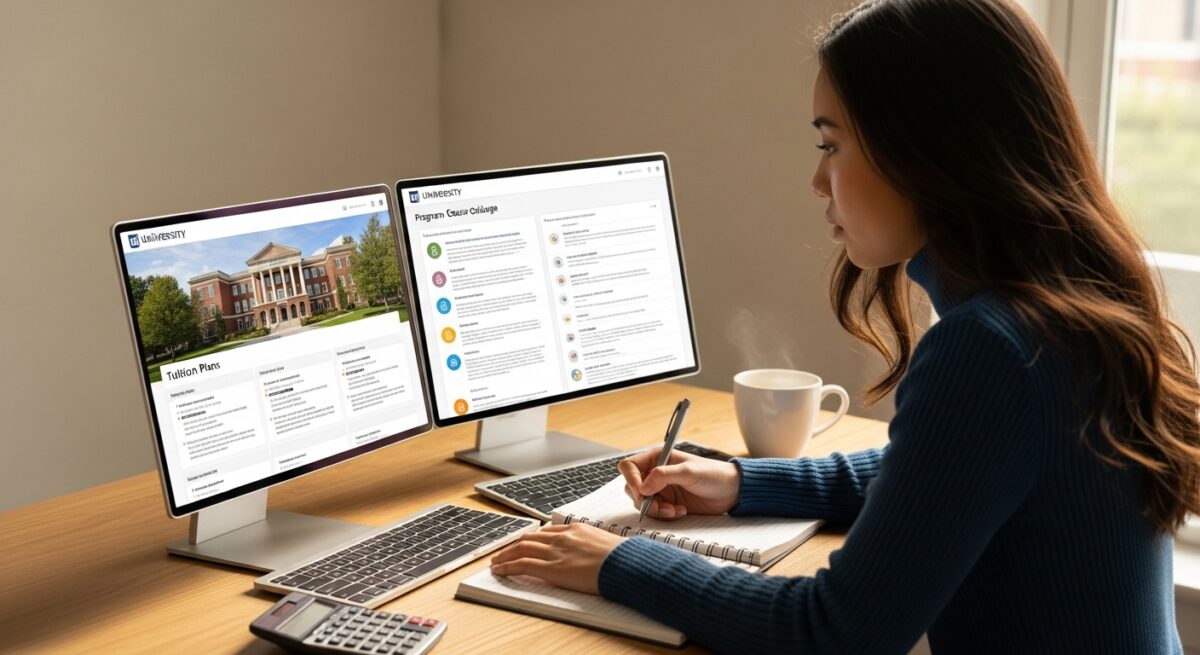
Pursuing a Master of Business Administration (MBA) is a proven way to accelerate your career, increase your earning potential, and build a powerful professional network. However, the cost of a traditional, on-campus MBA program can be staggering, often exceeding $100,000 for tuition alone. This financial barrier leads many ambitious professionals to search for more affordable alternatives. The good news is that a high-quality, accredited MBA does not have to come with a six-figure price tag. By focusing on the cheapest online MBA programs and understanding how to save on business degrees, you can achieve your academic and career goals without drowning in debt. This guide will walk you through the most effective strategies for finding low-cost online MBA options, evaluating their value, and making a smart financial decision that aligns with your future.
The landscape of online education has matured significantly. Accredited universities now offer rigorous, interactive, and respected MBA programs entirely online. These programs often have lower overhead costs than their on-campus counterparts, savings that are frequently passed on to students in the form of lower tuition rates. But identifying the truly cheapest online MBA programs requires more than just looking at the sticker price. You need to consider total cost, including fees, technology charges, and course materials. You also need to ensure the program holds proper accreditation, as this affects the value of your degree and your eligibility for federal financial aid. By the end of this article, you will have a clear roadmap for finding an affordable, high-quality MBA that fits your budget and your life.
What Defines a Truly Affordable Online MBA?
Before diving into specific programs, it is crucial to understand what makes an MBA program affordable. A low per-credit-hour rate is a great starting point, but it is not the entire picture. Many programs advertise a low tuition rate only to add substantial mandatory fees later. When comparing the cheapest online MBA programs, you must calculate the total program cost. This includes application fees, tuition, technology fees, library access fees, graduation fees, and the cost of textbooks or digital materials. A program that costs $400 per credit hour with no fees may be cheaper overall than one that costs $350 per credit hour but adds $200 in fees every semester.
Another defining factor is accreditation. The most respected and widely recognized accreditations for MBA programs are AACSB (Association to Advance Collegiate Schools of Business), ACBSP (Accreditation Council for Business Schools and Programs), and IACBE (International Accreditation Council for Business Education). An AACSB accreditation is often considered the gold standard and can be a requirement for certain employers or for those who wish to pursue a doctoral degree later. However, regionally accredited programs with ACBSP or IACBE accreditation can also provide excellent value and a quality education. Always verify that the school itself is regionally accredited, as this is essential for transfer credits and federal financial aid. A cheap program without proper accreditation is not a bargain; it is a risk.
Finally, consider the program format. Some of the cheapest online MBA programs are accelerated, allowing you to finish in 12 to 18 months instead of the traditional two years. This reduces the total time you are paying tuition and gets you back into the workforce faster. Other programs offer a self-paced format, which can be ideal if you have a variable work schedule. However, be cautious: the fastest and cheapest programs may also be the most intense. You need to honestly assess your ability to manage a rigorous course load while working full-time. explore college degree programs to see how different formats align with your personal and professional commitments.
Strategies for Finding Low Cost Online MBA Options
Finding a genuinely low-cost MBA requires a targeted search strategy. You cannot simply type “cheap online MBA” into a search engine and trust the first result. Instead, use a systematic approach to uncover the best value programs. The following strategies will help you identify affordable options that do not compromise on quality.
Focus on Public Universities. Public universities, especially those in your state of residence, often offer significantly lower tuition rates for online students. Many public institutions have extended their in-state tuition rates to all online students, regardless of where they live. This can dramatically reduce the cost of an MBA. For example, a public university in Texas might charge $500 per credit hour for online MBA students, while a private university might charge $1,500 or more for a similar program. Research the online MBA offerings from public universities in your state and in states known for low tuition rates.
Look for Flat-Rate Tuition Models. Some universities charge a flat rate per term (e.g., $3,000 per six-month term) instead of per credit hour. This model can be extremely cost-effective if you take a heavier course load. If you can handle 9 credit hours in a term, a flat-rate program might cost the same as taking 6 credit hours, effectively lowering your per-credit cost. This is a common feature in competency-based education (CBE) programs, which we will discuss next.
Consider Competency-Based Education (CBE). CBE programs are a game-changer for cost-conscious students. Instead of paying for time spent in class, you pay for a subscription period (e.g., every six months) and take as many courses as you can complete during that time. If you have significant professional experience, you can often move through the material quickly, earning your degree in less time and for less money. Western Governors University (WGU) is a well-known example of a non-profit, accredited university offering a CBE MBA program for around $4,500 per six-month term. This model is ideal for self-motivated learners who can work independently.
Leveraging Employer Tuition Assistance
Many employers offer tuition reimbursement or assistance programs as part of their benefits package. This is one of the most effective ways to reduce the cost of an MBA, and it is often overlooked. Before you enroll, check with your Human Resources department to see if your company offers any educational benefits. Some companies will reimburse a percentage of tuition costs, while others may pay for the entire degree up to a certain annual limit. If your employer offers this benefit, it can transform a moderately priced program into one of the cheapest online MBA programs for you. Be sure to understand any requirements, such as maintaining a minimum grade point average or committing to stay with the company for a certain period after graduation.
Even if your current employer does not offer tuition assistance, it is worth asking. Some companies are willing to negotiate educational benefits as part of a performance review or professional development plan. If you can demonstrate how the MBA will benefit the company directly (e.g., by improving your leadership skills or project management abilities), you have a stronger case. Additionally, you can explore external scholarships and grants specifically for online MBA students. Organizations like the Graduate Management Admission Council (GMAC) and local business associations sometimes offer scholarships to help reduce the financial burden.
Top Affordable Online MBA Programs to Consider
While specific tuition rates change annually, several universities consistently rank among the most affordable and respected for online MBA programs. These programs offer a combination of low tuition, strong accreditation, and positive student outcomes. Here are a few examples of the cheapest online MBA programs that you should investigate further.
- University of Texas Permian Basin (UTPB): This AACSB-accredited online MBA is known for its low tuition rate, often under $10,000 total for in-state students. It offers concentrations in areas like finance, management, and data analytics.
- University of North Alabama (UNA): UNA offers an AACSB-accredited MBA with a very competitive tuition rate for both in-state and out-of-state online students. The program is flexible and can be completed in about one year.
- Western Governors University (WGU): As mentioned, WGU’s competency-based model is one of the lowest-cost options available. The program is accredited by ACBSP and is ideal for self-directed learners.
- Stephen F. Austin State University (SFA): SFA provides an AACSB-accredited online MBA with a focus on practical, real-world skills. Its tuition is consistently among the lowest for AACSB-accredited programs.
- Texas A&M University-Commerce: This university offers an AACSB-accredited MBA with multiple concentration options and a very affordable tuition rate. It is particularly well-regarded for its student support services for online learners.
When evaluating these programs, do not just look at the tuition. Contact the admissions office and ask for a complete breakdown of all fees. Also, inquire about the average time to completion, graduation rates, and job placement statistics. A program that is cheap but has a low graduation rate or poor job placement may end up costing you more in lost income and delayed career advancement. A truly affordable program is one that helps you finish and succeed.
How to Maximize Savings on Your Online MBA
Beyond choosing one of the cheapest online MBA programs, there are several proactive steps you can take to further reduce your costs. These strategies focus on reducing the time to completion, minimizing debt, and leveraging available resources.
Transfer Credits. If you have taken graduate-level courses in the past, you may be able to transfer those credits into your MBA program. Many programs allow you to transfer up to 6 or 9 credit hours, which can shave off one or two semesters of tuition. Even undergraduate business courses that are recent and advanced may be considered for transfer, though this is less common. Always check the transfer policy of your target program before applying.
Test Out of Courses. Some MBA programs allow you to waive certain foundational courses if you can demonstrate proficiency through prior coursework or professional experience. For example, if you have a strong background in accounting, you might be able to waive the introductory accounting course. This saves both time and money. You may also be able to earn credit by passing standardized exams like the CLEP or DSST for certain business subjects, though this is more common at the undergraduate level.
Choose a Fixed-Rate Tuition Plan. If you need to take out loans, choose a program that offers a fixed-rate tuition payment plan. This allows you to pay in installments over the course of the semester, avoiding the need to take out large loans all at once. Some universities also offer discounts for paying tuition in full at the beginning of the semester. While this requires a lump sum, it can save you money on interest and fees in the long run.
Apply for Scholarships. Do not assume that scholarships are only for undergraduate students or for students with perfect GPAs. Many universities offer scholarships specifically for online MBA students. These may be merit-based, need-based, or tied to specific demographics or professional backgrounds. Spend time searching for external scholarships through websites like Fastweb or Scholarships.com. Even a $1,000 scholarship can make a significant difference in the total cost of your degree. Our guide on online MBA programs that do not require the GMAT can help you identify additional schools that may offer lower application costs and less financial friction.
Frequently Asked Questions
Are the cheapest online MBA programs worth it?
Yes, if they are properly accredited. A low-cost MBA from a regionally accredited institution with programmatic accreditation (AACSB, ACBSP, or IACBE) is a worthwhile investment. The value of the degree comes from the knowledge you gain, the skills you develop, and the network you build, not the price you pay. Many employers care more about the accreditation and reputation of the school than the tuition cost. However, be cautious of unaccredited programs, no matter how cheap they are.
How long does it take to complete an affordable online MBA?
Most affordable online MBA programs are designed to be completed in 12 to 24 months. Accelerated programs, especially those using a competency-based model, can be finished in as little as 12 months if you are able to dedicate significant time to your studies. Traditional semester-based programs typically take 18 to 24 months for a full-time student. Part-time options can take 3 to 4 years, but this will increase the total cost due to additional fees and potential tuition increases.
Can I get financial aid for a cheap online MBA?
Yes. If the program is offered by a regionally accredited university, you are eligible to apply for federal financial aid using the Free Application for Federal Student Aid (FAFSA). This includes federal student loans (both subsidized and unsubsidized) and, in some cases, federal grants. You may also be eligible for state-based aid or institutional aid. Even if the program is cheap, federal loans can help you manage cash flow while you are studying.
What is the difference between AACSB and ACBSP accreditation?
AACSB accreditation is often considered the highest standard for business schools and focuses heavily on research output and faculty credentials. ACBSP accreditation places a stronger emphasis on teaching quality and student outcomes. Both are legitimate and respected. For most students, especially those focused on a practical, career-oriented MBA, an ACBSP-accredited program offers excellent value. For those aiming for roles in academia or top-tier consulting firms, an AACSB-accredited program may be more beneficial. The key is to ensure the program has one of these accreditations, not just national accreditation.
Your Path to an Affordable Business Degree
Finding the cheapest online MBA programs is not about cutting corners; it is about being a smart consumer of education. You can achieve a high-quality MBA without taking on excessive debt by focusing on public universities, competency-based models, and flat-rate tuition structures. Remember to consider the total cost, including fees and materials, and to prioritize proper accreditation. The strategies outlined in this guide will help you navigate the landscape of low cost online MBA options and find a program that fits both your career ambitions and your financial reality.
Take the next step today. Research the programs mentioned, contact admissions offices, and apply for scholarships and employer assistance. Your future self will thank you for making a financially sound decision that opens doors to new opportunities. The journey to an advanced business degree is challenging, but with the right approach, it does not have to be financially crippling. Start your search now and commit to investing in your future wisely.
About the Author: James Taylor