
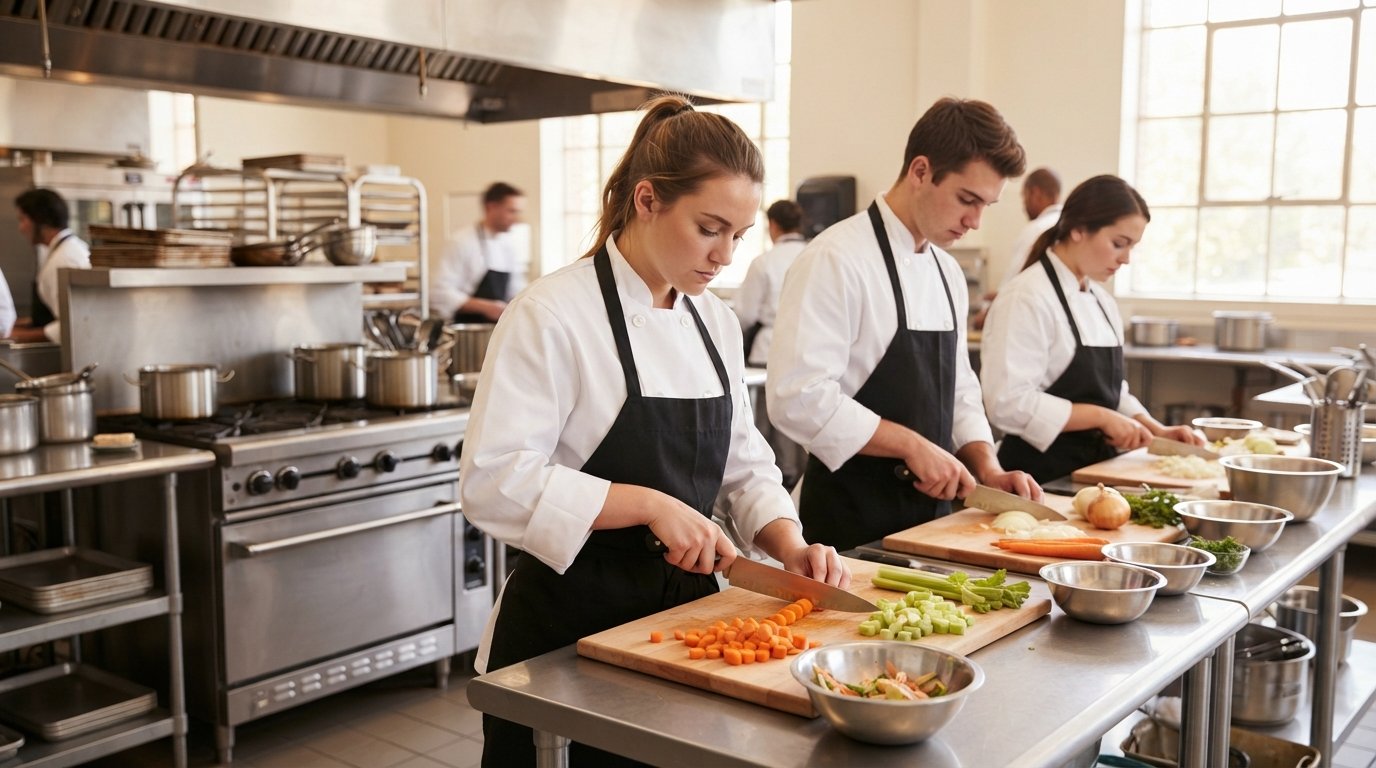
Culinary Arts Certificate at ENMU Ruidoso: 12 Weeks to 1 Year
The Culinary Arts/Chef Training Certificate at ENMU Ruidoso takes 12 weeks to less than 1 year, in person. Call 8772187081 for enrollment help.

By Ethan Brooks
Eastern New Mexico University Ruidoso Branch Community College offers a hands-on Culinary Arts/Chef Training Certificate that can be completed in 12 weeks to less than 1 year, entirely in person. For students who want to enter the workforce quickly, this program delivers practical kitchen skills, industry-recognized credentials, and a clear pathway to entry-level culinary positions. Unlike four-year degrees that require two years of general education before you ever touch a commercial range, this certificate gets you into professional kitchens fast, with training that employers actually value.
If you are a career changer, a recent high school graduate, or someone who simply loves cooking and wants to turn that passion into a paycheck, the ENMU Ruidoso culinary certificate is worth serious consideration. The program is short, affordable, and designed around the realities of the food service industry. You will learn knife skills, food safety, baking fundamentals, and line cooking, all while earning credits that can later stack into an associate degree if you decide to continue. This article explains what the certificate covers, who it is for, how to enroll, what it costs, and how to make the most of your investment.
Why a Short-Term Culinary Certificate Makes Sense
The traditional path to a culinary career often involves expensive private culinary schools with tuition exceeding $40,000 for an associate degree. That model works for some, but it leaves many graduates with heavy debt and entry-level wages. A short-term certificate at a community college like ENMU Ruidoso flips that equation. You pay a fraction of the cost, finish in months rather than years, and enter the same kitchens with the same fundamental skills.
Employers in restaurants, hotels, hospitals, and catering companies care about one thing: can you execute on the line? They want to see food handler certifications, knife proficiency, and the ability to work clean and fast under pressure. A 12-week to 1-year certificate delivers exactly that. It also gives you a low-risk way to test whether culinary work is right for you before committing to a longer degree. If you decide to continue, many community college credits transfer into associate programs, including at ENMU.
Another advantage is location. Ruidoso is a resort town with a steady demand for kitchen staff, especially during ski season and summer tourism. That means you can often find part-time or full-time work while you train, gaining real experience that makes your resume stronger the day you graduate.
What You Will Learn in the Culinary Arts Certificate Program
The curriculum at ENMU Ruidoso is built around core competencies that every professional kitchen expects. You will spend most of your time in a commercial kitchen lab, not in a lecture hall. Expect hands-on instruction in sanitation, knife work, stocks and sauces, protein fabrication, baking, and plate presentation.
Specific courses typically include food safety and sanitation (often aligned with ServSafe certification), culinary fundamentals, baking and pastry basics, and advanced cooking techniques. Depending on the track, you may also cover menu planning, cost control, and front-of-house operations. The goal is to produce a graduate who can step onto a line and contribute immediately.
Here are the core skill areas you can expect to develop:
- Food safety and sanitation: temperature control, cross-contamination prevention, and HACCP principles
- Knife skills: proper grip, cuts (dice, julienne, chiffonade), and sharpening techniques
- Cooking methods: dry heat, moist heat, and combination methods for meats, vegetables, and grains
- Baking and pastry: doughs, batters, quick breads, and basic desserts
- Kitchen management: mise en place, timing, and communication during service
Because the program is in person, you get immediate feedback from instructors who have worked in professional kitchens. That feedback loop is critical. You cannot learn to feel when a steak is medium-rare by watching a video. You need to touch it, smell it, and taste it under supervision. The in-person format at ENMU Ruidoso is one of its biggest strengths.
Admission Requirements and Enrollment Steps
Admission to the culinary certificate program is straightforward. ENMU Ruidoso is an open-admission community college, meaning you generally need a high school diploma or equivalent (GED) to enroll. There is no minimum GPA for most certificate tracks, though you may need to take a placement test for math and English if you are entering a degree program. For the certificate alone, the requirements are minimal.
Here is a simple step-by-step process to get started:
- Apply to ENMU Ruidoso online or through the admissions office.
- Submit official high school transcripts or GED scores.
- Complete the FAFSA to determine financial aid eligibility.
- Meet with a culinary advisor to plan your course sequence.
- Register for classes and pay tuition or set up a payment plan.
Because the program is short, start dates matter. Most students begin in the fall or spring semester, but some cohorts may start in summer. Check with the college for the current schedule. If you are a working adult, ask about evening or weekend options, though not all courses may be available at those times.
One more consideration: you will need a chef's knife, uniform, and non-slip shoes. Some programs provide these, others require you to purchase them. Budget $150 to $300 for tools and attire. It is a small investment compared to the cost of a private culinary school.
Cost, Financial Aid, and Return on Investment
Tuition at ENMU Ruidoso is among the most affordable in New Mexico. As a community college, it charges per credit hour, and the culinary certificate typically requires 15 to 30 credits depending on the track. For in-district students, tuition can be under $2,000 for the entire certificate. Out-of-district and out-of-state students pay more, but still far less than private culinary schools.
Financial aid is available. The FAFSA opens access to Pell Grants, which do not need to be repaid, and federal student loans if needed. New Mexico also offers state-level aid programs, and ENMU Ruidoso may have institutional scholarships for culinary students. You can also explore private scholarships through resources like Scholarship.Education, which aggregates opportunities for students at all levels.
When calculating return on investment, look at local wages. Entry-level cooks in Ruidoso and surrounding areas typically earn $14 to $18 per hour, with overtime and tips in some settings pushing that higher. A certificate that costs $2,000 and helps you land a $32,000 per year job pays for itself in weeks, not years. Compare that to a $40,000 culinary degree that might get you the same starting wage, and the value proposition becomes obvious.
If you are comparing this program to other short-term options, such as online certificates, keep in mind that hands-on kitchen time is irreplaceable. You can learn food safety theory online, but you cannot learn to sauté, grill, or plate under pressure without a real kitchen. That is why the in-person format at ENMU Ruidoso is worth the commute.
Career Outcomes and Next Steps After Graduation
Graduates of the culinary arts certificate program are prepared for a range of entry-level positions. Common job titles include line cook, prep cook, pastry assistant, catering assistant, and kitchen supervisor in smaller operations. With a few years of experience, you can move into sous chef or kitchen manager roles. Some graduates go on to open food trucks, start catering businesses, or work in institutional kitchens such as schools and hospitals, which offer more stable hours and benefits.
If you want to continue your education, the certificate stacks into an Associate of Applied Science in Culinary Arts at ENMU or transfers to other institutions. That pathway lets you earn while you learn and avoid debt. Many students work in local restaurants while completing their associate degree, then move into higher-paying roles.
For those considering a broader range of college options, including online degrees and cost comparisons, resources like State University of New York Colleges and Costs Explained can help you understand how different systems price their programs. The same principles of comparing tuition, fees, and outcomes apply whether you are looking at culinary arts or computer science.
Before you enroll, do a quick self-assessment. Are you comfortable standing for long periods? Can you handle the heat, both literal and figurative? Do you work well in a team under pressure? If yes, you are likely to thrive. If not, a short certificate is still a low-risk way to find out. You can always pivot to another field, and the credits you earn may count toward general education requirements.
How to Succeed in the Program
Success in a 12-week to 1-year culinary certificate comes down to attendance, practice, and attitude. Missing a lab session means missing a skill you will need later. Show up early, keep your station clean, and ask questions. Instructors notice the students who treat the kitchen like a real job, because that is exactly what it is.
Outside of class, practice at home. Buy a cheap cut of meat and break it down. Make stocks from scraps. Bake bread until you understand how yeast behaves. The more repetitions you get, the faster your hands learn. Also, network with local chefs. Ruidoso has a tight-knit hospitality community, and a good word from an instructor or a chef you met during a stage (internship) can open doors.
Finally, keep your resume updated and be willing to start at the bottom. Every executive chef started as a prep cook. The certificate gets you in the door; your work ethic keeps you there and moves you up. If you are ready to start a hands-on culinary career without years of debt, the ENMU Ruidoso program is one of the most direct paths available.