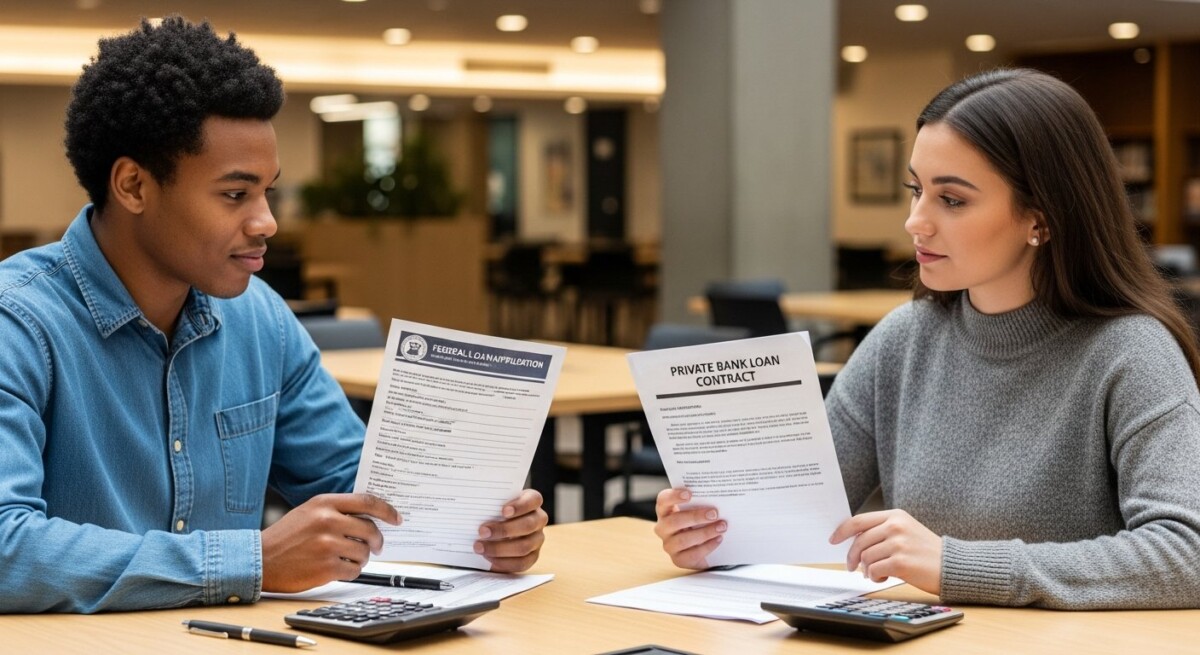
Deciding how to pay for college is one of the most consequential financial decisions you will make. The choice between a federal loan and a private loan can shape your repayment experience for years. While both options provide funding for tuition and living expenses, they operate under very different rules. Understanding these differences is critical because the wrong choice could cost you thousands of dollars in extra interest or leave you without crucial borrower protections. This guide breaks down the federal vs private student loan dilemma so you can make a confident, informed decision.
What Makes Federal Student Loans Unique
Federal student loans are issued by the U.S. Department of Education. They are designed with the borrower’s long-term financial health in mind. The government sets fixed interest rates each academic year, and those rates are almost always lower than what private lenders offer. For undergraduate loans disbursed after July 1, 2024, the interest rate is 6.53%. Graduate and parent PLUS loans carry higher rates, but they are still fixed for the life of the loan.
The most powerful feature of federal loans is the built-in safety net. Borrowers automatically gain access to income-driven repayment (IDR) plans. These plans cap your monthly payment at a percentage of your discretionary income. If your income is low enough, your payment can drop to zero dollars. After 20 or 25 years of qualifying payments, any remaining balance is forgiven. No private lender offers this kind of long-term protection.
Federal loans also offer deferment and forbearance options. If you lose your job or face a medical emergency, you can temporarily stop making payments without going into default. During the COVID-19 pandemic, federal loan payments were paused entirely with zero interest accrual. Private lenders did not offer this relief. Additionally, federal loans are eligible for Public Service Loan Forgiveness (PSLF). If you work for a government agency or a qualifying nonprofit for ten years while making on-time payments, the remainder of your loan balance is forgiven tax-free.
The Reality of Private Student Loans
Private student loans come from banks, credit unions, and online lenders. They are not backed by the government. This fundamental difference changes everything about how they work. Interest rates can be either fixed or variable. Variable rates often start low but can increase over time, making your monthly payment unpredictable. Fixed rates from private lenders are typically higher than federal rates, especially for borrowers who do not have excellent credit.
Private lenders determine your interest rate based on your credit score and income. Most undergraduate students have limited credit history. This means they will either need a creditworthy cosigner or they will face a very high interest rate. A cosigner is someone who agrees to repay the loan if you cannot. This puts the cosigner’s credit and financial stability at risk. If you miss a payment, both your credit score and your cosigner’s credit score will suffer.
Repayment options for private loans are far less flexible. Some lenders offer a short period of deferment while you are in school, but after that, the options are limited. There are no income-driven repayment plans. There is no forgiveness program. If you struggle to make payments, your options are usually limited to a short forbearance period. Interest continues to accrue during that time, making your balance grow larger.
Key Differences at a Glance
To help you see the full picture, here are the most important differences summarized side by side.
- Interest rates: Federal loans have fixed rates set by Congress. Private loans have rates based on your credit, which can be fixed or variable.
- Repayment flexibility: Federal loans offer income-driven plans, deferment, and forbearance. Private loans offer limited options and no income-driven plans.
- Forgiveness programs: Federal loans qualify for PSLF and IDR forgiveness. Private loans have no forgiveness programs.
- Cosigner requirement: Federal loans do not require a cosigner. Private loans almost always require a cosigner for students with limited credit.
- Loan limits: Federal loans have annual and aggregate limits. Private loans can cover the full cost of attendance up to the school’s certified amount.
These differences highlight why federal loans are generally the safer first choice. The protections built into federal loans are designed to prevent borrowers from falling into a financial crisis. Private loans lack those protections, which makes them riskier.
When Federal Loans Are the Clear Winner
For the vast majority of students, federal loans should be the first option you pursue. This is especially true if you plan to work in a field with a modest starting salary. Teachers, social workers, nurses, and public servants benefit enormously from income-driven repayment and PSLF. Even if you do not pursue a public service career, the ability to cap your payments based on income provides a safety net that private loans cannot match.
Another scenario where federal loans win is when you have little or no credit history. Without a cosigner, a private lender may reject your application or offer an interest rate above 15%. A federal Direct Subsidized or Unsubsidized Loan does not check your credit score at all. As long as you complete the Free Application for Federal Student Aid (FAFSA) and are enrolled at least half-time, you are eligible.
Federal loans also protect you if you decide to return to school later. If you enroll in graduate school, your undergraduate federal loans can be placed into deferment. Interest on subsidized loans does not accrue during deferment. Private lenders generally allow deferment while you are in school, but interest will continue to accrue on all balances.
When Private Loans Might Make Sense
There are situations where a private loan is a reasonable tool. The most common reason is that federal loan limits are not enough to cover your total cost of attendance. Undergraduate dependent students can borrow a maximum of $31,000 in federal Direct Loans over four years. If your tuition, room, and board exceed that amount, you may need a private loan to bridge the gap.
Another scenario is when you have an excellent credit score and a stable income. If you qualify for a low variable rate, you might end up paying less interest than the federal fixed rate. However, this strategy carries risk. If interest rates rise, your variable rate will rise too. You are betting that your income will keep pace with your payment increases. For a graduate student or a professional with a high earning potential, this bet might pay off. For an undergraduate, it is usually too risky.
Some private lenders also offer specialized loans for specific degree programs. For example, a medical school loan might offer a lower rate for students entering a high-demand specialty. These niche products can be useful, but they should only be considered after you have exhausted all federal loan eligibility. Before signing any private loan, you should compare offers from multiple lenders and read the fine print about deferment and forbearance policies.
How Your School Choice Affects the Decision
The cost of your school directly influences how much you need to borrow. A more expensive school may require you to use private loans to fill the gap after federal aid and scholarships. This is where careful planning becomes essential. Before you commit to a school, use a net price calculator to estimate your true out-of-pocket cost. Compare that number to your expected starting salary in your chosen field. A general rule of thumb is to keep your total student loan debt below your expected first-year annual salary.
If you are considering an online degree program or a career-focused certificate, be especially careful about borrowing. Some programs are expensive and may not lead to the high income you expect. In our guide on online graduate studies for future doctoral students, we explain how to evaluate program costs and return on investment. The same principles apply to any degree. Always borrow the minimum amount necessary to achieve your educational goals.
Your school’s financial aid office can also help you understand your options. They can tell you how much federal aid you are eligible for and whether your school participates in any state-specific loan programs. Some states offer low-interest loans to residents attending in-state schools. These loans often have terms that fall somewhere between federal and private loans. Ask your aid office about these programs before you apply for a private loan.
For more detailed information on college financing strategies, you can explore resources at CollegeDegree.education, which offers additional guidance on affordable higher education paths.
Frequently Asked Questions
Can I switch from a private loan to a federal loan later?
No. You cannot convert a private loan into a federal loan. The only way to get federal loan benefits on a private loan is to refinance it into a federal loan, but that option does not exist. Once you take a private loan, you are locked into that lender’s terms. This is why it is critical to use federal loans first.
Do private loans ever offer forgiveness?
Very rarely. Some private lenders offer death or disability discharge, but there is no broad forgiveness program like PSLF. If you die or become permanently disabled, the loan may be discharged. Otherwise, you are responsible for the full balance plus interest.
What happens if I default on a federal loan versus a private loan?
Defaulting on a federal loan triggers collection fees, wage garnishment, and tax refund seizure. However, you can rehabilitate the loan and get back into good standing. Defaulting on a private loan leads to similar consequences, but there is no rehabilitation program. The lender can sue you and obtain a judgment that lasts for years. Your credit score will be severely damaged in both cases.
How do I apply for federal student loans?
You must complete the FAFSA each year you need aid. The FAFSA opens on October 1 for the following academic year. Your school uses the information to determine your eligibility for grants, work-study, and federal loans. You accept the loan offer through your school’s financial aid portal.
Making Your Final Choice
Choosing between a federal and private student loan is not about finding the lowest interest rate alone. It is about protecting your future financial flexibility. Federal loans offer a safety net that private loans cannot match. Start with federal loans. Max out your Direct Subsidized and Unsubsidized loans before considering any private option. If you must use a private loan, borrow only what you absolutely need and shop around for the best rate with a creditworthy cosigner if possible. Your future self will thank you for making a deliberate, informed decision today.
About the Author: Michael Anderson