
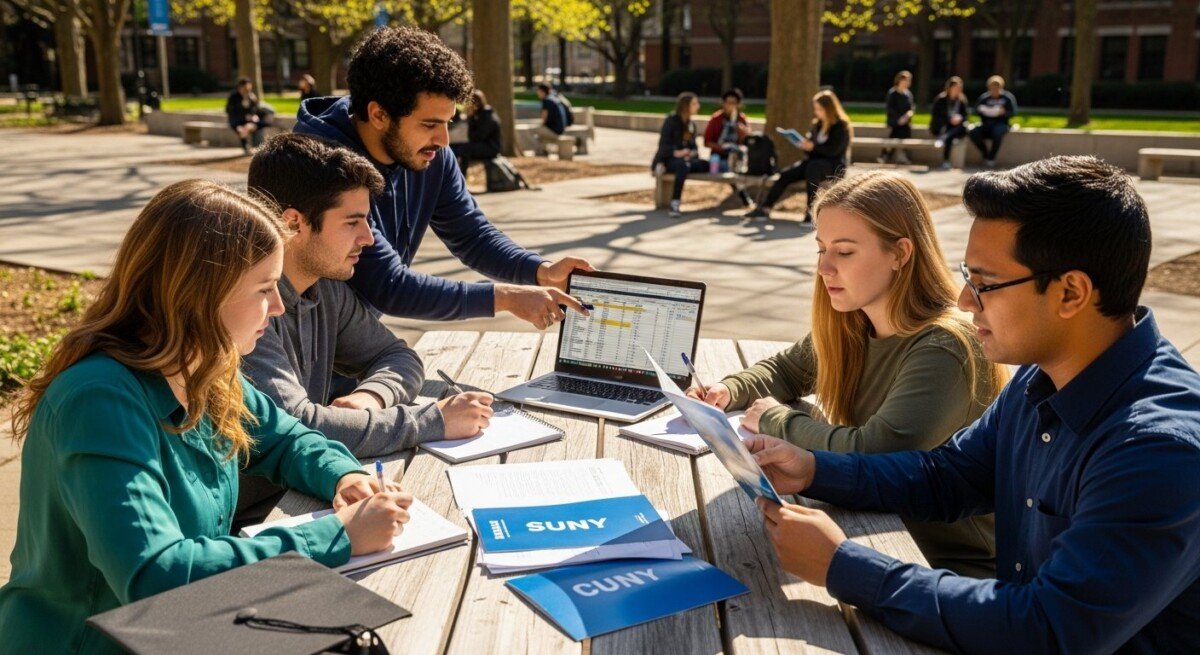
Finding New York’s Most Affordable University Tuition Rates
Discover how SUNY and CUNY systems, combined with state aid, offer New York’s most affordable university tuition rates, potentially leading to a debt-free degree.

By Lisa Bennett
Navigating the high cost of higher education can feel overwhelming, especially in a state known for its prestigious and often expensive institutions. However, New York State offers a surprising array of affordable university tuition rates for residents who know where to look. The key to unlocking a valuable degree without crippling debt lies in understanding the state’s public university systems, financial aid programs, and strategic pathways designed to keep costs manageable. This guide will demystify the landscape, highlighting the institutions with the lowest published tuition, the programs that can reduce your out-of-pocket expenses to near zero, and the planning steps every student should take. Affordable education in New York is not a myth, it’s a matter of informed strategy and resourcefulness.
Understanding New York’s Public University Systems
New York’s commitment to public higher education is structured through two primary systems: The State University of New York (SUNY) and The City University of New York (CUNY). These networks form the backbone of affordable education in the state, offering high-quality degrees at a fraction of the cost of private colleges. SUNY is one of the largest comprehensive university systems in the United States, encompassing 64 campuses including university centers, comprehensive colleges, technology colleges, and community colleges. CUNY, a cornerstone of New York City, is comprised of 25 campuses, including senior colleges, community colleges, and graduate and professional schools. The tuition rates for these institutions are set by the state, providing a level of predictability and affordability unmatched by the private sector. For a detailed breakdown of costs across these systems, our guide on New York Public University Tuition And Costs Explained provides essential context.
The published “sticker price” tuition at SUNY and CUNY schools is where the affordability conversation begins. For the 2024-2025 academic year, annual undergraduate tuition for full-time New York State residents is approximately $7,070 at SUNY four-year colleges and $6,930 at CUNY senior colleges. SUNY and CUNY community colleges have even lower rates, often around $5,000 per year. It is critical to understand that these are base tuition figures before any financial aid is applied. When compared to the national average for private nonprofit four-year colleges, which exceeds $40,000 per year in tuition alone, the value proposition of New York’s public systems becomes starkly clear. This foundational affordability makes pursuing a bachelor’s or associate degree a realistic goal for a much broader population.
Top Institutions With the Lowest Published Tuition
While the SUNY and CUNY systems provide a general framework for low costs, specific campuses stand out for their particularly affordable rates, especially when considering two-year degrees that can lead to high-paying careers or seamless transfer pathways. SUNY community colleges, such as SUNY Adirondack, Cayuga Community College, and Clinton Community College, typically have the lowest published tuition in the state, often dipping below $5,000 annually for residents. These institutions are gateways to associate degrees and certificates in high-demand fields like nursing, information technology, and skilled trades. Similarly, CUNY’s community colleges, including Borough of Manhattan Community College (BMCC), Kingsborough Community College, and LaGuardia Community College, offer parallel affordability within New York City, with strong articulation agreements to CUNY senior colleges.
Among four-year options, certain SUNY colleges maintain lower tuition while offering a comprehensive university experience. SUNY College of Environmental Science and Forestry (ESF), SUNY Polytechnic Institute, and the College of Technology at Delhi are examples where specialized, career-focused education is delivered at the standard SUNY tuition rate. The true cost, however, is rarely the published tuition. A student’s final net price is determined after grants, scholarships, and tax benefits are accounted for. New York’s Excelsior Scholarship, when combined with other aid, can make tuition free for eligible families earning up to $125,000. Furthermore, the federal Pell Grant, which does not need to be repaid, can cover a significant portion, if not all, of the base tuition at these affordable institutions for students with the greatest financial need.
Maximizing Financial Aid and Scholarship Opportunities
Securing New York’s most affordable university tuition rates is less about finding the cheapest sticker price and more about aggressively pursuing all available financial aid to minimize your net cost. The process starts with the Free Application for Federal Student Aid (FAFSA) and the New York State-specific application, the TAP (Tuition Assistance Program) application. Completing these forms is non-negotiable for unlocking need-based grants, which are essentially free money. New York State is notably generous with its aid programs. The TAP grant alone can provide up to $5,665 per year for eligible students attending a SUNY or CUNY school. The Excelsior Scholarship, mentioned earlier, covers any remaining tuition balance after other state grants are applied, effectively creating a tuition-free scenario for qualifying students.
Beyond state programs, a strategic approach to scholarships is vital. This includes:
- Institutional Scholarships: Many SUNY and CUNY campuses have their own merit-based and need-based scholarship funds. Always check the financial aid page of your target schools.
- New York-Specific Scholarships: Programs like the STEM Incentive Program, which provides full SUNY or CUNY tuition to top STEM students, or scholarships for children of deceased or disabled veterans.
- External Scholarships: Numerous private organizations, community foundations, and corporations offer scholarships to New York residents. Diligent, ongoing search efforts are required.
- Federal Work-Study: This program provides part-time jobs for students with financial need, allowing them to earn money to help pay education expenses.
The goal is to create a financial aid package composed primarily of grants and scholarships, minimizing reliance on loans. A student who strategically combines a low-tuition SUNY or CUNY education with state, federal, and institutional aid can often graduate with minimal to no student debt, a outcome that defines true affordability. For broader strategies on finding low-cost options, similar principles apply in other states, as explored in our article on Affordable Georgia Universities.
Strategic Pathways to Reduce Overall Degree Cost
Affordability extends beyond annual tuition. Smart academic planning can significantly reduce the total cost of your degree. One of the most effective strategies is beginning your education at a SUNY or CUNY community college. By completing your associate degree and general education requirements at a lower cost (often half the per-credit rate of a four-year school), you can then transfer to a SUNY or CUNY four-year college to complete your bachelor’s degree. New York has strong transfer pathways and articulation agreements within its public systems, ensuring credits move seamlessly. This “2+2” model can save tens of thousands of dollars over four years.
Another powerful tactic is leveraging Advanced Placement (AP) exams, International Baccalaureate (IB) credits, or college-level examination program (CLEP) tests. Earning college credit through these exams in high school or before enrollment can allow you to graduate a semester or even a year early, slashing tuition, fees, and living expenses. Furthermore, taking a full course load (typically 15 credits per semester) is crucial. Falling into the habit of taking only 12 credits (the minimum for full-time status) extends your time to graduation and increases total cost. Summer and winter session courses at community colleges can also help you stay on track or get ahead at a lower per-credit cost. When planning these pathways, comprehensive college tuition information and degree planning resources can be invaluable for mapping out the most efficient and cost-effective route to your academic goals.
Frequently Asked Questions
What is the absolute cheapest university tuition in New York?
The lowest published tuition rates are at SUNY and CUNY community colleges, with annual full-time tuition for residents often around $5,000. However, after need-based grants like Pell and TAP, the net cost for eligible students can be $0.
Can I get free tuition in New York?
Yes, for many students. The combination of the Excelsior Scholarship, TAP Grant, and federal Pell Grant can cover full tuition at SUNY and CUNY schools for eligible New York residents whose families earn up to $125,000 annually. “Free tuition” typically refers to tuition only, not fees, room, or board.
Are SUNY and CUNY schools good quality?
Absolutely. Many SUNY and CUNY schools are highly ranked nationally and regionally for academic quality, specific programs, and value. Institutions like SUNY Binghamton, Stony Brook University, CUNY Baruch College, and Hunter College are consistently recognized for excellence.
Do I have to be a New York resident to get these rates?
The low in-state tuition rates are exclusively for New York State residents who have lived in the state for at least 12 continuous months prior to enrollment. Out-of-state and international students pay significantly higher tuition at SUNY and CUNY schools.
How does the Excelsior Scholarship work?
The Excelsior Scholarship covers any remaining tuition balance after other state grants and aid (like TAP) are applied. Recipients must be full-time students, complete 30 credits per year, and agree to live and work in New York State for the same number of years they received the award after graduation.
Finding an affordable education in New York requires a shift in perspective from focusing solely on sticker price to understanding the dynamic ecosystem of public systems, financial aid, and strategic planning. By targeting SUNY and CUNY institutions, diligently applying for all available grants and scholarships, and employing cost-saving academic pathways, a high-quality university degree becomes an accessible and financially prudent investment. The resources exist to make higher education affordable, empowering students to pursue their ambitions without the shadow of unsustainable debt.