
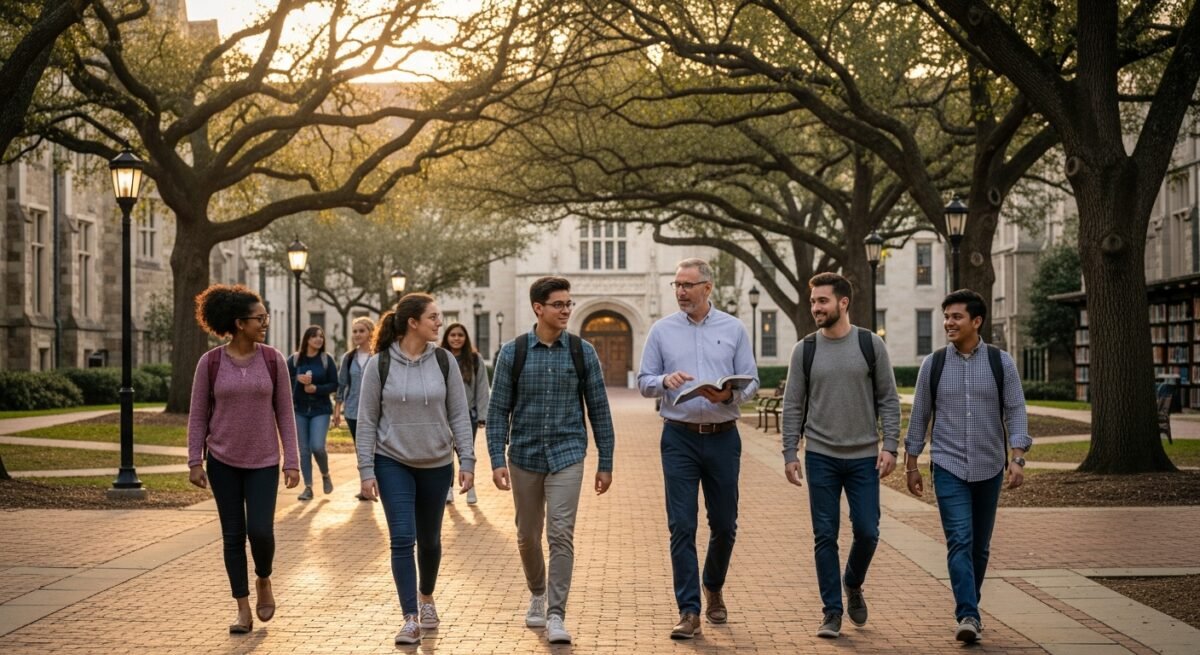
Traditional Campus Education: Beyond the Lecture Hall Experience
Traditional campus education fosters holistic development through immersive community and hands-on learning. It builds irreplaceable personal and professional networks within a structured, transformative environment.

By Sarah Thompson
In an era dominated by digital learning platforms and virtual classrooms, the enduring model of traditional campus education stands as a testament to a centuries-old pursuit of knowledge. While online programs offer unparalleled flexibility, the brick-and-mortar university experience provides a holistic developmental journey that extends far beyond academic transcripts. The value of living and learning in a dedicated intellectual community, navigating social dynamics in person, and accessing resources that are tangible and immediate creates a formative chapter unlike any other. This immersive environment is designed not just to educate, but to transform, building professional networks and personal resilience through a shared, physical experience.
The Core Pillars of the On-Campus Learning Model
At its heart, traditional campus education is built upon synchronous, in-person engagement. This model creates a structured rhythm of academic life, from scheduled lectures and laboratory sessions to set office hours and library study groups. The physical proximity to faculty is a cornerstone; the ability to stop by a professor’s office after class to clarify a complex theory, or to engage in spontaneous debate in a hallway, fosters mentorship and deepens understanding in ways that are challenging to replicate digitally. This environment demands and cultivates time-management and personal accountability within a community framework, preparing students for the structured collaboration of many professional workplaces.
The campus itself acts as a curated ecosystem for learning. Beyond classrooms, it houses specialized facilities: science labs with advanced equipment, performing arts theaters, engineering workshops, and archival libraries. Access to these resources is often immediate and hands-on. A chemistry student can run experiments, an architecture student can build models in a studio, and a history student can handle primary documents. This tactile, experiential learning is integral to many disciplines. Furthermore, the library becomes more than a book repository; it’s a silent sanctuary for deep work, a hub for group projects, and a place where librarians provide expert, face-to-face research guidance.
The Unquantifiable Benefits of Immersive Community
Perhaps the most significant differentiator of traditional campus education is the development of the “whole person” through constant, unstructured social and intellectual interaction. Dorm life, student union gatherings, campus events, and even casual conversations in the dining hall contribute to a vital education in interpersonal skills, emotional intelligence, and cultural awareness. Students learn to navigate conflicts, build friendships with diverse peers, and develop a sense of independence within a supportive safety net. This micro-society is where leadership is practiced in student government, empathy is forged in late-night discussions, and lifelong networks begin.
The concentration of ambitious, like-minded individuals in one place creates a powerful synergy. Study groups form organically. Interdisciplinary conversations happen over coffee. Clubs and organizations allow for the deep pursuit of passions, from debate teams to robotics clubs, often with dedicated faculty advisors and university funding. This ecosystem accelerates personal growth, pushing students to explore interests they never knew they had and to build a robust extracurricular portfolio that complements their academic record. The sense of shared identity and school spirit that emerges from this collective experience can foster alumni networks that are incredibly strong and professionally valuable for decades.
Navigating the Financial and Logistical Realities
The profound benefits of on-campus learning come with significant considerations, primarily cost and logistics. Tuition, room, board, and ancillary fees represent a major financial investment. Families must plan for this substantial expense, which extends beyond academics to include lifestyle costs. However, numerous avenues exist to mitigate this burden. Universities offer need-based aid, merit scholarships, work-study programs, and grants. Proactively seeking these opportunities is crucial. For comprehensive guidance on navigating this complex landscape, exploring dedicated Scholarship & Financial Aid Resources can be an essential first step in making a campus education financially feasible.
Logistically, attending a physical campus requires relocation for most students, involving a move away from home and the establishment of a new life in a different city or state. This requires adaptability, planning for living arrangements, and often managing a tighter, less flexible daily schedule bound by class times, facility hours, and commuting across campus. Unlike the asynchronous nature of many online education programs, the traditional model demands physical presence, which can limit part-time work opportunities or family commitments for some students.
Strategic Integration with Digital Evolution
The modern campus is not a relic resisting technology; it is increasingly a blended environment. The most effective traditional programs now intelligently incorporate digital tools to enhance the in-person experience. Learning Management Systems (LMS) like Canvas or Blackboard are used to distribute syllabi, submit assignments, and host discussion forums that continue conversations outside of class. Lectures may be recorded for review, and digital libraries provide 24/7 access to journals. This hybrid approach leverages technology for administrative efficiency and supplemental learning while preserving the core value of live interaction.
Furthermore, campuses are becoming living labs for technological innovation itself. Courses in data science, artificial intelligence, and virtual reality are not only taught about but are often developed and applied within university research centers. Students in these programs benefit from direct access to cutting-edge tools and the faculty who are creating them. For instance, a student studying how AI is used in mathematics can witness and participate in groundbreaking research right on campus, collaborating with professors and graduate students in a hands-on capacity that purely online programs may struggle to provide at the same scale.
Who Thrives in a Traditional Campus Setting?
Identifying the ideal candidate for this model helps students make informed choices. Traditional campus education is particularly powerful for:
- Hands-on Learners: Students in STEM fields, fine arts, performing arts, and lab-based sciences who need constant access to specialized physical equipment and spaces.
- Social Learners and Network Builders: Individuals who gain energy and insight from group dynamics, debate, and collaborative projects, and who understand the long-term value of a strong professional network.
- Those Seeking Structured Independence: Young adults ready to leave home and build self-reliance, but who benefit from the supportive framework of dorm life, academic advising, and on-campus health and wellness services.
- Students Undeclared or Exploring: The ability to easily sit in on different classes, visit various department fairs, and have spontaneous conversations with students in other majors provides an unparalleled environment for intellectual discovery.
This model may be less ideal for highly disciplined self-starters who require maximum scheduling flexibility due to full-time work or family obligations, or for those for whom the cost is prohibitively high without substantial financial aid. For these learners, high-quality distance education programs offer a compelling and valid alternative path to a degree.
The decision to pursue a traditional campus education is a significant one, weighing profound developmental benefits against real financial and logistical considerations. It remains a powerful rite of passage and an immersive investment in one’s future. In a world of increasing digital connection, the value of physical community, direct mentorship, and experiential learning within a dedicated intellectual space continues to hold immense, irreplaceable power for shaping capable, connected, and well-rounded graduates. The future of higher education likely lies not in the extinction of this model, but in its continued evolution, thoughtfully integrating the best of technology to enrich its timeless human core.