
Mathematics Associate's Degree at Dodge City CC: 2 Years
Earn a Mathematics, General Associate's degree in about 2 years in person at Dodge City Community College and transfer affordably to a four-year math or engineering program.

Choosing a college path that balances cost, flexibility, and real career value is harder than it looks. A Mathematics, General Associate's degree, usually 2 years In-person at Dodge City Community College, offers a focused, affordable route for students who want strong analytical skills without committing to a four-year university right away. Dodge City Community College (DC3) in Dodge City, Kansas, delivers this program on campus, giving learners face-to-face instruction, small class sizes, and a clear transfer pathway to bachelor's degrees in math, engineering, data science, and education.
This guide breaks down what the program covers, who it suits, how much it costs, and how to decide whether it fits your goals. You will also see how a two-year math degree fits into broader affordability planning, including tuition-free community college promise programs by state that can reduce or eliminate tuition for eligible students. If you are weighing a low-cost start against a university track, the details below will help you compare options with confidence.
What the Mathematics, General Associate's Degree Covers
The Mathematics, General Associate's degree at Dodge City Community College is built around foundational coursework in calculus, linear algebra, differential equations, and statistics, paired with general education requirements in English, humanities, and natural sciences. Because it is a general mathematics degree rather than a specialized track, the curriculum keeps your options open. You can tailor electives toward engineering transfer, computer science, actuarial preparation, or secondary math education.
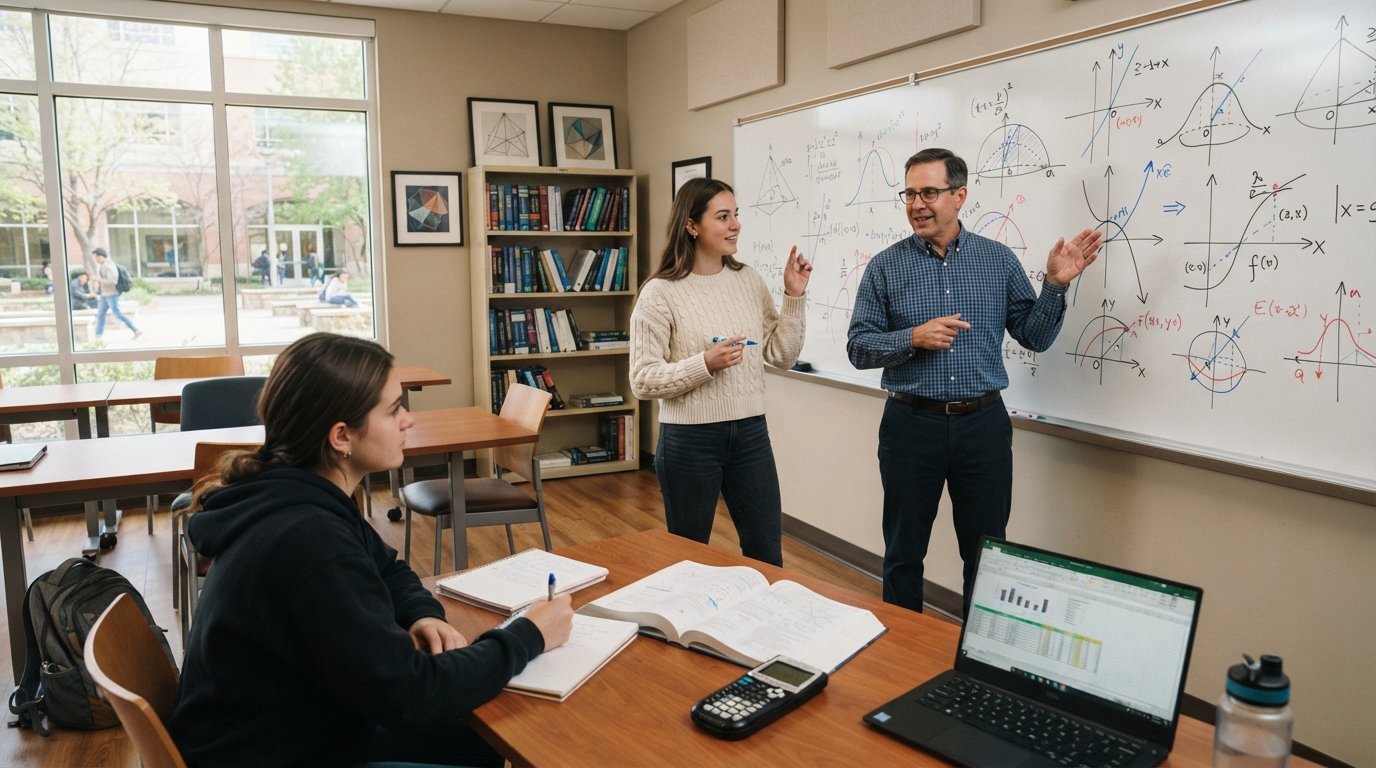
Most students complete the program in about two years of full-time study, though part-time learners often stretch it to three or four years. The in-person format matters here: you attend classes on the Dodge City campus, work directly with instructors during office hours, and use campus tutoring and math labs. That structure tends to help students who want accountability and real-time feedback, especially in courses like Calculus II and III where concepts build quickly.
Typical course groupings include:
- Calculus I, II, and III, plus differential equations
- Linear algebra and introductory statistics or probability
- General education: composition, speech, humanities, and lab sciences
- Electives in computer science, physics, or education based on transfer goals
One practical advantage of a general math associate's degree is transferability. Kansas has strong articulation agreements among its public institutions, and DC3 credits commonly transfer to four-year schools such as Fort Hays State University, Kansas State University, and Wichita State University. If you plan carefully with an advisor, you can enter a bachelor's program as a junior, saving two years of university tuition. That cost difference is often tens of thousands of dollars, which makes this pathway worth serious consideration for budget-conscious families.
It is also worth noting that the program is not only for future mathematicians. Employers in finance, logistics, agriculture technology, and data analysis value the problem-solving and quantitative reasoning skills this degree builds. For students who are unsure about a four-year commitment, the associate's degree provides a credential that can lead directly to entry-level roles or serve as a stepping stone.
Who Should Choose This In-Person Program
The Mathematics, General Associate's degree, usually 2 years In-person at Dodge City Community College, fits students who learn best in a structured classroom environment. If you thrive with scheduled classes, direct access to professors, and a campus routine, this format can be more effective than self-paced online study. It also suits students who plan to transfer into engineering, computer science, or math education programs and want to complete foundational courses at a lower cost.
Adult learners returning to college after a gap often choose this program because DC3 offers developmental math support and advising. Students who struggled with math in high school can rebuild skills before tackling calculus. Meanwhile, high-achieving high school students in the region can sometimes take dual credit courses that count toward the degree, shortening the time to completion.
On the other hand, this program may not be the best fit if you need maximum scheduling flexibility, live far from Dodge City, or require fully online delivery. In those cases, online math associate's degrees or hybrid options at other colleges may serve you better. The key is matching the delivery format to your life situation, because even an affordable program becomes costly if you cannot attend consistently.
Career and academic outcomes also deserve attention. Graduates often pursue roles such as data entry analyst, actuarial assistant, math tutor, or transfer to a four-year teaching program. The U.S. Bureau of Labor Statistics projects steady demand for occupations requiring quantitative skills, from statisticians to operations research analysts. For students who want to explore how different careers map to degrees and training paths, resources like Careers.org provide occupation profiles, education requirements, and work settings that can inform your decision.
Costs, Financial Aid, and Affordability
Community college tuition is generally far lower than four-year university tuition, and DC3 is no exception. As a public two-year institution, Dodge City Community College charges per-credit-hour rates for in-district, in-state, and out-of-state students, with in-district residents paying the least. For a full-time student taking 15 credits per semester, total tuition and fees for two years often land well below the cost of a single year at many public universities.
Financial aid can reduce that number further. Students should complete the FAFSA to access Pell Grants, federal work-study, and subsidized loans. Kansas also offers state grant programs, and DC3 awards institutional scholarships for academics, athletics, and technical programs. Many students combine these sources to cover most or all of their tuition.
Another underused strategy is checking whether your state operates a promise program. These programs can cover tuition at community colleges for eligible students, sometimes with conditions like full-time enrollment or service requirements. Families should compare the net price of attendance, not just sticker price, and ask financial aid offices about book costs, transportation, and housing if they plan to live on or near campus.
For readers building a broader college budget, the College & Tuition site offers tools and guides on comparing tuition, understanding financial aid packages, and estimating total costs. Pairing that research with a conversation with a DC3 advisor gives you a realistic picture of what two years will actually cost and how transfer scholarships might reduce your final two years at a university.
Admissions Steps and Transfer Planning
Applying to DC3 is straightforward, but planning your transfer early makes a bigger difference than the application itself. Most students follow a sequence like this:
- Complete the DC3 admissions application and submit high school transcripts or equivalency documents.
- Take placement assessments in math and English, or submit ACT scores if available, to determine starting courses.
- Meet with an academic advisor to map a two-year plan aligned with your intended bachelor's major.
- File the FAFSA and apply for DC3 scholarships and any state or promise program aid.
- By your second semester, identify target four-year schools and confirm which credits transfer under articulation agreements.
Transfer planning deserves special emphasis because course sequencing in math is unforgiving. If you start one level below calculus, you may need summer terms to finish in two years. Advisors can help you avoid wasted credits and choose electives that satisfy both associate's and bachelor's requirements. Students aiming for engineering should confirm whether their target university requires specific physics or computer science courses that differ from the general math track.
It also helps to visit four-year campuses, attend transfer fairs, and ask about merit scholarships for transfer students. Many universities reserve funding specifically for community college graduates, and some guarantee admission for associate's degree holders who meet GPA thresholds. These agreements can turn a two-year plan into a predictable, affordable path to a bachelor's degree.
Comparing Your Options and Next Steps
When you compare the Mathematics, General Associate's degree, usually 2 years In-person at Dodge City Community College, against alternatives, focus on four factors: total cost, transferability, delivery format, and support services. A private four-year college may offer smaller classes but at a much higher price. An online program may offer flexibility but less structure. DC3's in-person format sits in the middle: affordable, structured, and designed for transfer.
Prospective students should also consider class size and faculty access. At a community college, introductory math courses are often taught by instructors rather than graduate students, and tutoring centers provide free help. For students who need to build confidence in quantitative subjects, that support can be the difference between passing and thriving.
Finally, think about the long game. A math associate's degree can lead to a bachelor's in mathematics, statistics, data science, engineering, or education, and those degrees open doors to careers in analytics, teaching, actuarial science, and research. Even if you are unsure today, the general track keeps multiple doors open while you build skills employers consistently demand.
To move forward, contact Dodge City Community College admissions, schedule an advising appointment, and file your FAFSA early. Compare your net costs, confirm transfer agreements with your target universities, and use College & Tuition's planning resources to keep your budget on track. With careful planning, two years in Dodge City can be the most cost-effective step toward a rewarding quantitative career.