
Aquinas College Physics Bachelor's: 4-Year In-Person Degree
Explore the four-year, in-person physics bachelor's at Aquinas College, including curriculum, costs, financial aid, and career outcomes for science majors.

By Logan Parker
Choosing a physics degree is about more than memorizing formulas and solving problem sets. It is about understanding how the universe works, from the smallest subatomic particles to the largest galaxies, and developing a way of thinking that applies far beyond the laboratory. At Aquinas College, a private Catholic liberal arts institution in Grand Rapids, Michigan, the general bachelor's degree in physics offers students a four-year, in-person experience that blends rigorous scientific training with the college's Dominican tradition of inquiry, service, and ethical reflection. For students and families comparing programs, this guide breaks down what the degree involves, what it costs, how to plan for the financial side, and how a physics education fits into longer-term career decisions.
Why a Physics Degree at Aquinas College Stands Out
Aquinas College is not a large research university, and that is precisely the point for many students. Classes in the physics program are small, taught by faculty members rather than graduate assistants, and grounded in a liberal arts core that encourages students to connect scientific reasoning with questions of meaning, ethics, and community. The general physics bachelor's degree is designed to be completed in four years of full-time, in-person study on the Grand Rapids campus, with coursework spanning classical mechanics, electromagnetism, thermodynamics, quantum mechanics, and laboratory practice.
What distinguishes the Aquinas experience is the combination of scientific depth and the college's Catholic, Dominican identity. Students are asked not only to calculate and experiment but also to consider how scientific knowledge serves the common good. That framing appeals to students who want a science education that is rigorous without being narrowly technical, and who value mentorship from professors who know them by name. The in-person format also means access to laboratory equipment, research collaborations with faculty, and the kind of spontaneous discussion that happens when students and instructors share a classroom and a campus.
The program prepares graduates for several paths at once: graduate study in physics or engineering, professional programs in medicine or law, teaching, or direct entry into technical and analytical roles in industry. Because the degree is general rather than highly specialized, students have room to add minors, pursue research, or tailor electives toward their goals. That flexibility is a real advantage when the job market and graduate school landscape shift during a student's four years.
What the Four-Year Curriculum Looks Like
Most physics programs in the United States follow a similar arc, and Aquinas is no exception. The first year builds a foundation in calculus and introductory physics, typically mechanics and waves. The second year moves into electricity and magnetism, multivariable calculus, and modern physics. By the third and fourth years, students tackle quantum mechanics, statistical mechanics, advanced laboratory work, and electives such as astrophysics, computational physics, or optics. A senior capstone or research project often ties the experience together.
Because the degree is a general bachelor's in physics rather than a specialized track, students usually have space for courses in mathematics, chemistry, or computer science, which strengthens their preparation for graduate school or industry work. At a liberal arts college like Aquinas, these technical courses sit alongside core requirements in philosophy, theology, and the humanities. That combination can be a selling point: employers and graduate programs increasingly value scientists who can communicate clearly and reason across disciplines.
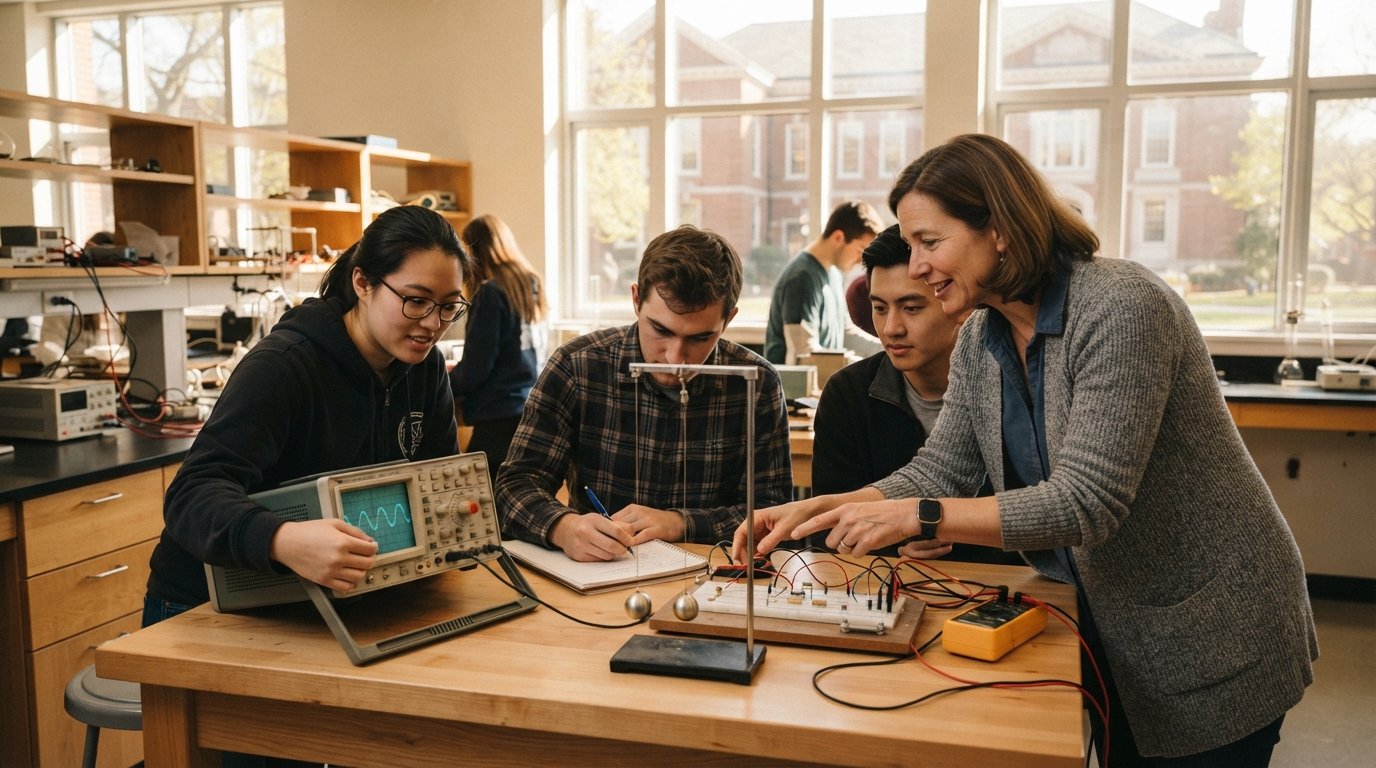
Students should expect laboratory time to be a significant part of the schedule. Physics is an experimental science, and hands-on work with instruments, data analysis, and error propagation is where much of the real learning happens. At a smaller college, students often get more direct access to equipment and faculty guidance than they might at a large university where labs are run by teaching assistants.
- Year 1: Calculus I and II, introductory mechanics, waves and optics, liberal arts core courses
- Year 2: Electricity and magnetism, multivariable calculus, modern physics, laboratory sequence
- Year 3: Quantum mechanics, thermodynamics and statistical mechanics, advanced lab, electives
- Year 4: Electives, senior research or capstone, comprehensive exams or thesis where required
The exact sequence varies by catalog year and by a student's math placement, so families should review the current course map with an academic advisor. Students who enter with advanced calculus credit or strong AP scores may have more room for research, internships, or a second major.
Admissions and Academic Preparation
Admission to the physics program at Aquinas is handled through the college's general undergraduate admissions process rather than a separate departmental application. Prospective students should expect the admissions office to look at high school coursework, GPA, test scores where submitted, essays, and extracurricular involvement. Strong preparation in mathematics is especially important: students who have completed precalculus or calculus in high school tend to have a smoother transition into the physics sequence.
Students who are unsure about physics as a major can often enter as undecided or in a related science field and declare later. Because the first-year courses overlap heavily with other science majors, switching into physics after the first semester is usually manageable. Families should ask about merit scholarships, need-based aid, and any departmental awards during the admissions process, since private colleges often have more flexibility in awarding institutional aid than public universities.
Transfer students should confirm which calculus and physics courses will transfer and how they map onto the Aquinas sequence. A four-year graduation timeline depends on starting the physics and math sequence early, so transfer credit evaluation is worth doing before committing.
Cost, Financial Aid, and Planning for a Private College Degree
Cost is often the deciding factor for families considering a private liberal arts college. Aquinas College, like most private institutions, has a published tuition rate that is higher than in-state public options, but the net price after institutional aid is frequently much lower than the sticker price. Students and families should file the FAFSA, apply for institutional scholarships, and compare net price calculators across schools rather than comparing published tuition alone.
For a four-year, in-person physics degree, the main costs to plan for include tuition, fees, room and board, books and lab supplies, and travel. Physics students may also have expenses related to research presentations, summer programs, or professional society memberships. On the aid side, families can pursue federal grants and loans, state grants, institutional merit and need-based awards, and outside scholarships. Private colleges sometimes offer generous merit awards to strong science students, so it is worth asking specifically about science or STEM scholarships.
Students who are also weighing other science or arts programs may find it helpful to compare how different institutions structure costs and aid. For a sense of how one specialized four-year program approaches curriculum and cost planning, our guide to the Art Center animation degree program shows how a focused bachelor's can be evaluated on time to degree, facilities, and total cost. The same framework applies to physics: compare net price, four-year graduation rates, and the availability of research or internship experiences, not just the headline tuition number.
Families should also plan for the possibility of a fifth year or a reduced course load. Physics is a demanding major, and students who add a second major, study abroad, or change their math sequence may need extra time. Building a small financial cushion or discussing a plan with the financial aid office early can prevent surprises later.
Careers and Graduate Study After a Physics Bachelor's
A general physics bachelor's degree is one of the more versatile science degrees available. Graduates go into software development, data analysis, engineering roles, teaching, finance, and research support, among other fields. The degree signals quantitative ability, problem-solving, and the capacity to learn complex technical material quickly, which employers in many industries value. Students who want to understand how different occupations map to specific degrees and training paths can explore career profiles and pathway guides through Careers.org, which outlines typical job duties, work settings, and the education each role requires.
For students aiming at graduate school, the physics bachelor's provides the foundation for master's and doctoral programs in physics, astronomy, engineering, and materials science. It also works well for professional paths such as medicine, law, or secondary teaching, provided students plan the necessary prerequisite courses. At a smaller college, faculty mentorship often plays a large role in helping students identify research opportunities, write applications, and connect with alumni networks.
Internships and summer research experiences are especially valuable. Many physics students spend a summer at a national laboratory, a university research group, or an industry site, and these experiences often shape their career direction. Families should ask during campus visits how the department supports undergraduate research and whether students have presented at conferences or co-authored papers.
- Graduate study in physics, astronomy, or engineering
- Professional programs in medicine, law, or education
- Industry roles in software, data science, aerospace, energy, and manufacturing
- Teaching at the secondary level with additional certification
- Research support positions in universities and national laboratories
Because career outcomes depend heavily on internships, research, and networking, students should treat the four years as a sequence of deliberate steps rather than a checklist. Advising, alumni connections, and career services at a small college can be a real asset if students use them early.
How to Decide If Aquinas College Is the Right Fit
Choosing a physics program comes down to fit: academic rigor, cost after aid, campus culture, and access to faculty and research. Aquinas College offers a specific combination of small classes, a liberal arts core, and a Catholic intellectual tradition, which will appeal to some students and not others. Visiting campus, sitting in on a class, and talking with current physics majors is the best way to assess whether the environment matches a student's learning style and values.
Families should also compare four-year graduation rates, net price, and the department's track record in placing graduates in graduate schools and jobs. Asking specific questions, such as how many students conduct research, what kind of lab equipment is available, and how advising works for the physics major, will produce more useful answers than general brochures. It also helps to ask about support for students who struggle with the math sequence, since physics depends heavily on calculus and students who fall behind can lose a semester.
Finally, students should think about the long game. A physics degree is a strong foundation, but the outcomes depend on what students build on top of it: research, internships, communication skills, and professional networks. A four-year, in-person program at a college with strong mentorship can provide the structure and relationships that make those experiences possible.
A general bachelor's degree in physics at Aquinas College is a four-year, in-person commitment to rigorous science within a liberal arts community. For students who want small classes, faculty mentorship, and a values-driven education, it can be a strong choice, provided families plan carefully for cost and financial aid and students take advantage of research and career resources along the way.